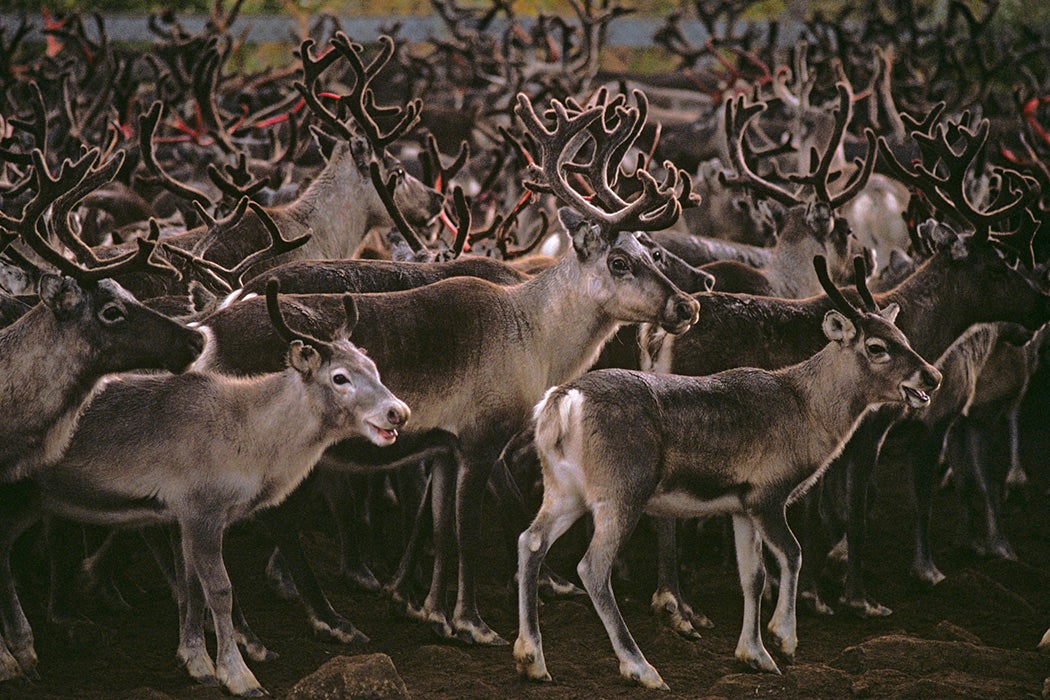
In 1986, after the Chernobyl disaster, the Earth Island Journal ran a story titled “Rudolph the Rad-Dosed Reindeer?” In the article, Gar Smith described fears that radioactive Cesium-137 had contaminated reindeer, threatening the health and livelihoods of the indigenous Sami people. Government officials tried to reassure people about the level of danger, but Smith remained skeptical.


In fact, scientists had been aware of fallout-contaminated reindeer for decades. In the 1960s, the discovery of contaminated caribou triggered a major public health investigation in Canada. Historian Jonathan Luedee describes how, in their efforts to unravel the mystery, scientists and politicians grappled with the reality of a nuclearized world.
“Between 1953 and 1958,” Luedee explains, “the US, UK, and the Soviet Union conducted more than 220 atmospheric nuclear tests,” leading to concerns about widespread ecological contamination. Caribou were already on scientists’ minds. Their population had been mysteriously declining, and Indigenous groups in northern Canada had long relied on caribou meat. Early radiation studies showed that caribou had “higher exposure levels than other grazing animals, including groups of animals located closer to nuclear testing sites,” Luedee writes. Then, in 1959, Canadian botanist Eville Gorham noted high levels of radioactive material in lichen.
After a brief testing pause, the Soviet Union resumed nuclear weapons tests in the Arctic skies in 1961. Fallout from years of testing gradually fell onto lichen. Animals grazed on the lichen, absorbing radioactive particles into their bones and their flesh.
More to Explore
The Reindeer Games
In 1962, biologist William Pruitt at University of Alaska-Fairbanks published a detailed report on the lichen-caribou-human contamination pathway. Luedee quotes Pruitt’s frightening conclusion: “one would expect the entire food chain to be contaminated.”
By 1963, a constellation of Canadian government agencies, led by the Radiation Protection Bureau (RPD), put together a plan. They divided the country up into geographic regions based on aerial studies of caribou herds. Researchers collected samples from caribou, while also studying peoples’ dietary habits and collecting their urine samples.
While the neatly drawn regions on their maps made things seem manageable, Luedee writes that “on the ground…the reality was much less orderly.” Some regions were largely inaccessible, while preserving and transporting samples proved complex and difficult. By 1965, researchers had lots of samples, but limited geographic coverage.
Weekly Newsletter
After several more years, they determined that human exposure had peaked in 1965, then declined. But Luedee points out that “even at 1965 levels, the amount of Cesium-137 detected in caribou meat was more than 580 times greater than that found in Ottowa’s poultry sample.”
The primary question was whether human exposure from dietary contamination exceeded “safe limits.” For this, officials relied on international standards created early in the nuclear age. Urine testing showed that radiation exposure was, on average, below the “maximal permissible dose” according to these standards—the point at which problems like leukemia or genetic issues arise.
Luedee argues that the Canadian government’s approach to this issue reflected older colonial approaches to managing complex geographic areas. “Through the management of caribou,” he writes, “the state sought to manage northern Indigenous peoples and their relationship with northern environments.”