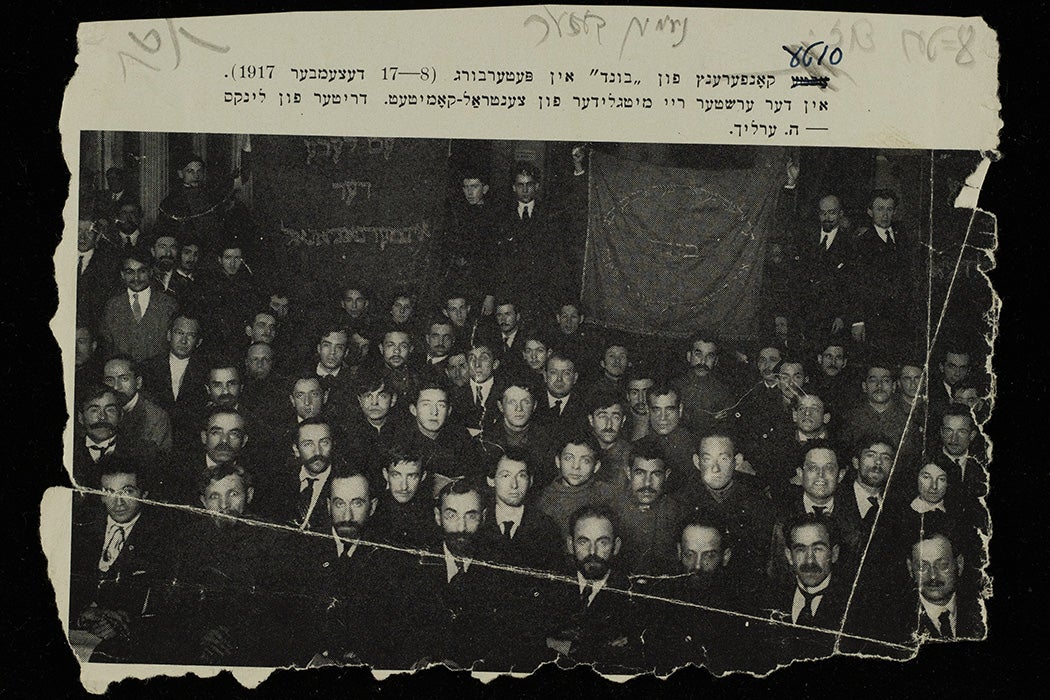
Molly Crabapple’s new best-seller, Here Where We Live is Our Country: The Story of the Jewish Labor Bund tells the nearly lost history of the “most influential Jewish political force in eastern Europe.” In the first two decades of the twentieth century, the General Jewish Labor Bund in Lithuania, Poland, and Russia—the places where the majority of Jews in the world then lived—was secular, socialist, and “uncompromisingly anti-Zionist.”


Zionism, the movement for a “Jewish homeland,” was antithetical to the Bundists’ sense of community, doikayt (Yiddish for “hereness”), succinctly summarized in Crabapple’s title: here where we live is our country. Migration to a thereness, or dorkayt, in the Middle East was the wrong path in the eyes of Bundists. The Bund was formed in 1897, the same year the First Zionist Congress was held to begin the establishment of a Jewish state in Palestine.
This history complicates the contemporary argument that anti-Zionism is necessarily antisemitic: some Jewish political movements, including the Bund, were themselves explicitly anti-Zionist.
The Bund didn’t survive Hitler and Stalin, but its legacy lived on, particularly among Eastern European Jews who migrated to the United States before the racially discriminatory national origins immigration quotas of 1924. Cultural studies scholar Benjamin Balthaser takes up the Jewish anti-Zionist legacy in Citizens of the Whole World: Anti-Zionism and the Cultures of the American Jewish Left. For the Bund, writes Balthaser in American Quarterly:
Zionism’s “separatist, chauvinist, clerical, and conservative” culture was understood as the “polar opposite” of the radical Yiddish-speaking organizations of Europe that were progressive, secular, and internationalist.
American Jews between the world wars were predominantly working class and left-wing. Balthaser describes how they were despised by the dominant Protestant culture as a “biopolitical” threat, the “most racially alien” and “unassimilable” of immigrants. Balthaser also notes that during the “red decade” of the 1930s, more Jews passed through membership in the Communist Party USA (CPUSA) than through the liberal American Jewish Committee. For these Jews, calls for the creation of a new Zion was petit-bourgeois, right-wing nationalist, and imperialist, “directly or indirectly requiring the support of the British Empire.”
For Jewish communists, the promised land was communism, not what the CPUSA called the “Jim Crowism” of Jewish-only settlements.
More to Explore

Israel and Gaza: A Syllabus of Background Readings
Even the resolutely non-communist Hannah Arendt, as late as 1945, saw Zionism as an elite collaboration with European imperialism that would “pass over” the “genuine national revolutionary movement which sprang from the Jewish masses.”
In 1947, the Soviet Union, writes Balthaser, “which had either sided with Palestinian anti-colonial revolts or at least was ambiguous enough so that local and national Communist Parties often went their own way,” came out in support of Partition. This was the UN plan to split British Mandate Palestine into Arab and Jewish states. Followers of the Moscow “line” suddenly switched from “advocating a binational, democratic state to supporting a single Jewish state.”
Weekly Newsletter
"*" indicates required fields
The 1948 Arab–Israeli War culminated in the establishment of Israel and the expulsion of nearly 700,000 Palestinians from their homes. Balthaser connects that history to what he describes as decades of Palestinian “displacement and state violence” and, since 1967, Israel’s “settler colonial project.”
For Balthaser, these developments bore out some of the Jewish left’s warnings about Zionism as a project of nationalism, imperialism, and ethnic exclusion. He argues that the “wide-spread opposition of working-class and left-wing US Jews to Zionism during the 1930s and most of the 1940s” was largely forgotten in the following decades as Zionism was claimed to “represent the unified interests or will of ‘the Jewish people.’”
But the legacy of Jewish anti-Zionism has been reawakened in the work cited here, and in the writings of Peter Beinart, Judith Butler, Naomi Klein, Shaul Magid, and others, as well as, more collectively, in organizations like Jewish Voice for Peace, IfNotNow, and a reborn Jewish Labor Bund.