The elusiveness of lasting peace isn’t a new problem. The ancient Greeks struggled to maintain it, even if they considered peace an ideal state. As Homer did in his Odyssey, many early poets paired stability with prosperity.


Athens was one of Greece’s most powerful city-states in the fifth century BCE. It dominated the seas with its naval power. While arts, philosophy, and democracy flourished, the golden century was also plagued by continuous warfare. The Peloponnesian War, the draining conflict with the rival polis Sparta, lasted from 431 until 404 BCE, with a shaky 15 years of detente in the middle. Whether against their expansionist Eastern neighbor, Persia, rival Greek city-states, or rebellious allies within its empire, Athens was involved in conflicts for a large part of the century.
The Peloponnesian War was a clash between two superpowers with fundamental ideological differences. Sparta was a military-led land power; Athens a democracy with a strong naval tradition. Their lack of trust was not unfounded. Athenians saw war as a way to glorify their city, weaken rivals, and stop enemy encroachment upon their lands. They used attacks and looting to gain resources, as the city had no alternate sustainable economic policy. They would welcome peace only after totally wiping out the enemy.
The Peloponnesian War ended in 404 BCE with Athens’s devastating loss. Its once heralded naval fleet was largely destroyed. Plague and defeat on the battlefield had killed more than a quarter of its people. Conflicts and epidemics had left the Athenian economy in shambles. Restoring prosperity required lasting peace, but asking the proud Athenians to lay down swords after humiliation was a political gamble. They needed a more straightforward approach to ending aggression.
After decades of war, the Athenians decided peace would no longer be an abstraction. Instead, it would be personified as a deity, the goddess Eirene, and worshipped as such. To be clear, religion in ancient Greece was not “faith” in the way we understand it today. It did not necessarily guide individual’s private thoughts or provide a moral compass. Instead, it was deeply embedded in public life. Practicing religion was a social and civic duty, aimed at maintaining harmony between mortals and the divine. Religious acts such as prayers, libations, and dedication of votive offerings were typically performed at public shrines and altars. These were visible, communal gestures, often tied to festivals, civic events, or transitions in life, such as marriage, war, or death.
Weekly Newsletter
Each city-state (polis) had its own religious calendar and patron deity—Athena in Athens, Apollo in Delphi, Hera in Argos. While the Greeks shared a pantheon of Olympian gods, there was no single, unified “Greek religion.” Worship was organized into local cults—a term that, in the context of ancient religion, simply refers to the structured worship of a particular deity or hero at a particular place. Indeed, it bears noting that the word cult comes from the Latin cultus, meaning “care” or “tending,” and carries none of the negative associations we project onto the word today.
Moreover, ancient Greeks believed that the gods were in some ways related to them—indeed, mythologies often linked the divine and the human, indicating a comingling of the two that is absent from the Abrahamic traditions that have come to predominate in the US and Europe.
There had been previously no religious practice, mythology, or cult activity surrounding Eirene. She is briefly mentioned as a gentle figure in myths that date from the seventh century BCE, where the idea and image of her was communicated to the Athenian public through works of theater. Eirene appears in Euripides’s tragedy Cresphontes (produced circa 424 BCE), when the chorus sings a hymn to peace, beckoning her into their city. A few years later, Aristophanes rejiggered Euripides’s creation as a basis for his satirical Peace (421 BCE). Theater offers a prime example of how divine personifications were introduced in visual rather than written form, and in the case of Eirene, these plays laid cultural groundwork for later cult practices.
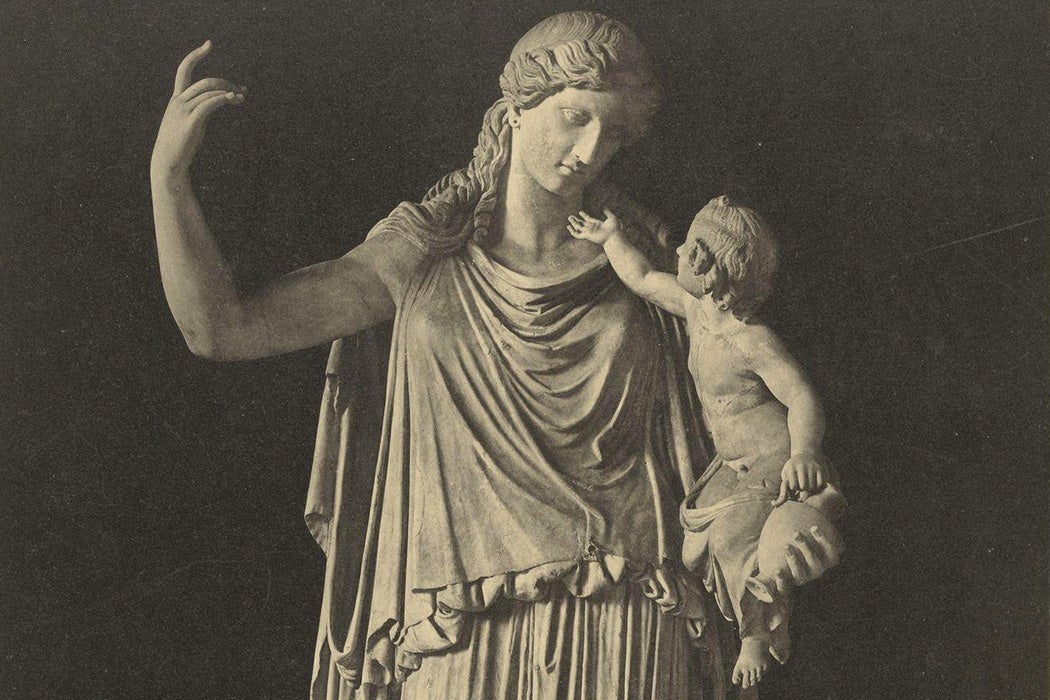
The cult around the personification of Eirene was established in roughly 375 BCE, a few decades after Aristophanes included her in his work. The citizens of Athens erected a large bronze statue of Eirene in the main public square, agora, around that same time. Sculpted by Kephisodotos the Elder, it was designed as a daily reminder of the centrality of peace in Athens. She is depicted holding a scepter—a symbol of authority—in her right hand. In her left arm, she holds the child Ploutos, who serves as an allegory of wealth. Posed together, the two figures representing peace and wealth communicate the notion that peace is not simply an absence of war, but a prerequisite for prosperity.
Religious devotion to a political ideal might be a foreign concept to contemporary readers, whose understanding of worship includes rituals, practices, and faith. The ancient Greeks, however, held no clear division between religion and politics; the two were intertwined. Honoring Eirene—or any Greek god—was a public affirmation of civic values and diplomatic goals.
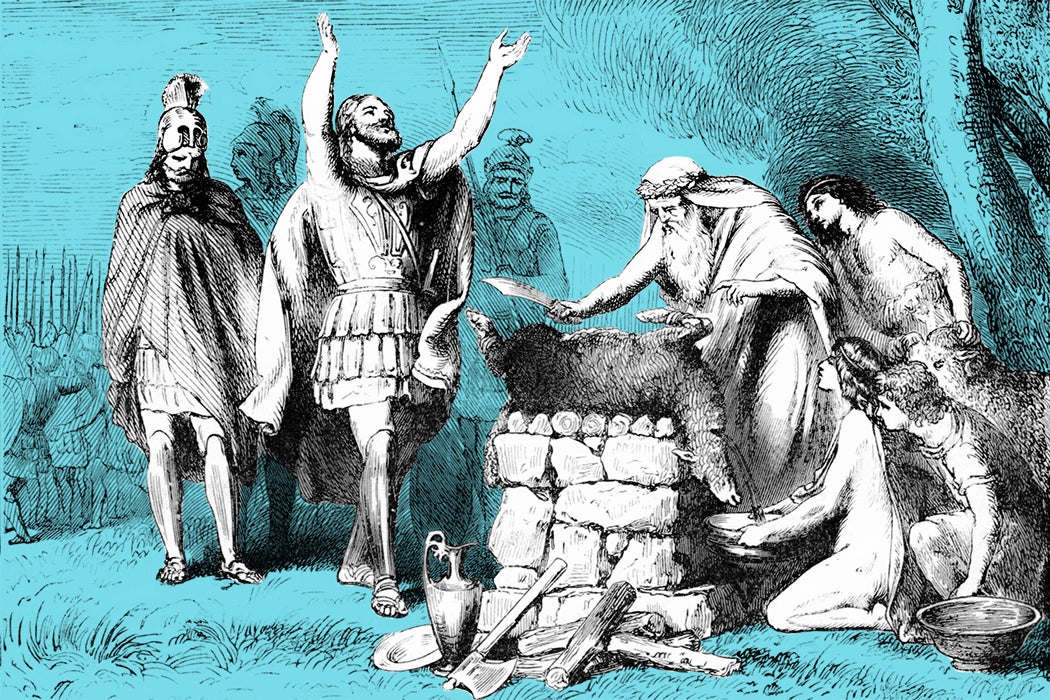
Eirene was celebrated with an annual festival that included animal sacrifice and religious processions, as was the custom. Army generals oversaw the festivities, during which some 85 oxen were sacrificed. These activities likely happened in agora, but the statue of Eirene was symbolic, not part of the cult; there was no altar or temple around it, suggesting it served as a public monument rather than an object of worship.
More to Explore
Smoke Gets in Your Eyes: Animal Sacrifice and the Greek Gods
These public religious activities for Eirene were important; for Greeks, religion was not a matter of private belief but rather of outward action. The worship of a deity happened in a public space around a cult image, not privately inside a temple. The most important element of the cult activity was the altar, which stood outside, in the open air. The location of Eirene’s altar is not known.
In Greek thought, there was no conflict between religion and warfare. Although Athenians worshipped peace, they simultaneously continued their devotional activities aimed at Ares and Athena, the half-siblings who are, respectively, the gods of war and strategic warfare. Ancient Greek religion, as indicated above, had no clear moral code. Gods themselves were not necessarily good, nor did they always act in a manner we would consider admirable. They often seemed to delight in violence and battle. According to the classics scholar William Chase Greene, Zeus himself seemed to take “pleasure in the carnage.”
Ancient Greeks took a very flexible approach to religion. Adding new personifications with a particular function was common. Along with the established pantheon of twelve Olympian gods, the Hellenistic world was likewise populated with minor gods, mythical characters, and local heroes. Spirits and gods embodied abstract concepts or natural elements. Health matters, for example, were left to the capable hands of the god Asclepius and his daughter Hygeia. Archaeologist and classics scholar T. B. L. Webster counts almost 300 different personifications for various concepts, from democracy to good fortune.
Ancient Greeks were also practical about religion. There was no holy text, no central authority organizing devotion, and knowledge about gods came from mythology, written down as epic poetry, or depicted in visual arts. Gods were related in a quid pro quo manner. People offered them prayers, gifts, votives, and the bones and smoke from animal sacrifices, while Athenians feasted on the meat and sold the hides. In return, Athenians expected happiness, health, and good fortune.
These were shared religious principles and while Greeks honored one another’s festivals, different city-states placed their own emphases on specific local cults, like that of Eirene. Athenians celebrated peace through public worship and ritual, yet this did not transform their deep-rooted civic identity. The goddess of peace might have stood in the agora, but she stood amongst citizens still shaped by deep pride and patriotism.
The identity of Athenian male citizens was tethered to being a soldier. Military training typically started at the age of sixteen or seventeen and lasted about two years. The training included military preparation, hunting, and sports, but also guarding government buildings and, maybe most importantly, taking an oath to serve their city, as Ronald T. Ridley explains in “The Hoplite as Citizen.” Because wars broke out as often as every three to four years, many men had first-hand experience in battle.
The city was decorated with public art, reminding people of shared values. Statues and reliefs celebrated heroic soldiers and their patriotic sacrifices. Perhaps the most poignant example stood atop the Acropolis hill, Athens’s religious, political, and cultural center.
Dedicated to Athena, the Parthenon temple on the Acropolis was decorated with a colorful frieze, depicting the divine connection between the gods of Olympus and the citizens of Athens.
An idea of desirable, all-abiding, permanent peace was a new concept in the fourth century BCE Greek political thinking. Peace agreements had been concluded before, but they were not meant to be permanent and none of them lasted long. Eirene was the embodiment of a newfound hope for a more lasting peace that could unify the country. However, despite the hopes Athenians placed in Eirene to deliver on this goal, appeals to a divinity could not prevent war. Worshipping a deity did not create practical mechanisms for diplomacy or conflict resolution.
Despite Eirene, the rivalry between the city-states endured, and their economies remained dependent on conquest and expansion. By introducing the cult of Eirene, Athenians sought to refashion themselves in the eyes of other city-states as champions of unity and peace. However, their celebration for peace became more of a display of Athenian strength, not goodwill, as Emma Stafford observes in Worshipping Virtues. Historian Walter Burkert goes a step further, describing the cult of Eirene as more propaganda than religion in his work Ancient Mystery Cults.
Eventually, the Greeks realized that peace was fragile, something that could be celebrated but not enforced—certainly not via animal sacrifice to a god. Though the cult of Eirene remained part of Athens’s major festivals through the late 330s BCE, her importance diminished thereafter.
And what happened to the great sculpture of Eirene on the agora? Like most bronze works from this era, it did not survive, though its likeness was depicted on contemporaneous vases and coins. Considering the persistence of war over millennia, a poet or a cynic might even consider the loss of a sculpture of the goddess of peace nothing if not a fitting, tragic, timeless metaphor.