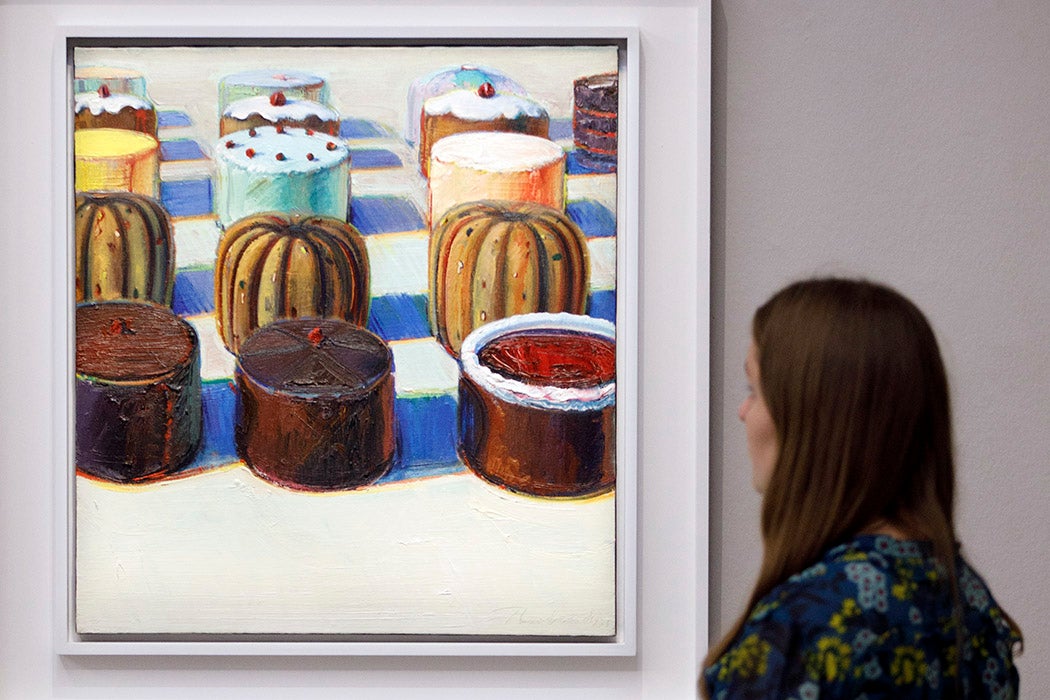
Pancakes. Burgers. Sundaes. Display cases of pies oozing filling and tiered cakes topped with cherries. Plates of food ready to eat. The feasts look scrumptious, but the cakes are iced with thick layers of paint, and the pies are luminous with colors more often found at an artist’s easel than a confectioner’s station. Even so, both the desserts and the paintings that showcase them are undoubtedly American creations.


With his luscious oil paintings in bright, rainbow hues, Wayne Thiebaud (1920–2021) delighted in tricking viewers into thinking they were staring through the display case windows of American diners. Thiebaud may be internationally beloved, but his works are grounded in specificity. As many of his contemporaries moved towards complete abstraction, Thiebaud remained rooted in realism and committed to his subject matter: the United States of the twentieth century. Thiebaud was intrigued by commonplace and ubiquitous experiences, and his paintings display a distinct nostalgia even as they veer away from sentimentality.
Thiebaud’s introduction to art came by peeling through newspapers in search of cartoons. During his childhood, he took to cutting out and copying the strips and eventually, when he was about 15, started to submit his own versions to magazines. This fascination led to him getting a gig as an “inbetweener” for Walt Disney Studios, drawing the intermediary frames in between key frames to allow the action to appear smooth and seamless in projection.
But his tenure at Disney was short-lived; he was fired for being a union man. During World War II, Thiebaud enlisted in the Army Air Forces and worked for the First Motion Picture Unit, where he helped craft topographical models of Japan to assist the pilots charged with the bombing campaign. After the war, and with the assistance of the G.I. Bill, he returned to school, interested for the first time in a formal arts education. In 1960, after earning a master’s degree, he started working as an assistant professor at the University of California, Davis. He taught there for the rest of his life, influencing generations of students as he developed and redeveloped his own art and interests. His experiences with cartoons, sign painting, and advertising all influenced the art for which he later became famous.
Weekly Newsletter
Although Thiebaud also painted sprawling mesas, towering cityscapes, and sun-drenched coastlines (inspiring its own California license plate), it’s the depictions of food that are unmistakably his. The barely garnished hot dogs of state fairs and the decadent milkshakes of soda shops have all been immortalized in his artworks. When Thiebaud was just starting out painting, he spent a year in New York City; there he befriended Willem de Kooning who advised him to pick a subject matter that felt genuine, saying: “Find something you really know something about and that you’re interested in, and just do that.” Diners with their dessert spreads, gumball machines with their colorful candies for mere cents, arcade games with their whiff of possibilities—these were, to Thiebaud, real experiences. These were the inexpensive pleasures on offer everywhere.
Thiebaud’s art is both realistic and exaggerated, influenced by everything from classical Masters to abstractionism. Admiring Thiebaud’s paintings, abstract expressionist painter Barnett Newman told him that “[t]hose European surrealists are boys compared to what you can do with a gumball machine. That’s a real surreal object in you.” But labeling Thiebaud and his art is surprisingly difficult. His paintings are heavy with allusions to Velázquez and Degas, Manet and Eakins, and they’re simultaneously humor-filled and containing a deep sense of time. He admired Chinese paintings, Japanese prints, cave art, and impressionism, and hated the idea of linear progress in art—or regional identity. Born in Arizona and raised on the West Coast, he rejected the label of “California painter” imposed by New York art critics; the very idea caused him to scornfully remark that “referring to ‘California painting’ is like referring to California mathematics.” Instead, he viewed himself as a type of art magpie, lifting ideas that he took a shine to—and freely admitting to it.
In 1962, an exhibition at the Allan Stone Gallery in New York City mislabeled Thiebaud’s work as Pop Art. Like René Magritte, who repeatedly disowned the label of Pop Art, Thiebaud disliked the term and found it ill-fitting for the type of realistic, paint-heavy work he undertook. However, Thiebaud also later attributed some of his success to that faulty categorization, saying, “I think I was wrongly given fame which I wouldn’t have gotten without that movement. I’m aware of the fact that occurred and thankful for it, except I’ve never thought of myself to be part of the Pop Art movement.” He didn’t like the flat, mechanical look of much of Pop Art, comparing it to advertising (and he thought advertising was more successful at it). Indeed, Roy Lichtenstein referred to his own art, and Pop Art in general, as a type of “industrial painting,” a sentiment with which Thiebaud agreed. On one trip to New York, a gallery representative showed him a silk-screened piece decorated with Coca-Cola bottles and asked what he thought of the work. “Not much,” he replied. It was by Andy Warhol. Thiebaud never revised his opinion.
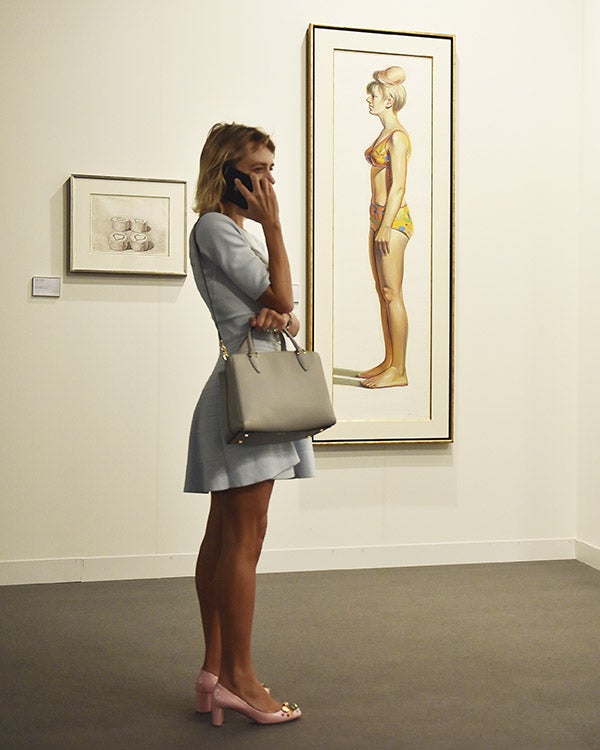
Thiebaud was also uninterested in the dead-end abstract styles where a piece completely separated the viewer from a sense of place or self, reiterating that he was “determined to elude any one-dimensional approach to the description of form.” He might admire a Frank Stella piece for its impact but felt ungrounded without a setting. He described the appeal of his subject matter—ice cream piled atop waffle cones, colorful balls rolling across the canvas—as “sensual impulses,” and he consistently experimented with light and texture in the pursuit of greater richness in his paintings. He was more interested in the greater questions about the human condition, which he felt that Pop Art and Abstract Expressionism disregarded.
Time, however, was also a concern of the setting. Thiebaud was fascinated by how time was reflected, alluded to, or compressed in paintings. As an artist who often painted from recollection, he strove to represent moments and composite memories with his pies, cakes, and gumball machines, remarking that “this is perhaps what makes them seem like icons, in a sense; they’re greatly conventionalized in many ways and yet they may allude to spatial and volumetric associations.” Thanks to these efforts, there’s no fear of becoming ungrounded in Thiebaud’s works. Each work is a window into the twentieth-century United States through the lens of delicatessen counters, fairground foods, and slot machines.
More to Explore
Why We Connect with Vincent van Gogh’s Paintings
Again and again, Thiebaud returned to artists he admired to inspire his own pieces. Based on Degas’s The Millinery Shop, with its fashionable bonnets arranged on hat stands, Thiebaud painted Display Cakes (1963). Similarly, Degas’s L’Absinthe, portraying a couple who dejectedly slouch over their drinks in a bar, inspired Eating Figures (Quick Snack). In his version, the pair, now painted in cheery, bright colors, sits on stools and stares wearily at their hot dogs. Moreover, Thiebaud’s Confections (1962) depicts three tall desserts alongside a short, squat fourth in a nearly identical composition to Giorgio Morandi’s Still Life (1941), with its scene of perfume bottles arranged unevenly on a table. Even as Thiebaud advanced in his career, he continued to find inspiration from artists and artworks he admired and fused those with scenes from his personal life. Several years after buying a new house in San Francisco, Thiebaud painted View from Potrero Hill (1987), which looks out from his and across the cityscape; in doing so, he drew on Paul Cézanne’s The Gulf of Marseille Seen from L’Estaque, including the iconic smokestacks standing tall above the houses. Even when Thiebaud’s pieces draw from other classical works, they never lose their sense of place or time. When viewers look at his paintings, they always have one foot in the United States.
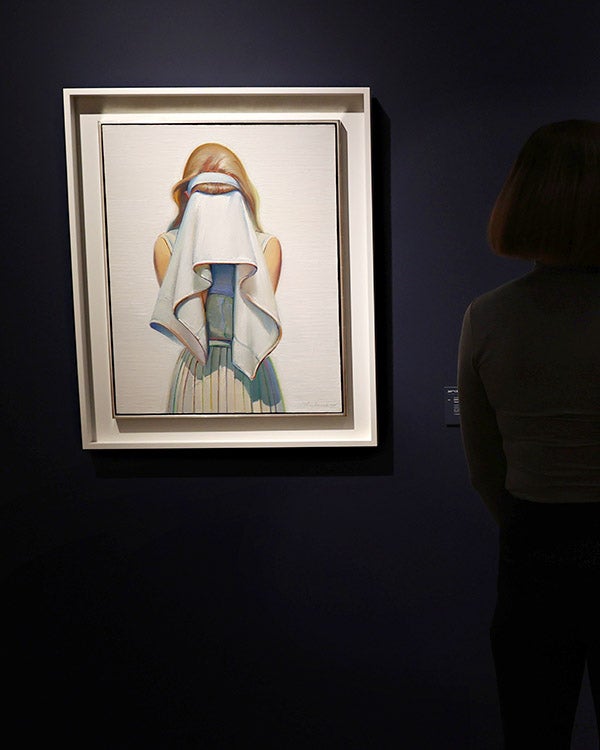
Thiebaud’s paintings are decadent. The red franks are nestled in their golden buns ready for consumption. His cakes feature thick layers of paint, swirled to mimic the application of icing. Standing in front of a Thiebaud painting gives a viewer the impression the artist likes dessert. (And he did. Lemon meringue pie was his favorite.) But there’s also a depth to his canvases. Look even closer at one of his pieces and notice the shifting hues that provide the outlines for his subjects as he played with light and object placement, even while referencing some of the most well-known pieces in art history.
Thiebaud was intrigued by the possibilities of still lives, and heavily influenced by those created by his artistic heroes Degas, Morandi, and Harnett. The tableaux and friezes they fashioned created scenes of drama enhanced by their choice of objects. Speaking on the worth of still life depictions, Thiebaud said:
We are interested because the things which happened over a hundred years ago are visually and materially attractive to us in terms of intrigue; how did they curl their hair, how did they cook their soup, how did they make their pies and so on. The remnants of that era are uncommon to us, they seem rather special.
The same can be said for the enduring interest in Thiebaud’s bubblegum dispensers, candy apples, and diner foods. In them, we recognize a time and place that has slipped away.
Thiebaud continued painting until he died in 2021 at the age of 101. He outlived the Pop artists to whom he was compared, as well as many of his critics. His more than seven-decade career inspired others—the photographer Sharon Core reinterpreted Thiebaud by baking the foods he depicted and then photographing them—and provided ample fodder for museums. The Crocker Art Museum in California, for instance, has hosted a Thiebaud exhibition every decade since 1951. His paintings, in their simplicity and through the emotions they evoke, have also been increasingly appreciated by the wider art market. The year before Thiebaud passed away, Four Pinball Machines (1962) set a record for his work when it was auctioned off for more than $19 million.
The recent exhibition of Thiebaud works at San Francisco’s Legion of Honor used the excuse of their own centenary to celebrate the artist’s many years of productivity. In doing so, it became the first to focus on Thiebaud’s artistic reinterpretations, revealing how he shamelessly stole from his heroes and reinterpreted their work in his humorous, luminous, American way. In interviews, Thiebaud refused easy categorization, announcing that “art comes from art,” as he talked across movements and styles; perhaps, then, it’s up to viewers to decide where they want to place him.
Given how evasive Thiebaud was in discussing genres, what a blessing it is for curators everywhere that he spoke so openly about his inspirations for individual paintings; otherwise, side-by-side comparisons might not exist. Whether in the tradition of Degas or Duchamp, he completely reformulated and reinvented the pieces with his own slant on American life. One thing’s certain: although Thiebaud’s America of the 1930s and ’40s no longer exists, his slice of Americana is still recognizable and immensely popular. Any visitors to an exhibition of his can expect to leave hungry.