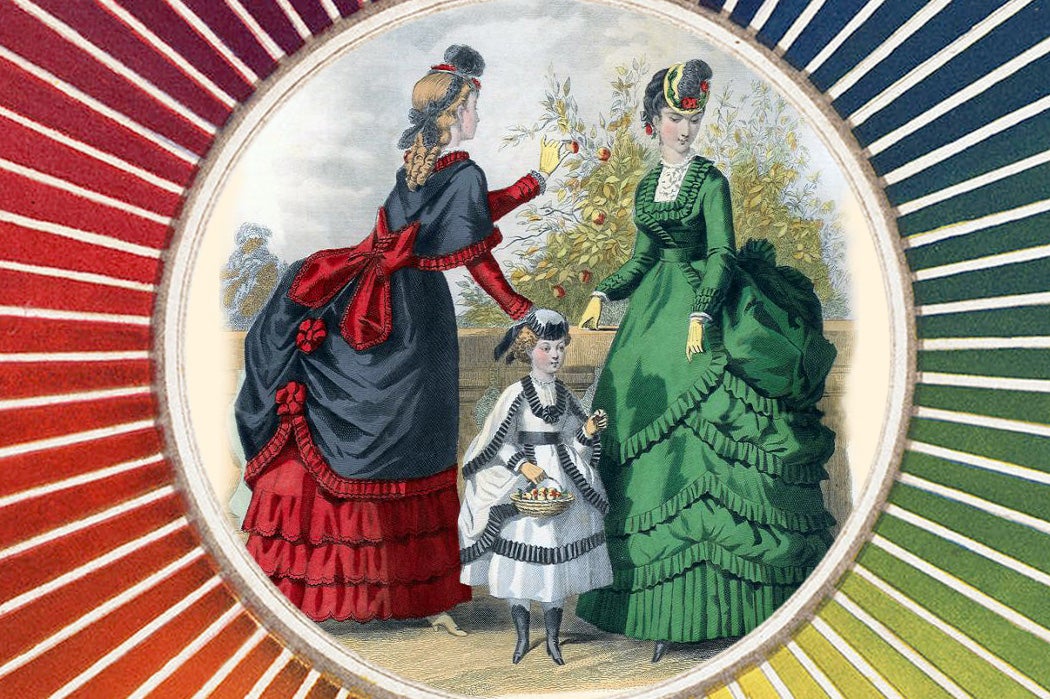
What colors best suit your complexion, scientifically speaking? As historian Charlotte Nicklas writes, that’s something that women in England and America started asking in the 1850s, thanks largely to magazines that encouraged them to learn about a newly developed color theory.


Nicklas writes that the modern science of color goes back to the seventeenth century, when Isaac Newton created the first color wheel, modeled on the musical octave. In the same era, Robert Boyle developed the idea of primary and secondary colors.
In the nineteenth century, academics and craftspeople such as Scottish housepainter David Ramsay Hay used these principles to develop theories regarding what color combinations made for harmonious and appealing homes, decorations, flower gardens, and clothing. Hay claimed that highly educated women already applied such ideas to their clothing, a skill likely developed due to their knowledge of music and “general cultivation of the mind.”
But, Nicklas writes, it was French dye chemist Michel-Eugène Chevreul whose work led magazine writers to encourage women to explore the science of color. Chevreul became interested in color theory as he observed how weaving together different colors in tapestries created various effects.
His books, first translated into English in the 1850s, systematically explained how this works. For example, putting red and yellow side by side causes both colors to appear brighter, while making the red look more purple and the yellow more green. From these observations, Chevreul derived rules for which colors ought or ought not be paired together. For example, a woman with light colored hair should wear a light blue hat, while a green hat suited a rosy complexion, and “a violet bonnet is always unsuitable to every complexion.”
More to Explore
Lipstick’s Complex History
Chevreul did acknowledge that his rules were not objective laws and reflected his own preferences, but his expertise as a chemist lent him credibility among audiences eager for a scientifically validated theory of fashion. That included the readers of women’s magazines. At the time, Nicklas writes, the magazines commonly discussed the science behind activities like cooking and gardening.
Weekly Newsletter
While Chevreul’s commentary about women’s fashion was aimed mainly at portrait painters, writers for women’s magazines shared his ideas with their own readers. An 1855 article in Godey’s Lady’s Book and Magazine titled “Choice of Colors in Dress; or, How a Lady May become Good Looking” described Chevreul’s work and how it could apply to clothing and home furnishings. The writer expressed admiration for the chemist’s scientific work but also gently poked fun at him, writing that “we are, for our own parts, not sufficiently under the influence of the color-sergeant to care much whether we sit on a white chair or a black one.”
Nicklas writes that this article, and the many like it that followed, encouraged a scientific approach to fashion. For example, one story suggested that readers conduct their own experiments, placing different colors of ribbon or paper together to observe the effects. As another magazine piece put it, “it is quite possible to teach a person taste that is willing to learn.”