The American war in Vietnam (1955–1975) is not typically viewed from the perspective of infrastructural power and the logistics of empire. But, as geographer Wesley Attewell argues, the war “catalyzed a revolution in imperial logistics,” requiring enormous transpacific flows of commodities and bodies, living and dead.


“Many of the specific technologies and calculative practices—just-in-time systems, containerization, and the like—that are now synonymous with logistics were first developed by the US military during World War II,” continues Attewell. But Vietnam saw more than just refinement of such logistical reach and power—it was a combat-contextual “stress-test” of “a deep hybridization of military and market methods” for “waging war across transnational space.”
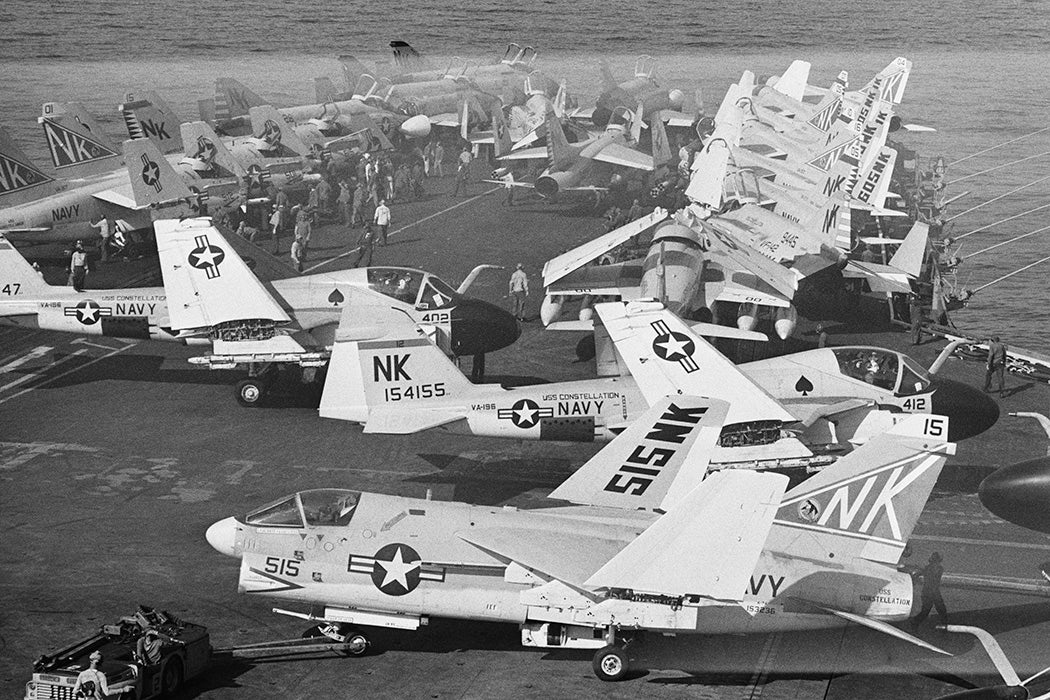
As an example, the first automated, computerized “transportation command and control system of its kind” was developed as the US ramped up military involvement in 1965. That was the first year combat troops—as opposed to “military advisors”—were deployed. Some 3,500 Marines arrived in early March; six months later the combat force would stand at some 125,000. Three years later, in 1968, a peak of 536,100 troops was reached. One American general likened the buildup to the transportation of an entire American city across 10,000 miles.
Long before the militarized subcontracting of the Gulf Wars became a scandal, Vietnam witnessed the first private contract in an active theater of war. A consortium of four companies, operating as Raymond Morrison Knudsen-Brown and Root and Jones (RMK-BRJ), handled what was then the largest construction project in the world. They constructed enormous “logistics islands” of defensible airfields, deep-water ports, and distribution complexes. In addition to the military material, the delivery of commercial goods from the US Agency for International Development (USAID) made for very crowded facilities.
More to Explore
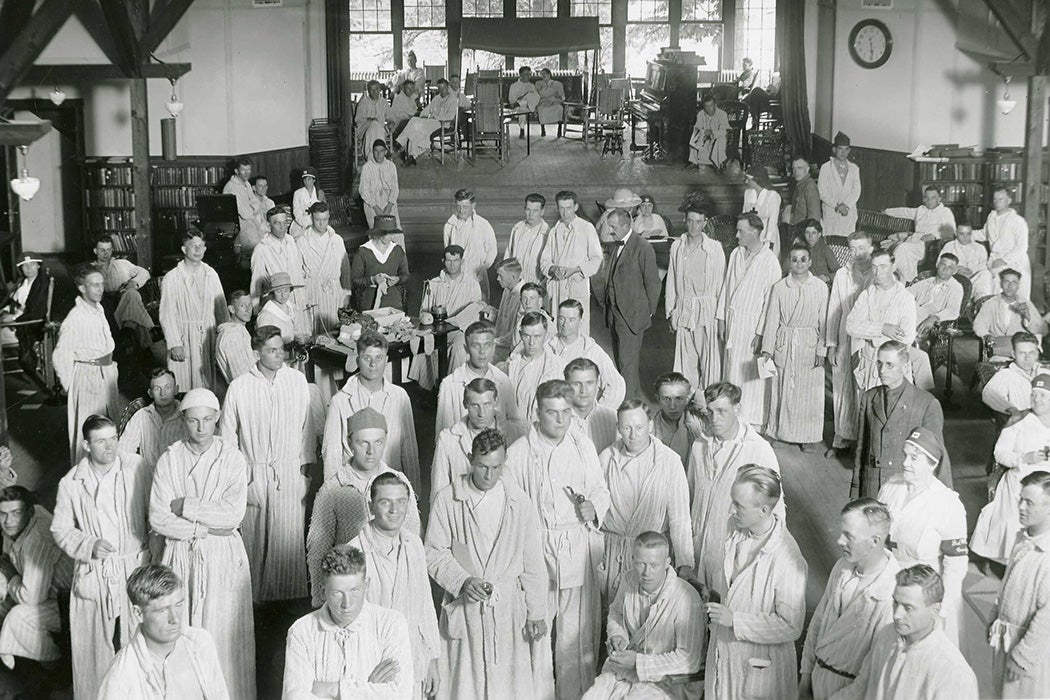
The Birth of the Modern American Military Hospital
(Texas-based Brown and Root was a major backer of the political career of Lyndon Johnson, the president who exponentially increased the US presence in Vietnam. Brown and Root later became a subsidiary of Halliburton, whose former CEO, Dick Cheney, was Vice President of the US from 2001–2009.)
RMK-BRJ also hired both unskilled locals and more specialized “Third-Country Nationals”( TCNs), mostly from South Korea and the Philippines. As subcontractors, these workers were outside the purview and responsibility of the US and its military.
“What emerged was a familiar hierarchy of racialized labor, which ranked white workers above South Koreans and Filipinxs, who were themselves deemed more ‘advanced’ than the Vietnamese,” writes Attewell. Collective action was thus intentionally undermined. Nonetheless, antagonisms between the groups and their treatment by Americans resulted in a “militant politics of resistance, rooted in a dynamic geography of strikes, blockades, and walkouts.” Racially stereotyped as “docile and malleable,” these workers were anything but. Such “friction” in the logistical gears has not been represented in American portrayals of the war.
Attewell gives some examples of the labor problems. In 1966, 129 militant women dockers were fired by RMK-BRJ, one of the factors that led to a Saigon dock strike at the end of that year. A protest over the food served to South Koreans at the Cam Ranh Bay complex turned violent in late 1967. The “hardcore troublemakers” were sent home to Korea, which, as a source of recruitment, also saw its share of labor unrest over jobs in Vietnam. Conflicts at Newport, a small dock a couple of miles from the center of Saigon that was massively upscaled to a deepwater facility between 1965–1967, made for another “cauldron of logistical friction.” A 1971 strike at Newport reduced daily port operations by three-fourths.
Weekly Newsletter
"*" indicates required fields
Vietnamese labor unions were in the thick of it, both blessed by the largess and cursed by the exploitative system. Infrastructure was also gendered, with Vietnamese women “meant to satisfy the ‘private’ needs—food, care, intimacy, and sex—of US soldiers.” Attewell notes that “maids were just as militant as dockers, truckers, or warehouse workers.”
Conditions changed with waning US involvement in the early 1970s, although here too conflict arose. When the 12-hour dockyard shifts were reduced to 10-hour, workers felt their already precarious standards of living threatened.
When the North Vietnamese overran Saigon at the end of April 1975, the infrastructure left behind by the US was a sprawling complex of facilities, acres of concrete, stockpiles of weapons, pervasive toxic pollution—and abandoned allies, including the TCNs.