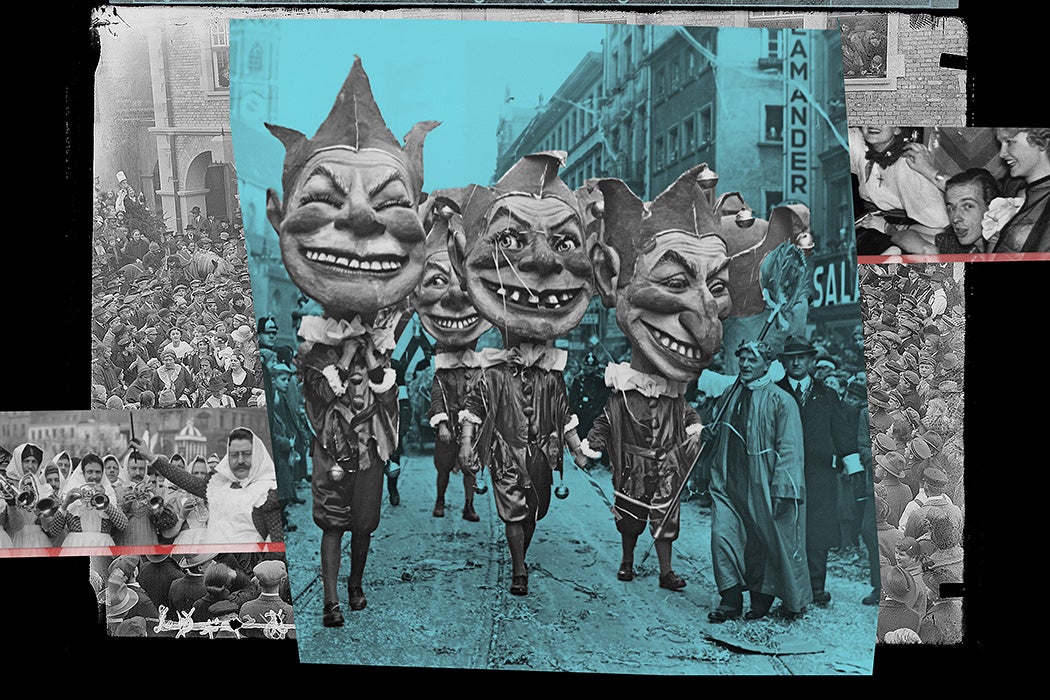
Carnival celebrations in Germany’s Rhineland are known for their giant, handcrafted, politically inflammatory parade floats, many of which poke fun at conservative leaders from across the world.


In recent years, the cobblestone streets of Cologne, Düsseldorf, and Mainz have borne witness to grotesque, car-sized caricatures of Donald Trump, Elon Musk, and Vladimir Putin, as well as German chancellor Friedrich Merz and Alice Weidel, the head of the far-right Alternative for Germany (AfD) party.
In keeping with carnival’s bold, boisterous atmosphere, these public figures are frequently accompanied by World War II-era symbols. In a particularly noteworthy 2025 float, Weidel—whose party has long been identified as a threat to German democracy by government watchdog organizations – assumed the role of the witch from Hansel and Gretel, distributing swastika-shaped candy to “Erstwähler” or first-time voters.
While some celebrants have greeted these caricatures with cathartic jeers and sneers, others are shocked and outraged. Sculptor and illustrator Jacques Tilly, who designed the aforementioned float, has been reported to the police for disseminating hate speech and violating the Criminal Code, which prohibits the use of Nazi imagery for purposes not expressly linked to art, scholarship, teaching, or reporting.
Weekly Newsletter
This is hardly the first time carnival celebrations have divided parts of German society and triggered debates about culture, politics, and history. Since the Middle Ages, this festival of uninhibited revelry and role reversals has provided the ultimate litmus test for what is and isn’t considered socially acceptable.
What’s funny? What’s unfunny? Who laughs? Who is laughed at? Answers to these questions have shifted across time, from one side of the political spectrum to the other. Far from exhibiting a coherent or consistent set of values, carnival has been co-opted by—and used to promote the philosophies of—various movements, from the Protestant Reformation to National Socialism.
Carne of Carrus?
The historical origins of German carnival traditions are difficult to ascertain—not only because they trace back millennia, but also because many primary and secondary sources on the subject may not be entirely trustworthy.
As Jeremy DeWaal, a senior lecturer in European history at the University of Exeter, suggests in a research paper titled “The Reinvention of Tradition: Form, Meaning, and Local Identity in Modern Cologne Carnival,” the historical record was jumbled up when the late-nineteenth-century King Frederick William III of Prussia promised to outlaw any local carnival tradition that could not trace its existence to before the Napoleonic occupation, and municipalities “scrambled to collect some sort of written documentation.”
Some traced their lineage far beyond Napoleon—to ancient Rome, contributing to the persistent misconception that contemporary German carnival is a direct descendant of various ancient festivals, from Greco-Roman Bacchanalia and Saturnalia rituals to pagan ceremonies heralding the arrival of springtime.
Maximilian J. Rudwin, an early-twentieth-century pioneer in European folk studies, asserted that one of the German names for carnival—“Fastnacht” or “the eve of the fast”—arose not from the familiar Abrahamic custom, but the long-forgotten “Teutonic practice of commencing the day with the evening.”
More to Explore
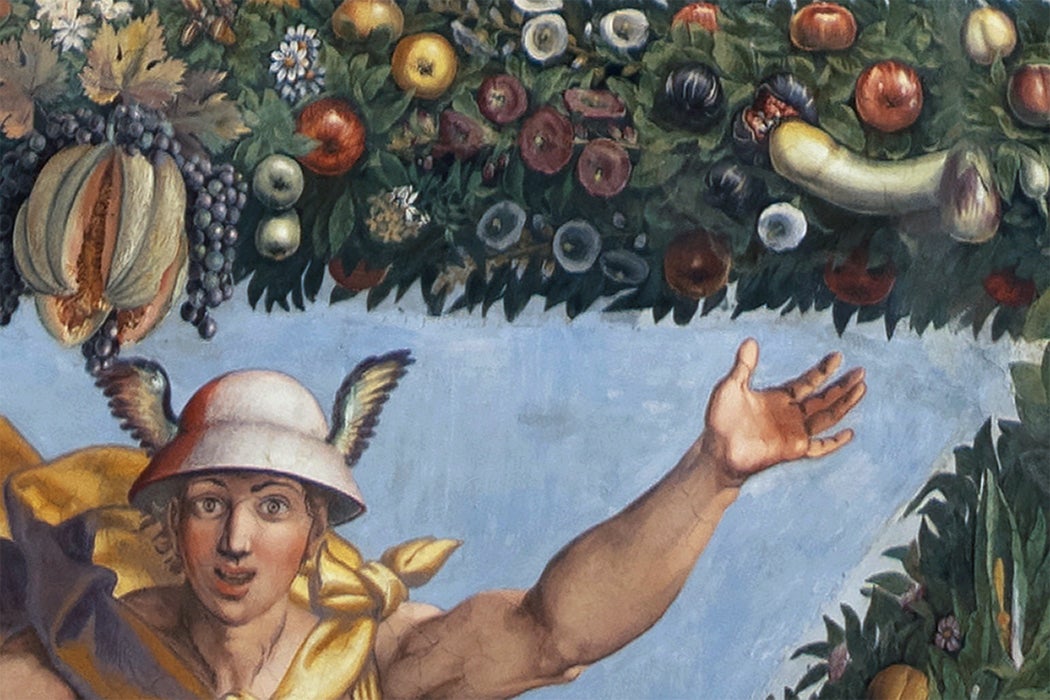
Fruit and Veg: The Sexual Metaphors of the Renaissance
Meanwhile, he supposed that “carnival” derived from the Latin phrase carrus navalis, meaning “ship-cart.” The contemporary carnival float, a well-documented fixture of the festival since medieval times, was therefore linked to processions in Alexandria and Athens that featured boats—symbols, influenced by Assyrian and Babylonian traditions, of fertility, renewal, and divine grace.
More recent scholarship disagrees. The current consensus, DeWaal notes, is that carnival is first and foremost indebted to early medieval Christianity. “Fastnacht” derives not from the Teutons but from springtime fasting, a practice that continues among Jews, Muslims, and some Christians.
By the same token, the word “carnival” is not connected to carrus navalis, but to carne or “meat,” and to the carnal, worldly desires which pious Christians were expected to observe and overcome at the beginning of each year. In its earliest known form, carnival was in essence the lived equivalent of one of those hellish Hieronymus Bosch paintings: an opportunity for people to flirt with sin and death before they returned to the stern embrace of God.
“The meaning of medieval Carnival,” DeWaal writes, “was defined by its rejection and the ultimate victory of Lent. It reflected the Augustinian two-city model of Christian thought, in which the Civitas Dei [City of God] was to be understood in contrast to the Civitas Diaboli,” the City of Devils.
Revelry Reformed
Already in the Middle Ages, there existed conflict between those who partook in carnival’s excesses for a higher, spiritual purpose, and those who enjoyed themselves for enjoyment’s sake.
In an article titled “Presentation and Representation: Carnival at Nuremberg, 1450–1550,” Samuel Kinser, professor emeritus at Northern Illinois University and director of its Center for Research in Festive Culture, presents evidence of Bürgermeisters and city councils criminalizing practices they considered obscene, including crossdressing.
“Such behavior,” they declared, “is, in the presence of honorable people and especially of maidens and women, sinful, annoying, and shameful.”
Carnival celebrations from this time period also exhibited class conflict. Far from temporarily dismantling the distinction between low and high-born, carnival provided opportunities for well-to-do burghers of towns and cities to ridicule the landless peasant, whose supposed lack of manners, intelligence, and self-restraint made him the perfect mascot for a holiday that was all about how not to behave.
“The peasant is a fool,” Kinser explains, “but in Carnival everyone is foolish and so, through the combination of a social prejudice, a literary stereotype, and the Carnival custom of inversion, the silly peasant also is a symbol of Everyman.”
During the Protestant Reformation, carnival celebrations became a means for German-speaking Christians to voice their disapproval of the Roman Catholic Church. In his article “Reformation, Carnival, and the World Turned Upside-Down,” Bob Scribner, a historian of both the Reformation and the contemporaneous Peasants’ War—in which preachers like Thomas Müntzer encouraged farm workers to rebel against their feudal overlords—discusses twenty-four incidents of Reformation-themed parades.
The earliest of these took place in Wittenberg, on the same day that Martin Luther famously burned the papal bull that threatened him with excommunication if he did not withdraw his 95 Theses. According to Scribner, students at a nearby university put together a float, filled it with books by Luther’s theological opponents, and promptly set it ablaze while singing the popular but controversial song O, poor Judas.
Elsewhere, in Bern, carnival organizers staged two anti-papal plays, one which criticized the by then common Catholic practice of selling indulgences for money, and another which dramatized Luther’s confrontation with the Vatican.
Seeking an answer to the obvious question of why reformers, who by and large abhorred rituals, nonetheless turned to carnival as a mode of both expression and activism, Scribner settles on the festival’s appeal to youth and capacity for desacralization—for rendering the holy mundane and the unspeakable speakable.
“The role of youth,” Scribner concludes, “was to invert the values of the previous generation, play and game inverted the mundane world, the ritual of rebellion upturned the structure of rule and hierarchy; carnival presented an alternative form of communication to that of the established order (the edict, the sermon, even the printed word), and ritual desacralization overthrew the given hierarchy of sacred persons and objects.”
National Holiday
Carnival’s contemporary character—as a festival of recreation and merriment disconnected from Christian moralizing—coalesced during the early nineteenth century. The biblical boogeymen of medieval celebrations (temptation and sin) were replaced by more lighthearted characters like General Isegrimm, who represented the absence not of goodness so much as happiness.
Floats, too, took on a new meaning. As DeWaal notes: “While the ship of fools in medieval depictions always hovered on the verge of sinking due to human folly, in modern Cologne, it (…) appeared not as a foil to the Church, but rather as a stalwart battleship prepared to wage war against the forces of unhappiness.”
Johanna Schopenhauer, the life-affirming mother of the notoriously pessimistic philosopher Arthur Schopenhauer, reached a similar conclusion when she visited Cologne in 1828. “The foundational principle of this festival,” she later wrote of the experience, “was the fight of unrestrained joy and freedom against the evil elements, which lie partially in human nature itself and partially in the exterior world, namely moroseness, boredom, fearful adherence to the conventional, and so forth.”
DeWaal suggests that this pivot towards joy may have been linked to the fortunes of Germany itself, which was on the cusp of being transformed from a collection of loosely affiliated fiefdoms into a unified German empire; during the nineteenth century, carnival not only became an outlet for joy, but also a platform for two contemporaneous causes of joy: nationalism and imperialism.
According to Carolyn Birdsall, a media studies professor at the University of Amsterdam and author of Nazi Soundscapes: Sound, Technology and Urban Space in Germany, 1933 – 1945, carnival parades in the 1890s and 1900s expressed the “desire to establish a national identity after unification,” one “exercised through the colonial project, with the subjugated colonial other employed as a means of defining the self.”
Celebrations from this time period assumed themes like “Prince Carnival as Coloniser,” and featured floats and costumes that referenced the German Empire’s newly established colonies in territories in what are now Namibia, Cameroon, Tanzania, and Papua New Guinea.
Ethnic (mis)representation at carnival in Weimar Germany was less straightforward. On the one hand, explains Birdsall, homages to African American jazz music—a genre which many upper-class Weimar Germans understood as “an expression of political freedom” and cultural revolution—reflected the republic’s urban cosmopolitan reputation.
On the other, crude caricatures of dark-skinned people—including a 1929 float which displayed the city of Düsseldorf financing an orphanage of African and mixed-race children—betrayed the rapidly sprouting seeds of racism and xenophobia, and foreshadowed the ascension of Adolf Hitler and the NSDAP (National Socialist German Workers’ Party) four years later.
Among the many race-related fears and conspiracies addressed by such carnival floats was the notion that interracial relationships between ethnic Germans and French colonial troops who occupied the Rhineland during the Allied occupation after the First World War would compromise Germany’s racial purity.
Kraft durch Freude
It should come as no surprise that carnival, having previously served as a platform for nationalism and imperialism, also proved an effective mouthpiece for National Socialism. While the 1930s and 1940s did see some instances of carnival poking fun at the tyranny of the Nazi regime (none of which, it should be noted, went unpunished), Birdsall and other scholars maintain that the festival was, first and foremost, an avenue for propaganda.
Carnival’s propagandistic potential can be partly attributed to the nature of the celebrations themselves—which at this point in history had long involved large crowds, marching bands, military uniforms, and call-and-response slogans and songs—and partly to the efforts of its Nazi-affiliated organizers.
Not long after Hitler rose to power, carnival guilds across the country were either taken over by or subordinated to Nazi party organs, including its official leisure organization, “Kraft durch Freude” or “Strength through Joy.” Like all other private and public enterprises in Germany, these guilds now began their meetings with anthems and Hitler salutes.
Newly created carnival songs like “Under One Hat,” composed by and for the freshly centralized Fastnacht Committee of Düsseldorf, stressed the importance of solidarity and homogeneity. Carnival was promoted as a festival for everyone—that is, everyone the Nazis considered part of their society.
Behind the scenes, Jewish artists and organizers, whom Birdsall says were falsely rumored to have played an outsized role in carnival committees during the Weimar period, found themselves out of work.
On the streets, speechmakers joked that America, to which many German Jews had already emigrated, had replaced Canaan as the “promised land.” The floats were more incendiary still. “The last ones are leaving,” read the banner of a 1934 specimen in Cologne, accompanied by Germans dressed in Orthodox clothing, glasses, and prosthetic noses.
That’s not to say carnival was perfectly aligned with the Nazi agenda, though. Aside from small acts of resistance (Cologne carnival speechmaker Karl Küppner was fired and jailed after making a Hitler salute and saying, “Looks like rain”), Birdsall notes Nazi leaders were quick to ban both party uniforms and images of the Führer, lest they be associated with—or, worse, defaced by—the inebriated and uninhibited.
Attempts at policing enjoyment led to the suppression of longtime carnival customs. Excessive drinking—which often resulted in mischief and vandalism—was discouraged, with newspapers calling for greater discipline, regulation, and surveillance. Cross-dressing was prohibited, as were speeches that mocked or questioned the party’s prudish, pro-family, heteronormative views on gender and sexuality; traditional German culture was to be celebrated, not mocked.
However, contrary to popular belief—which may well have arisen from Germany’s desire to distance itself from its Nazi past after the Second World War—carnival ultimately helped the Nazi party transform society in its own image. As Birdsall concludes:
“Not only did violence become more festival-like, but the carnival festival, too, was confirmed as an expression of radical exclusion. Carnival humour directed at those outside the Volksgemeinschaft manifested this exclusion in its laughter and calls, musical songs, radio broadcasts and across the urban soundscape more generally.”
Carnival Today
The anarchic, anti-authoritarian character of present-day carnival celebrations in Germany—exemplified by their scathing rebukes of Trump, Musk, Weidel, and others—are a far cry from the pro-nationalist, pro-imperialist, and pro-dictatorial festivities of the late nineteenth and early twentieth century. If festive pride persists, it is no longer connected to a country, empire, culture, or race, but the unique traditions of individual municipalities, pitted against one another in fierce but friendly, sportsmanlike rivalries.
Likewise, present-day carnival celebrations seem—if only to a certain extent—to have rejected the enjoyment-for-enjoyment’s sake attitude that prevailed in the days of Johanna Schopenhauer. Although countless people continue to celebrate carnival for primarily non-political reasons—to eat candy, drink alcohol, listen to music, and have fun with friends and family—float designers like Tilly have reinstated the festival’s reformatory heritage, upending the conventional social order and desecrating the images of leaders who consider themselves to be above comedy or critique.