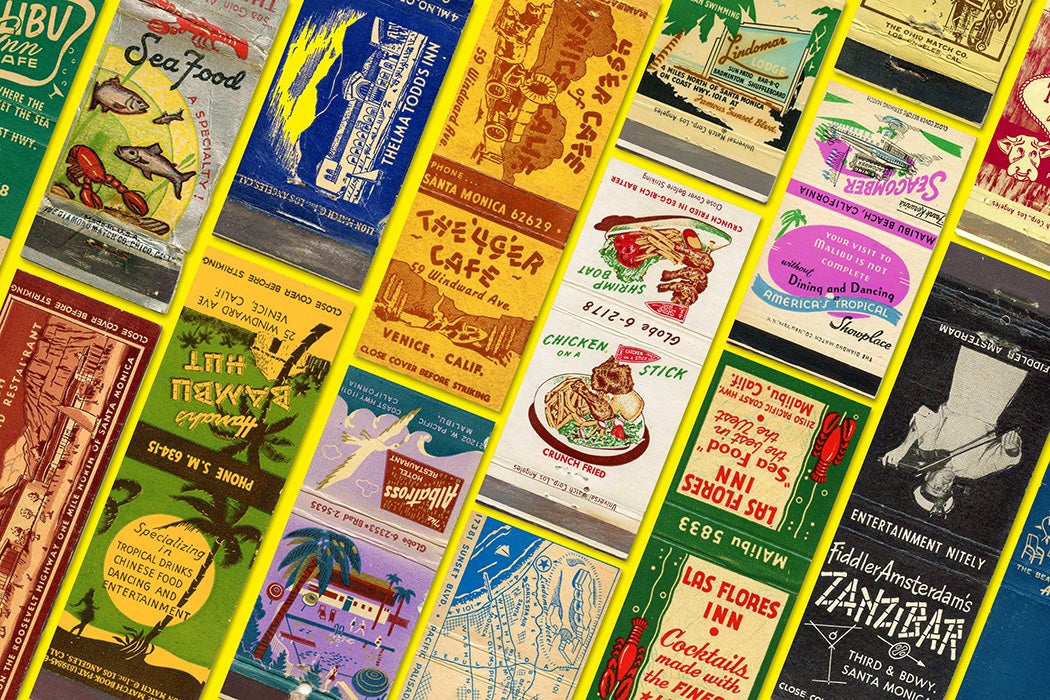
In film noir, a matchbook is never just a matchbook. Found in a victim’s apartment or a suspect’s lair, it leads to a last known location or crime scene; opened up, it reveals scribbled notes or hidden messages. The peculiar centrality of these pocket-sized throwaways in a genre perfected in the mid-twentieth century speaks to both their ever presence in everyday life during this period, and to the curious way that meaning adheres to disposable things.


It’s fitting, then, that a collection of matchbooks should hail from the region that produced film noir, and whose contradictions—between sunshine and darkness, promise and ruin, dreams and destruction—often served as its setting. The Eric Wienberg Collection of Malibu Matchbooks from Pepperdine University, which contains matchbooks and other local ephemera from the late nineteenth century through the 1980s, serves—like any good noir clue—as evidence of something bigger: a vanished mid-century Southern California commercial corridor, long displaced by fire and time.
The history of the familiar, ad-emblazoned matchbook mirrors that of California itself, both temporally and thematically. Indeed, like the journey of a covered wagon headed west, the quest for an on-demand flame was long, quixotic, and perilous. Though it began with the discovery of phosphorus and its incendiary properties in the seventeenth century, the introduction of the friction match in 1827 marked the arrival of the strikable, stick-based form we know today. These so-called “Lucifer” matches had serious downsides, however: their tendency to spontaneously ignite led railroads to refuse to carry them, while the white phosphorus used in their production caused a horrific disfigurement known as “phossy jaw” among factory workers. The nonpoisonous safety match eliminated both toxicity and combustibility, arriving just in time to meet the unprecedented demand for matches sparked by the introduction of mass-produced cigarettes.
In 1894, the Diamond Match Company purchased the patent for the “Flexible Match,” consisting of a folded strip of thick paper containing cardboard matches. Direct sales to consumers flopped, but a new market was inadvertently invented in 1896 when the Mendelson Opera Company used the blank surfaces of matchbooks to advertise upcoming performances. The marriage of matches and marketing was more or less official by 1902, when Pabst Brewing Company ordered ten million matchbooks from Diamond Match, stamped them with its logo, and distributed them free—turning customers into advertisements every time they lit a smoke, and completing the matchbook’s transformation from consumer good to miniature billboard.
Weekly Newsletter
Also in 1902—and perhaps not coincidentally, given rising demand—Diamond Match founder Ohio Columbus Barber turned his attention to the West, purchasing substantial California timberland for lumber harvesting and manufacturing after becoming intrigued by the state’s vast forests. In doing so, he joined a long procession of profit-seekers drawn by California’s natural resources, from gold in the 1840s, to oil in Los Angeles by the 1890s. It was the latter that attracted Frederick Rindge, a Massachusetts petroleum tycoon, and his wife, May Knight Rindge, who purchased 13,000 acres of land outside Los Angeles in 1892—land that would become modern-day Malibu.
While the Los Angeles landscape was being rapidly transformed by the extractive industries that had made the Rindges their fortune, the couple committed themselves to preserving the beauty of their own unspoiled stretch of coastline at any cost. But two forces proved unstoppable. The first was wildfire—the coastal canyons of Malibu sit directly in the path of the dry and devastating Santa Ana winds, and in 1903 a blaze swept through the region, burning the Rindge ranch.
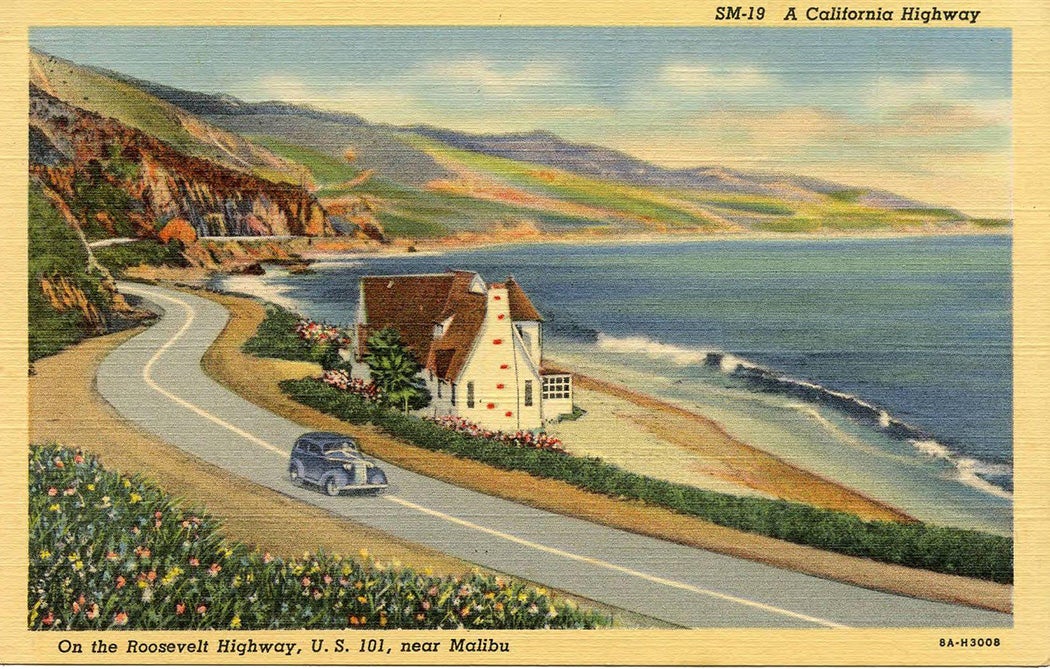
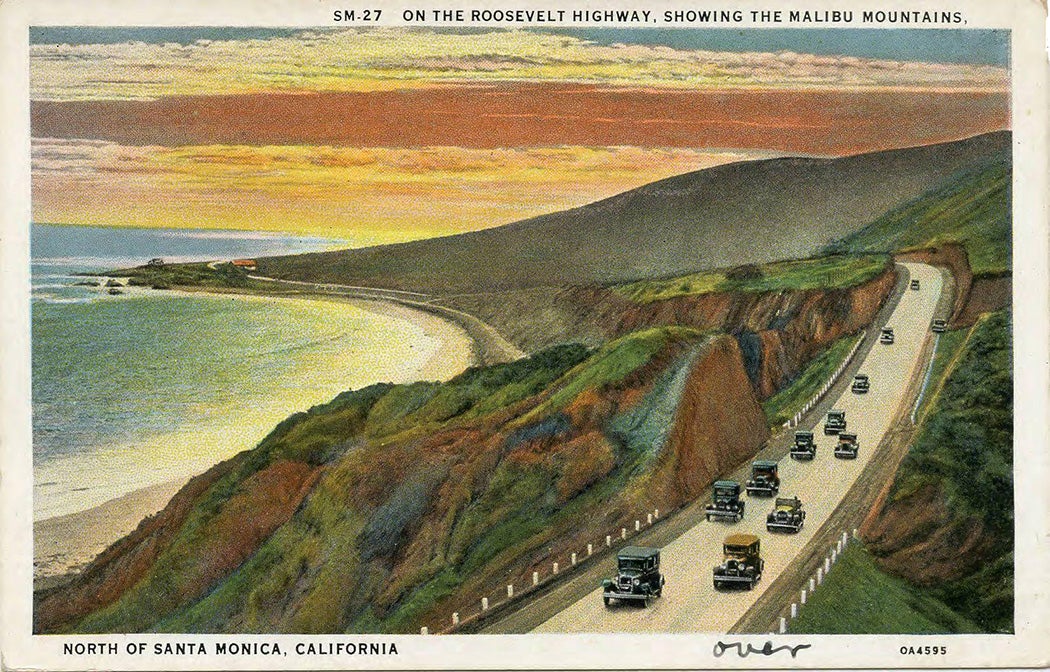
The second was the automobile, and the era of commercial tourism it made possible. When California began development of a coastal highway in the 1910s, the Rindges spent years in court trying to stop the road from running through their property. They lost this battle in 1923, and, when the Pacific Coast Highway opened in 1928, the public’s first look at the pristine coastline sparked an appetite that a new wave of businesses soon arose to meet.
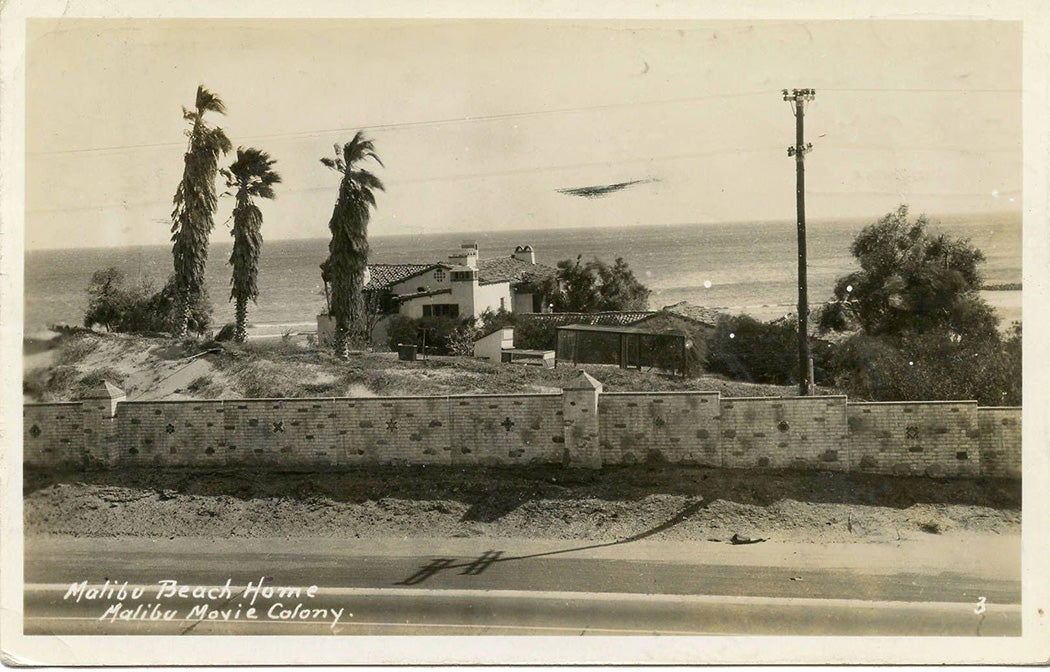
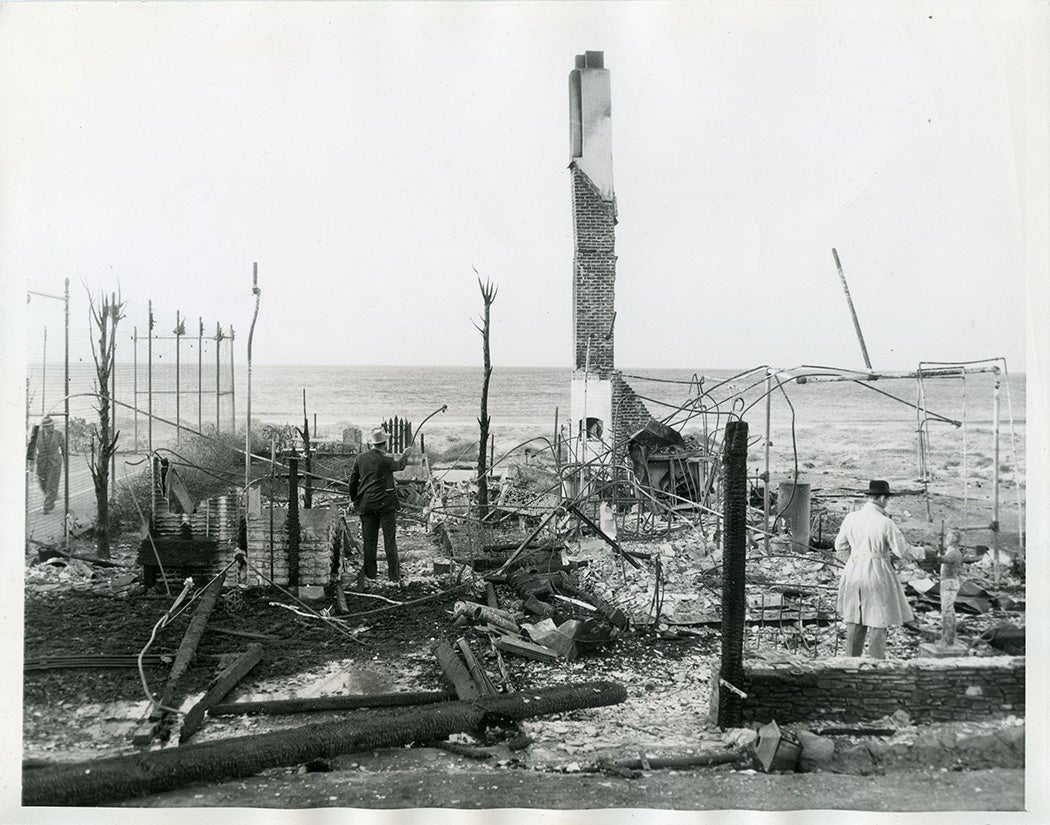
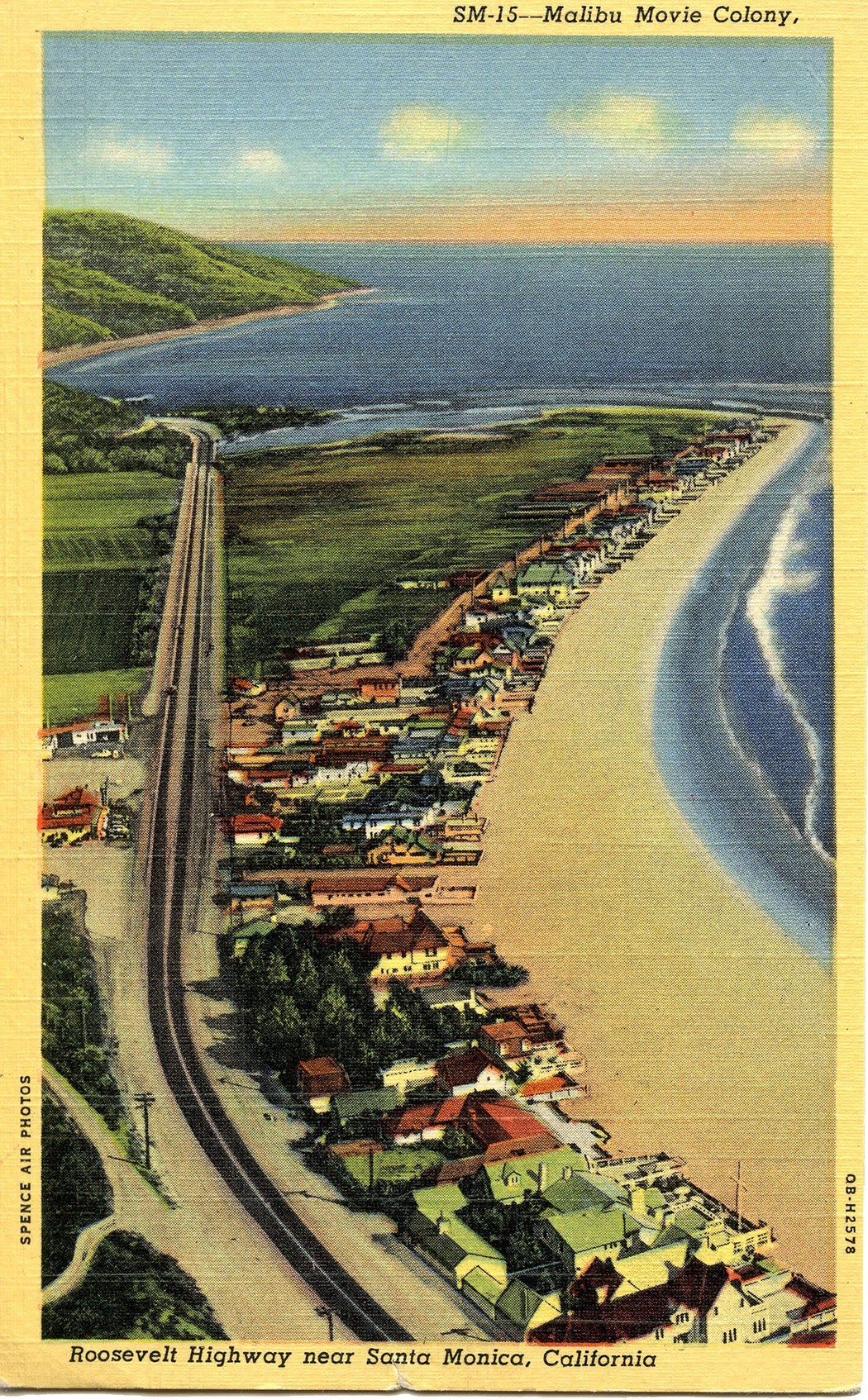
The cost of the legal battle forced the Rindge family to begin leasing land via the Malibu Movie Colony, which brought the world of motion pictures to the former ranchland, and then to sell it off completely in 1940, marketing it for “villas, hotels, golf clubs, estates, beach and yacht clubs” and more. Despite devastating fires in 1929 and 1930, followed by another stretch of bad luck between 1935 and 1938 that burned nearly 400 homes, the stretch of the PCH that ran through Malibu and south through Santa Monica proved irresistible. Its vistas and proximity to fame were a magnet for businesses of all kinds, creating a crowded marketplace that required each business to find inventive ways of asserting its unique promise of pleasure.
No vessel served this need better than the matchbook, whose potential audience had effectively doubled as tobacco companies began targeting women, and, with the standard twenty sticks in a book to match the number of cigarettes in a pack, offered the holder as many opportunities to take in its pitch. With the whole world suddenly smoking, everyone needed a light, and match manufacturers were more than happy to print matchbooks by the million—and to offer up every bit of surface, inside and out, to advertisers eager to meet consumers wherever they struck a match.
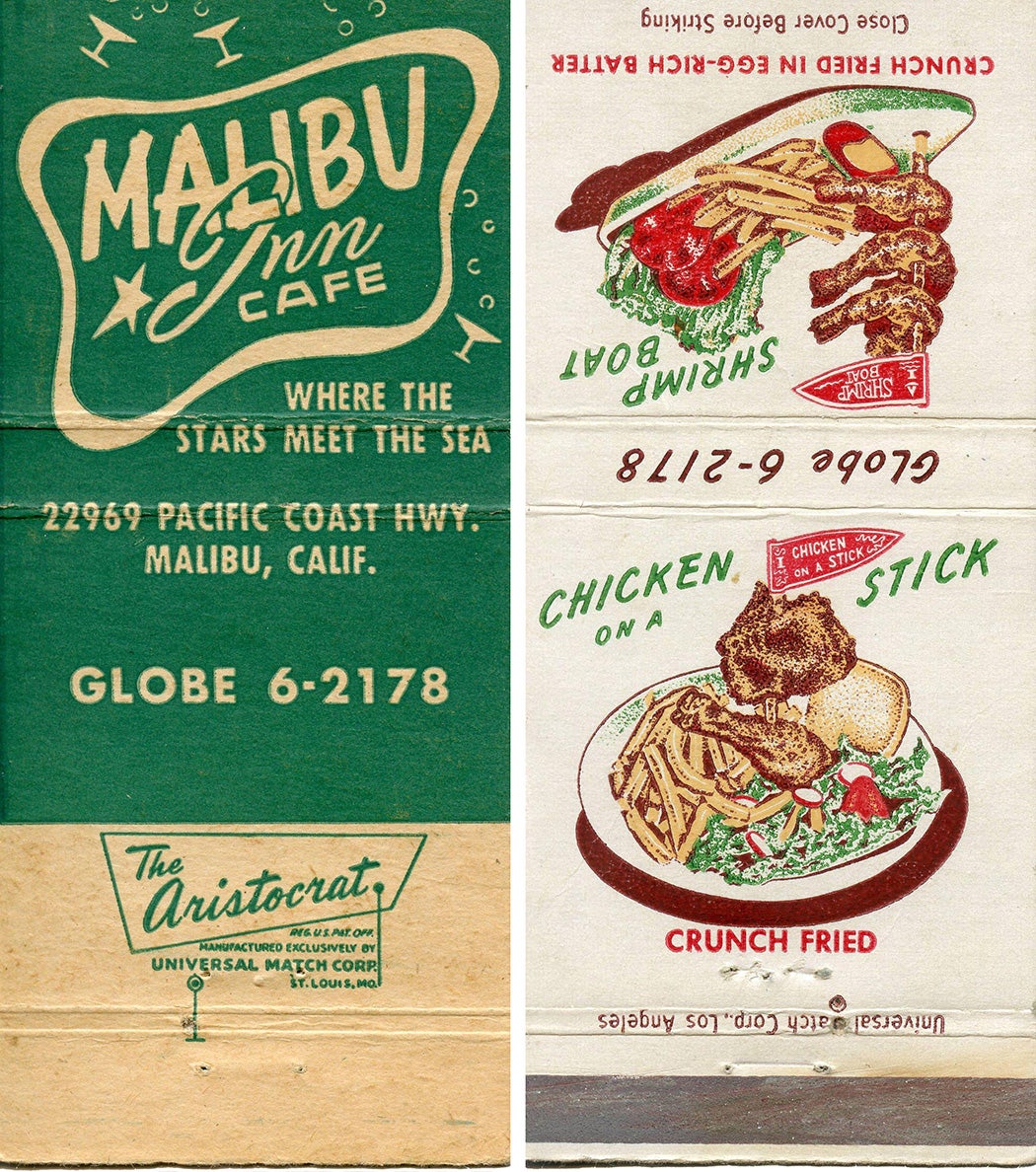
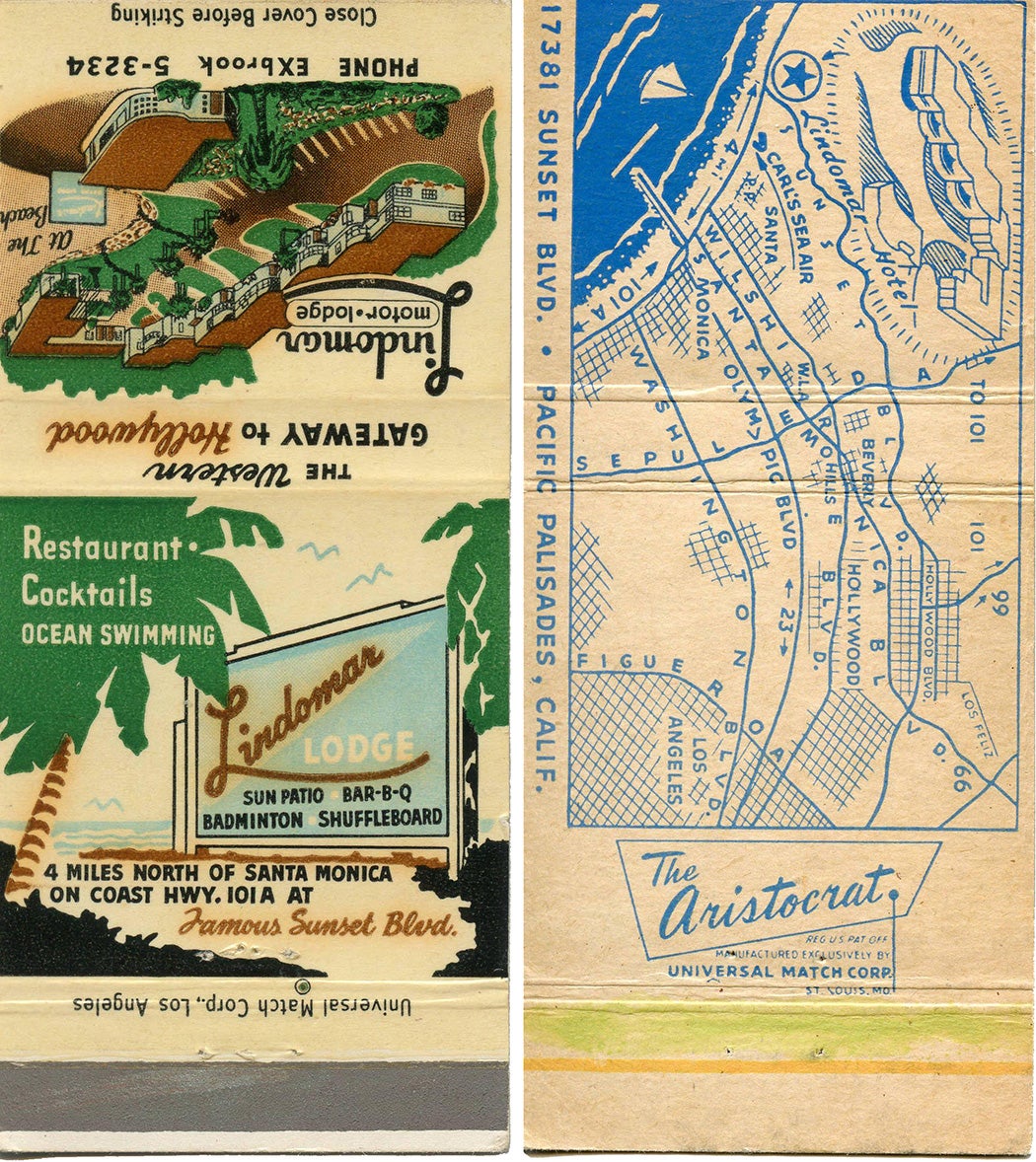
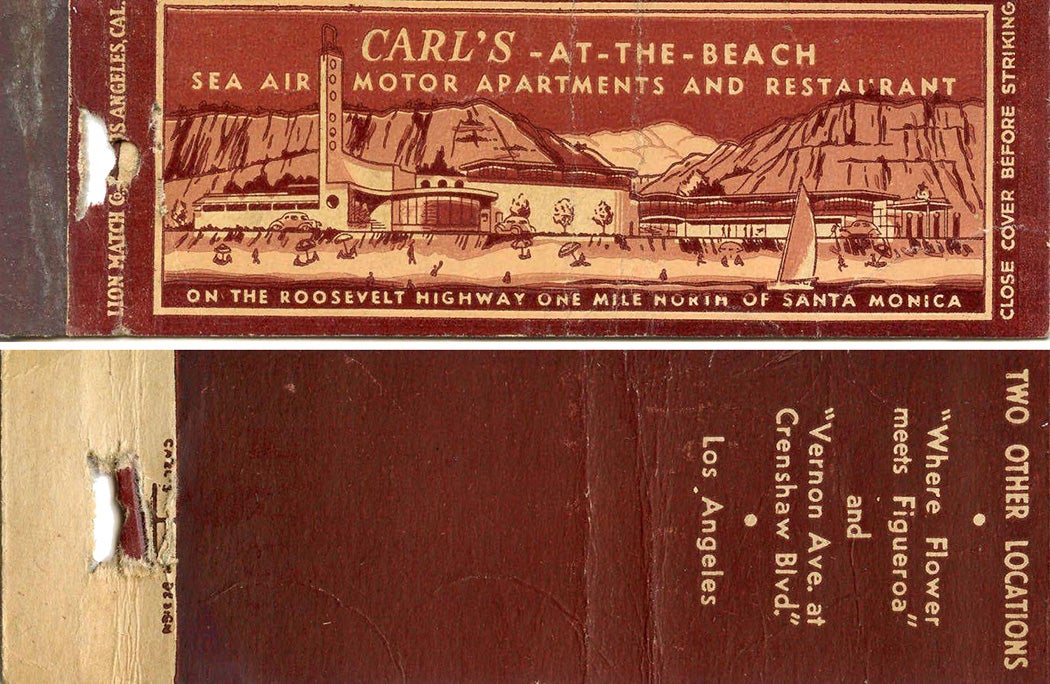
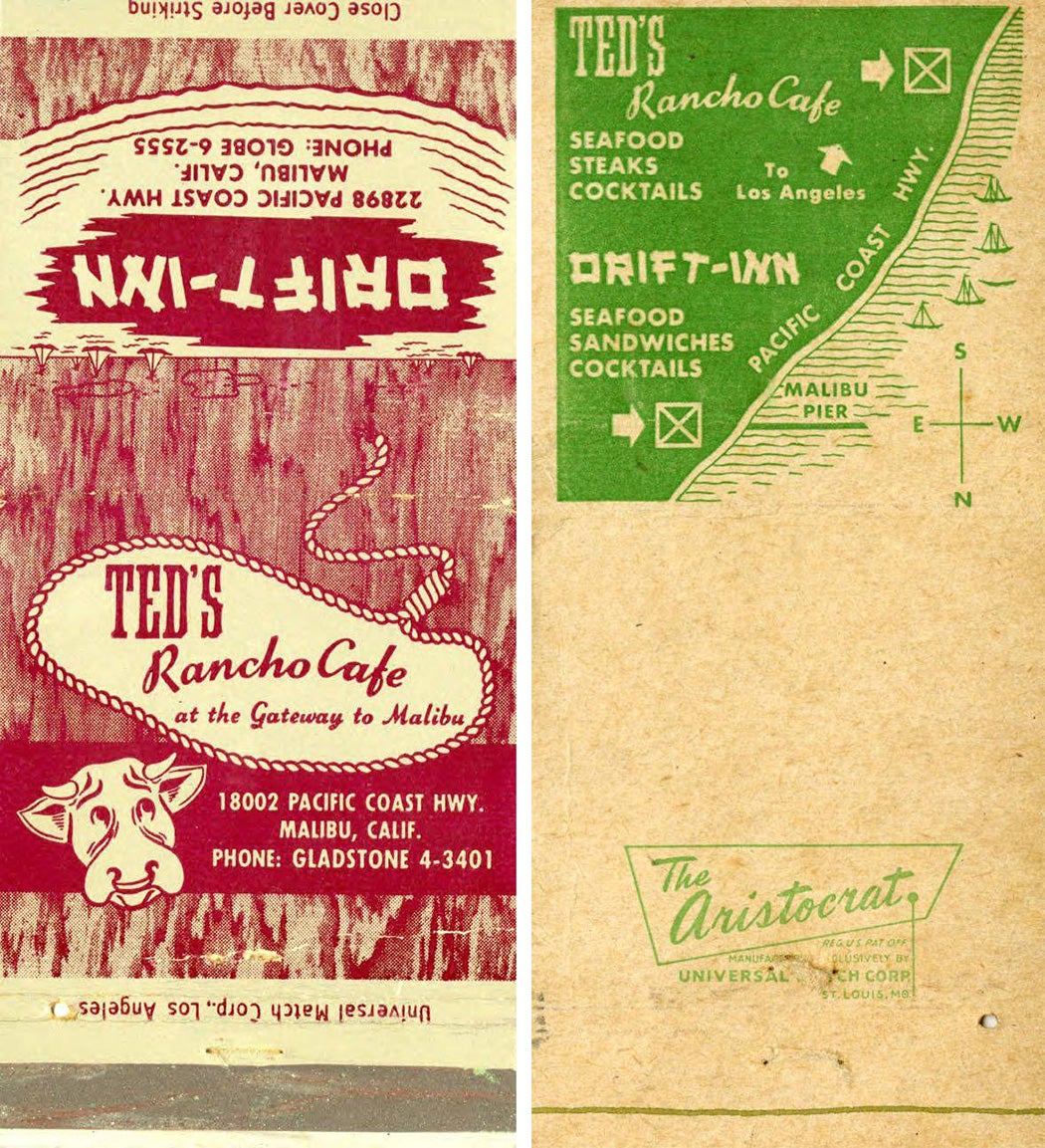
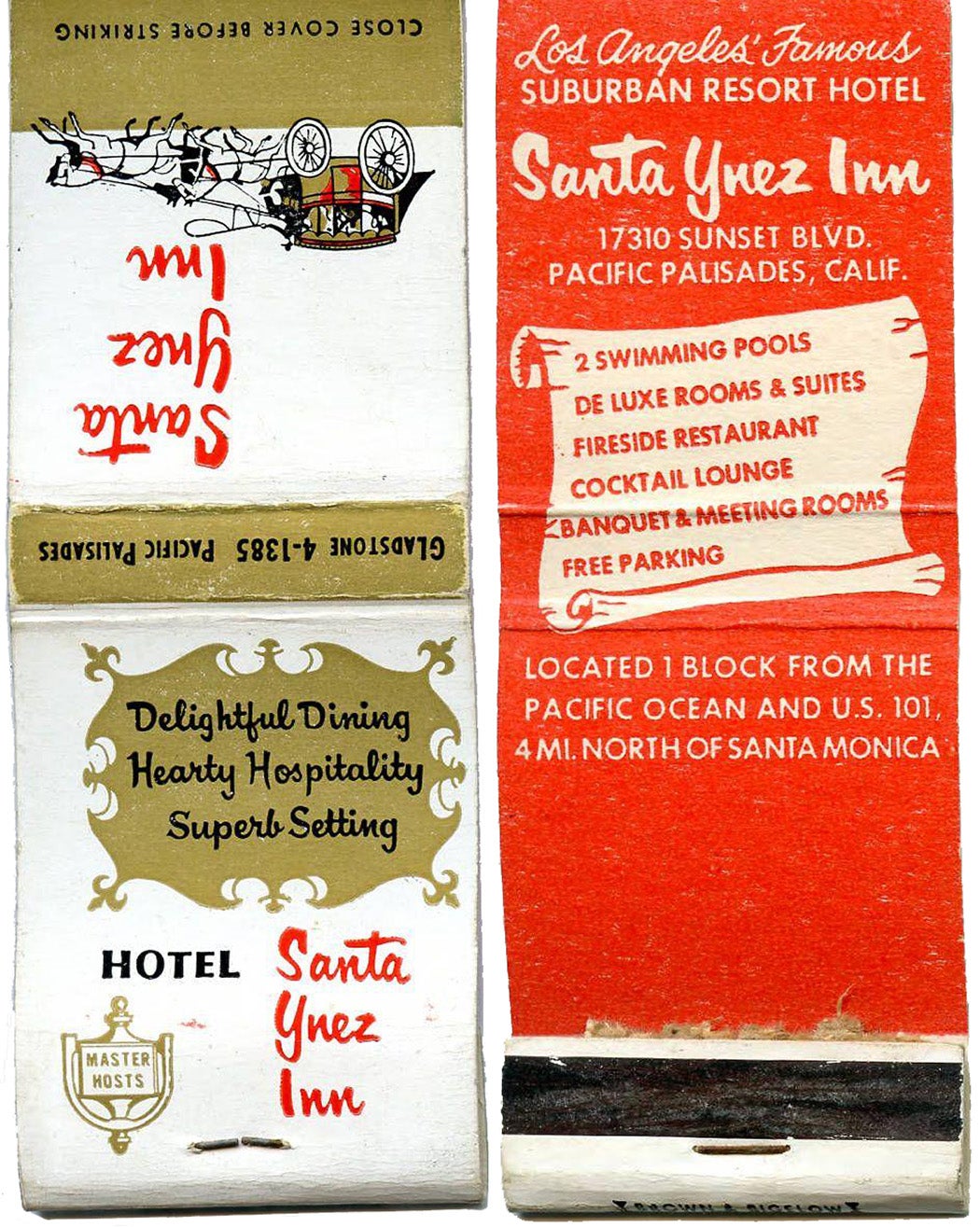
Advertising must always navigate the tension between the universal and the intimate, seeking to speak to everyone at once and directly to each individual. Rather than requiring every small business to produce its own artwork, the matchbook industry provided stock imagery, templates, and phrases, along with guidance on combining them with establishment-specific details. To that end, many of the businesses along the PCH tended toward similar iconography, with palm trees and seafood being particularly popular elements of matchbook ads. These stock images were paired with site-specific details, sometimes including tiny but intricate maps indicating the location of a bar, restaurant, or hotel amid the increasingly sprawling network of L.A. area roads, or simply spelling out the nearness of a sight worth seeing, such as “Famous Sunset Blvd.”
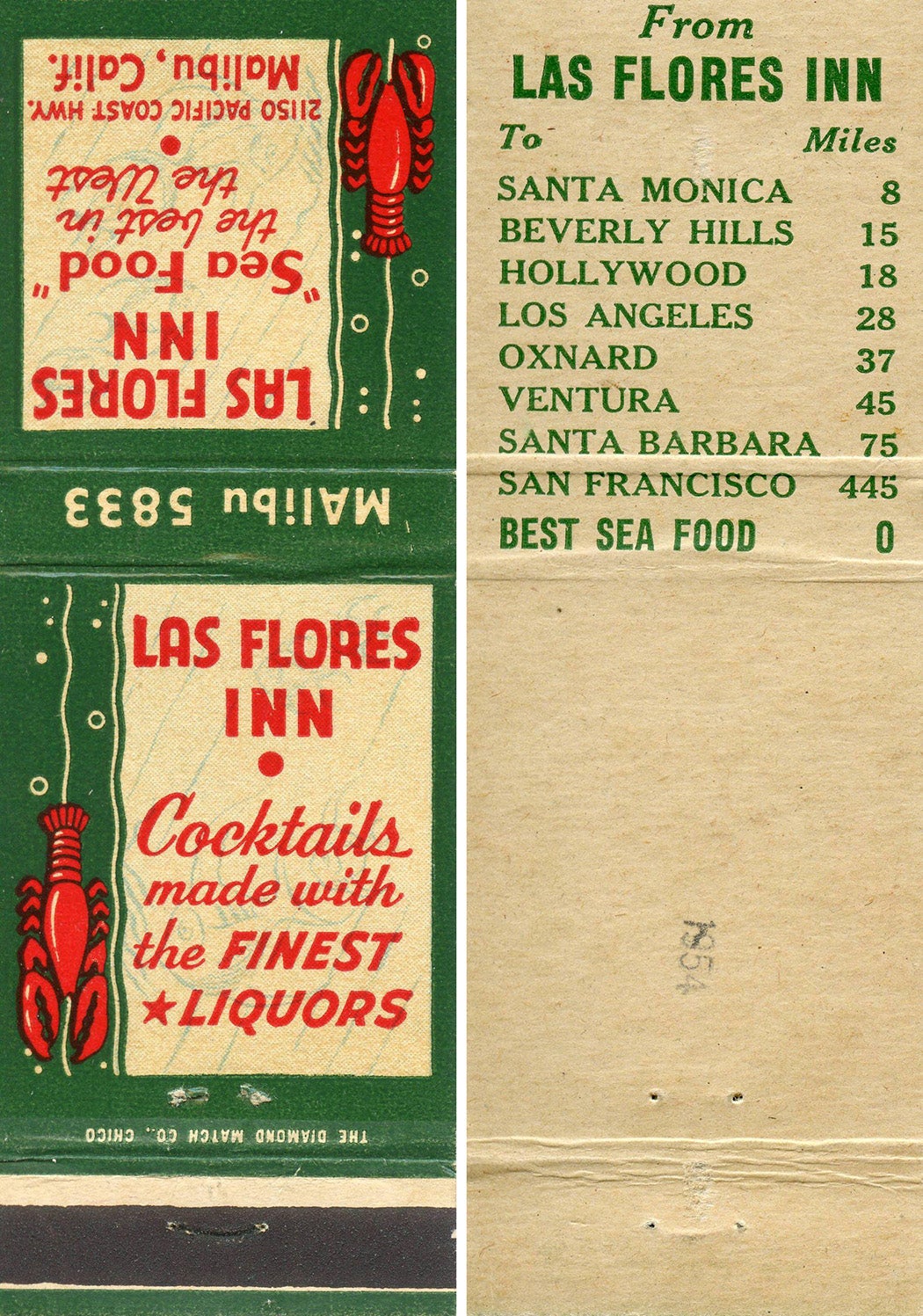
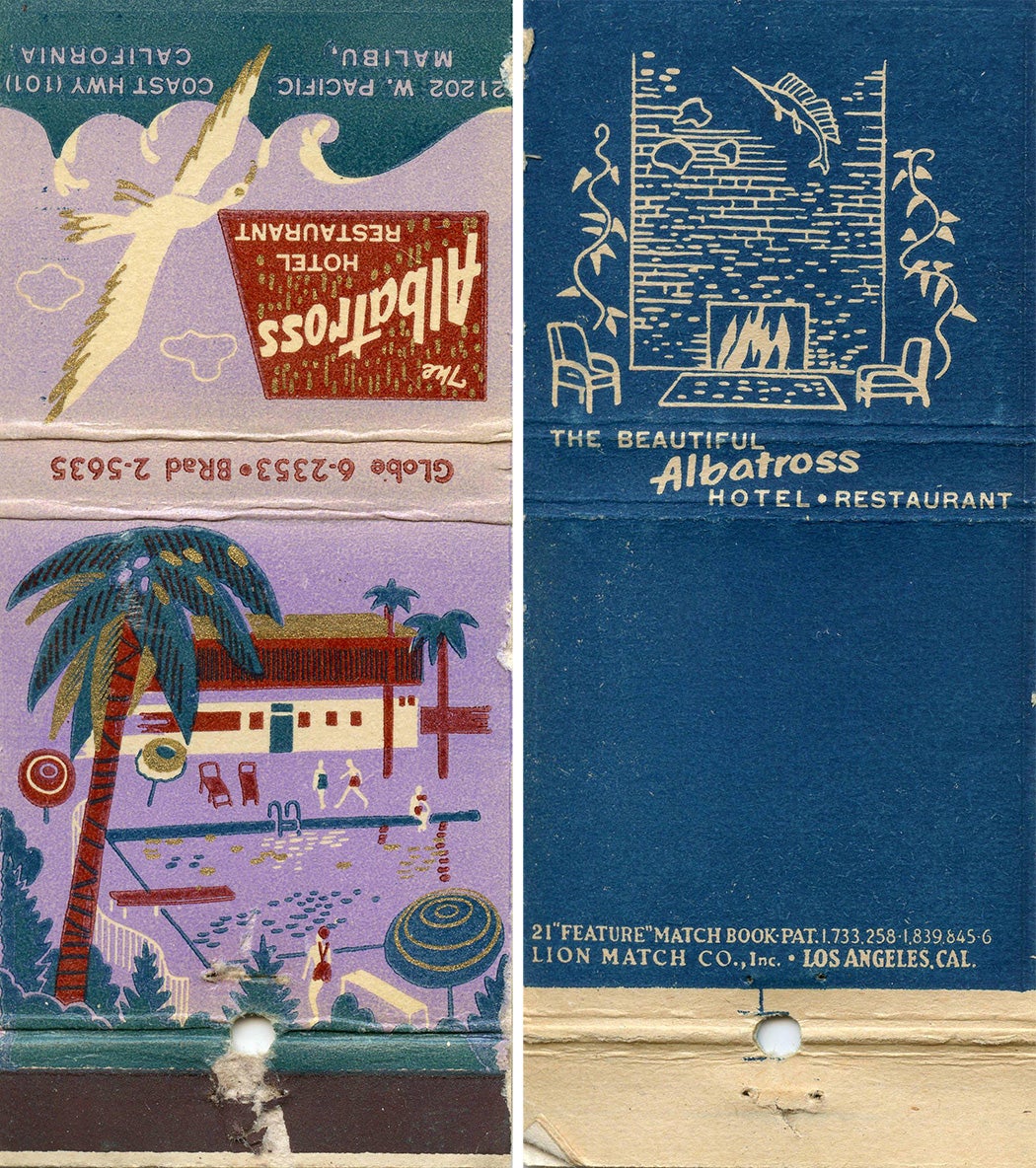
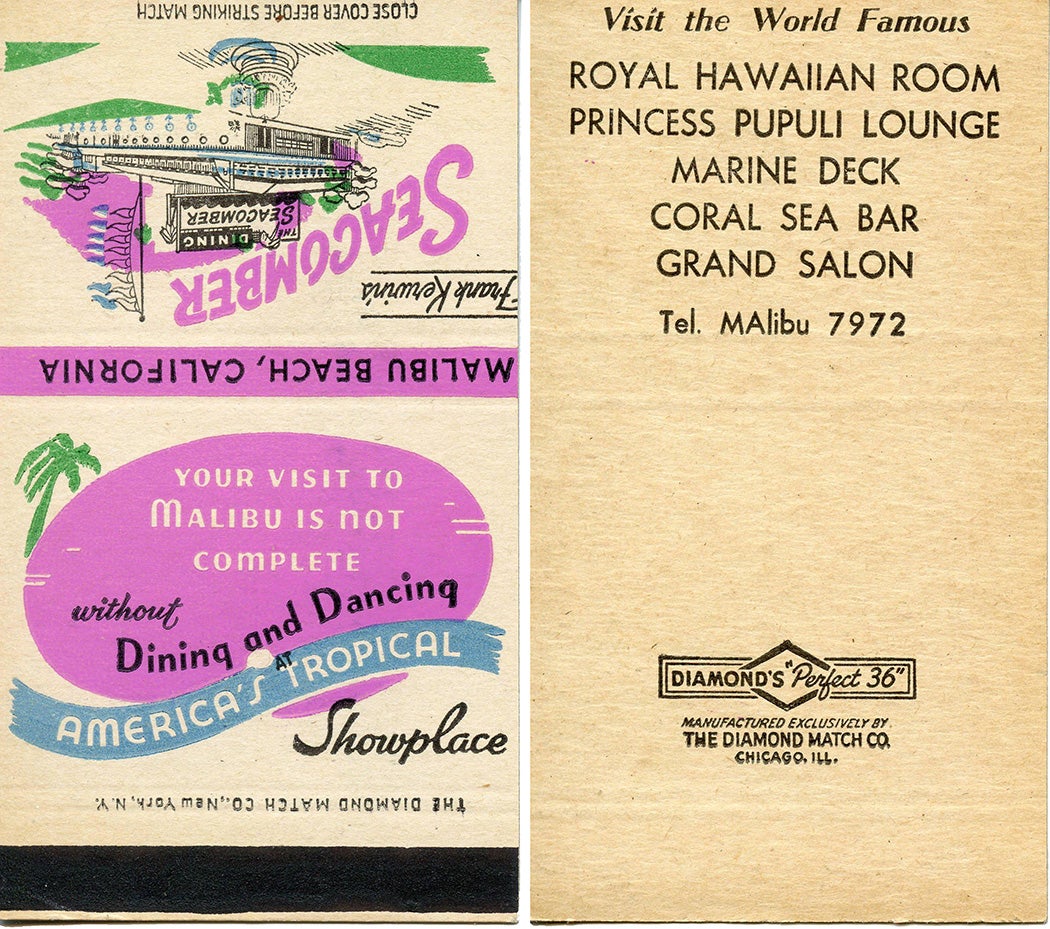
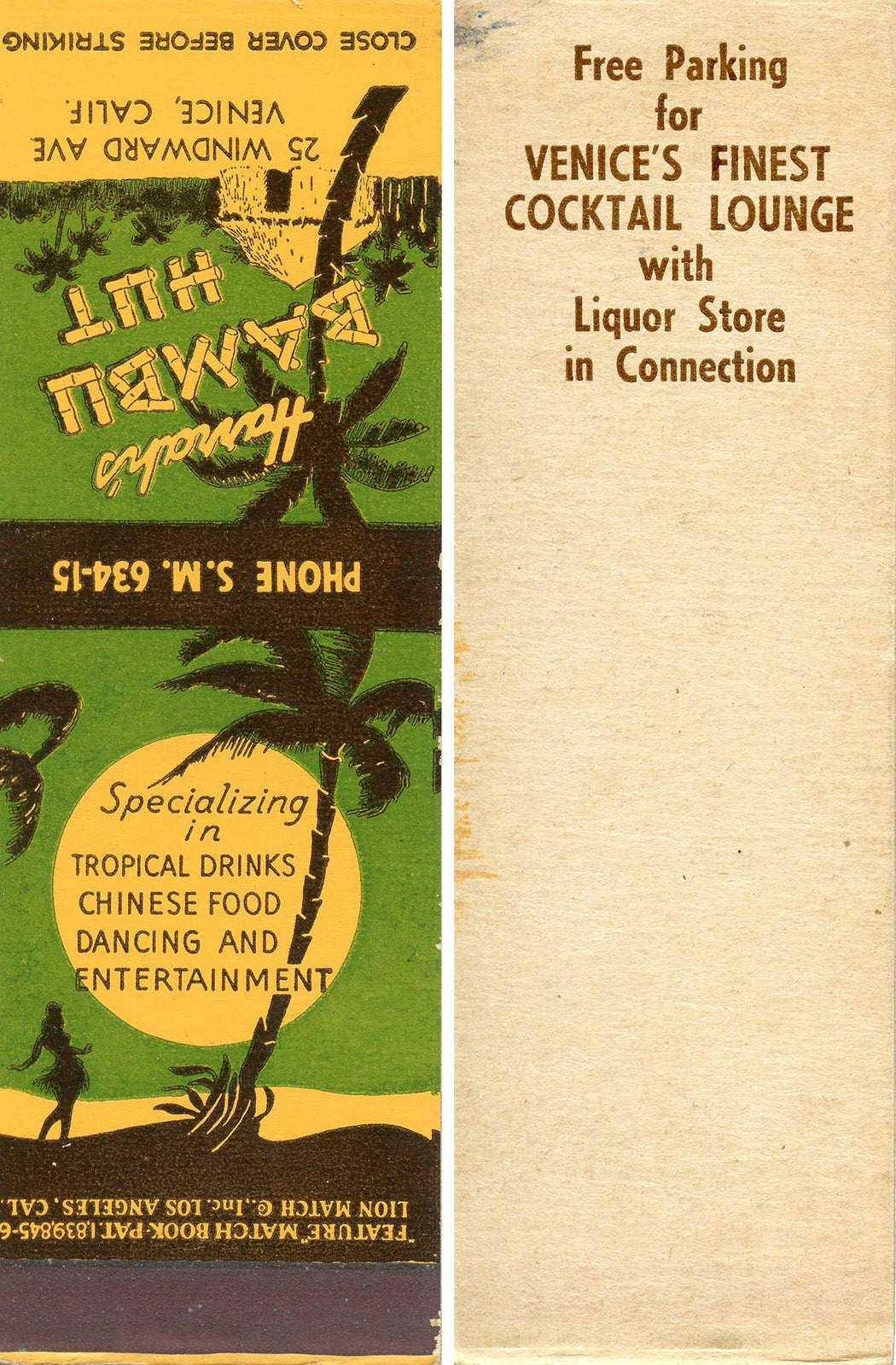
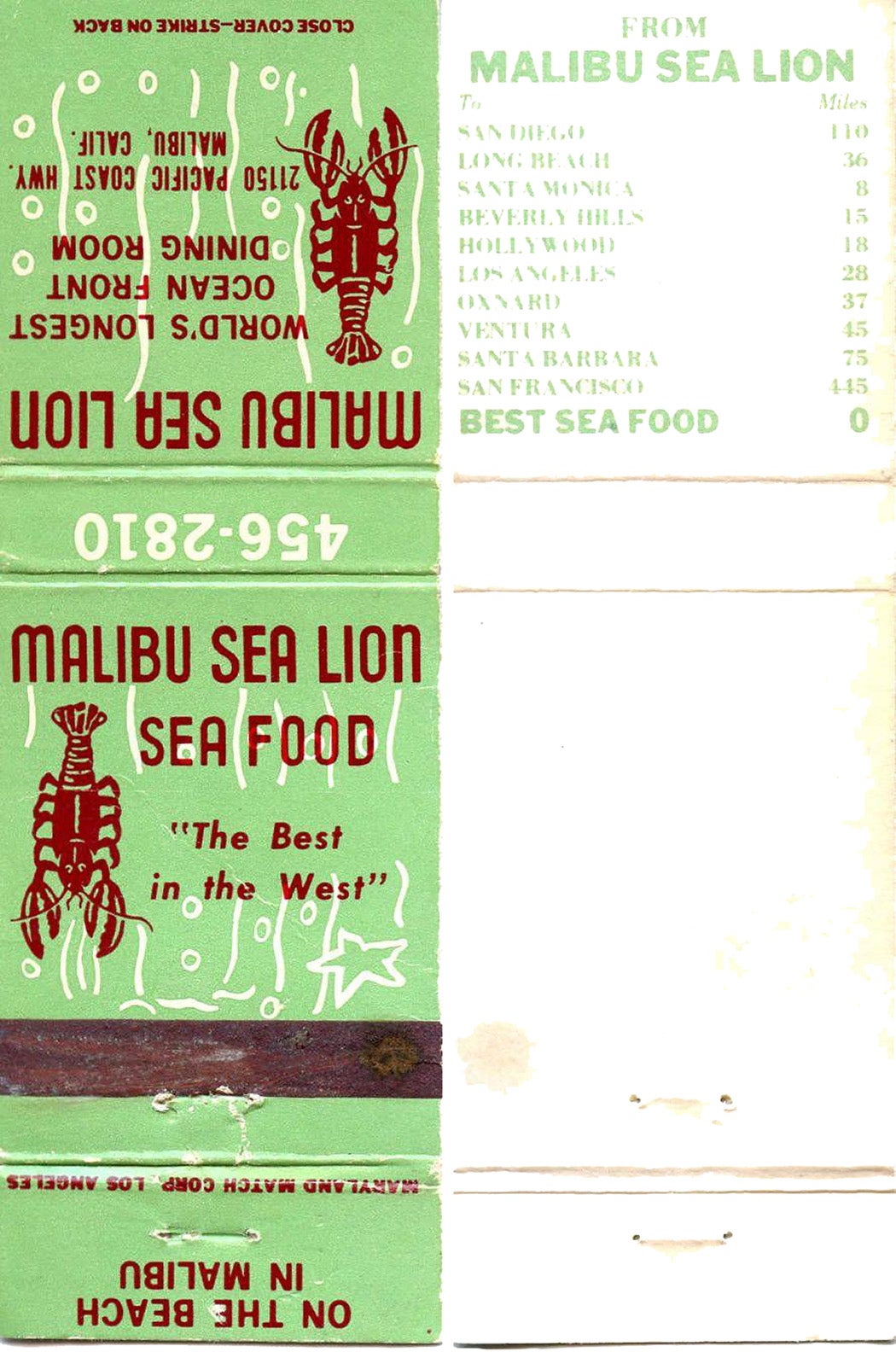
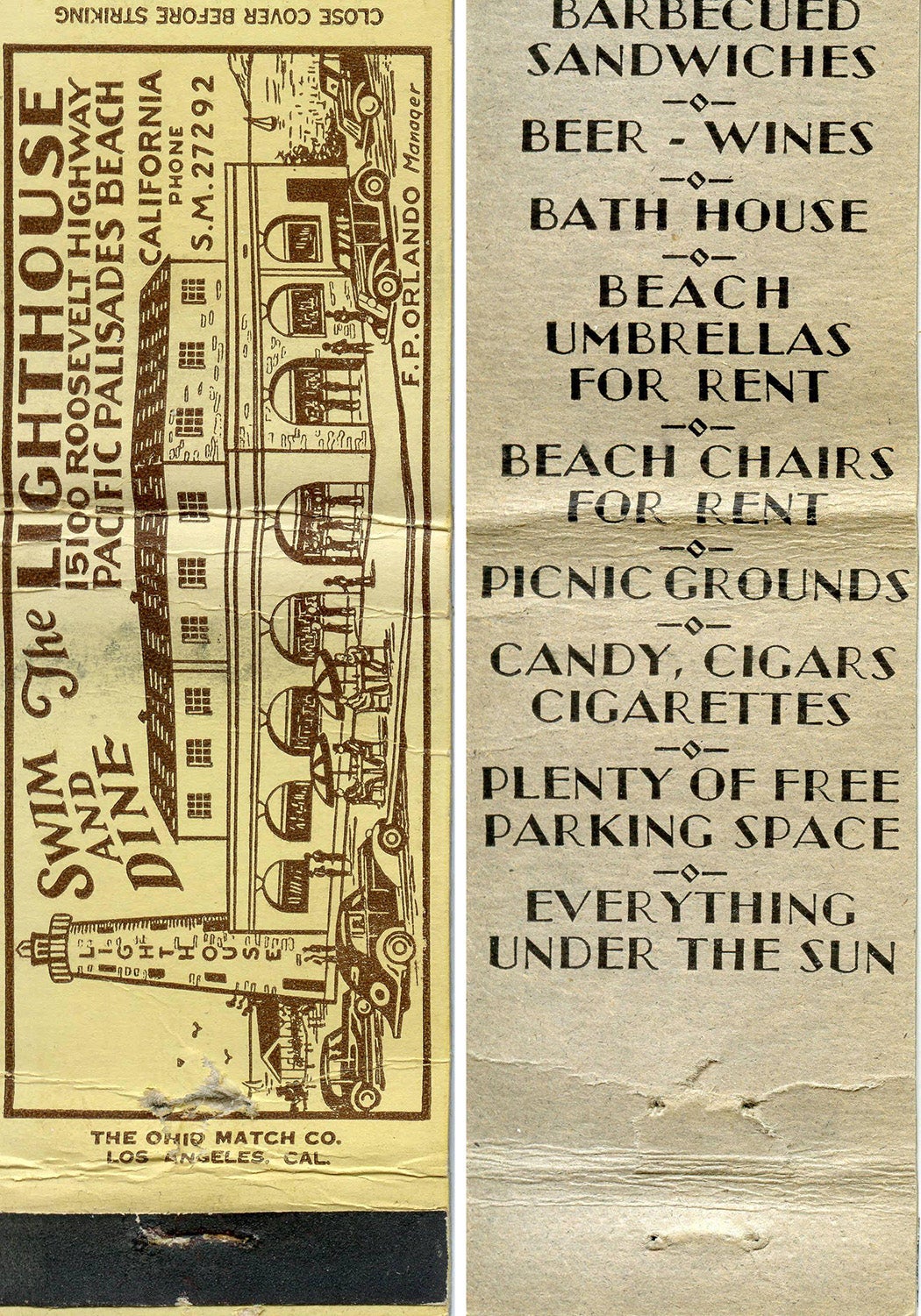
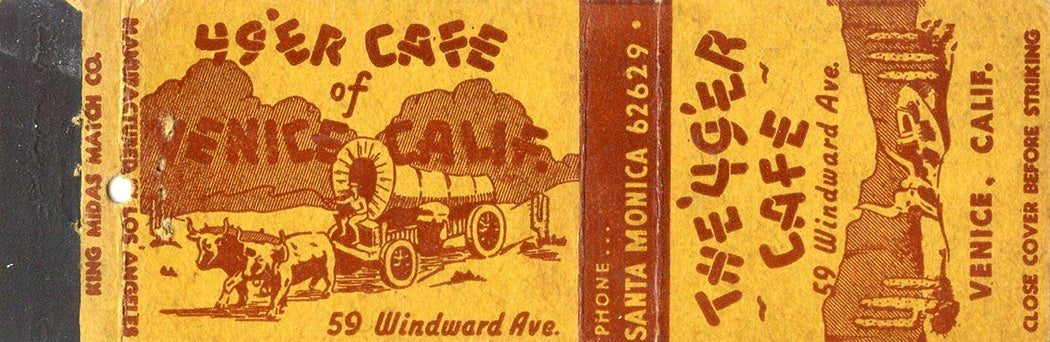
Since unique location and aesthetics were also essential differentiators for Malibu-area businesses, for some it was worth the extra effort to render an establishment in a way that emphasized what set it apart. A number of mid-century businesses consciously played into the relatively recent but already mythic past of the area, with names and corresponding images that alluded to the gold rush, ranching, covered wagons, and other wild west or pioneer themes. One early establishment, the Lighthouse, brought the manufactured world of the movies into reality: built to look like a real lighthouse, including a fully functional beacon, the building seemed to belong to some earlier era—and became a landmark despite being entirely invented.
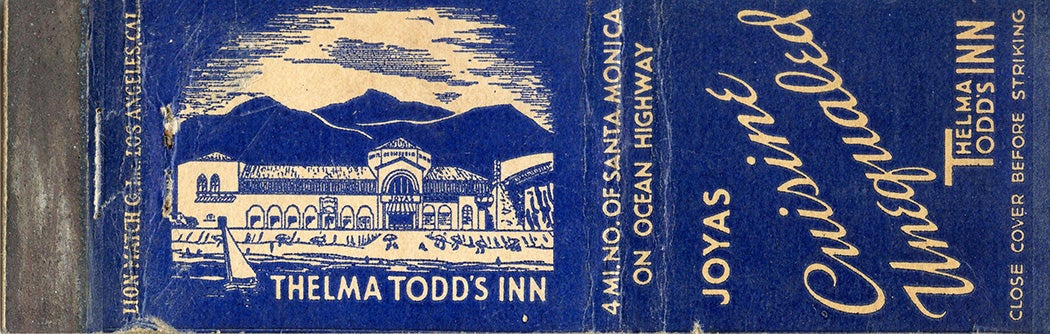
In film noir, what starts as a straightforward investigation into simple seediness often ends in the exposure of corruption, greed, or networks of vice. The places pointed to by matchbook clues, advertised as innocent providers of pleasure, are invariably where the good times ran out. Few spots along the PCH illustrated this better than the sordid story of Thelma Todd’s Inn. Opened in 1934 by the actress of the same name together with her lover and business partner, the married director Roland West, it was allegedly a mob hangout and indisputably the site of Todd’s mysterious death by carbon monoxide poisoning in 1935. In the aftermath, rumors swirled that West had murdered her, or that organized crime was involved, but the roadhouse continued to be run under her name for some time after her death. In a dark inversion of the noir formula, the matchbooks that advertised Thelma Todd’s became clues one could pocket on purpose.
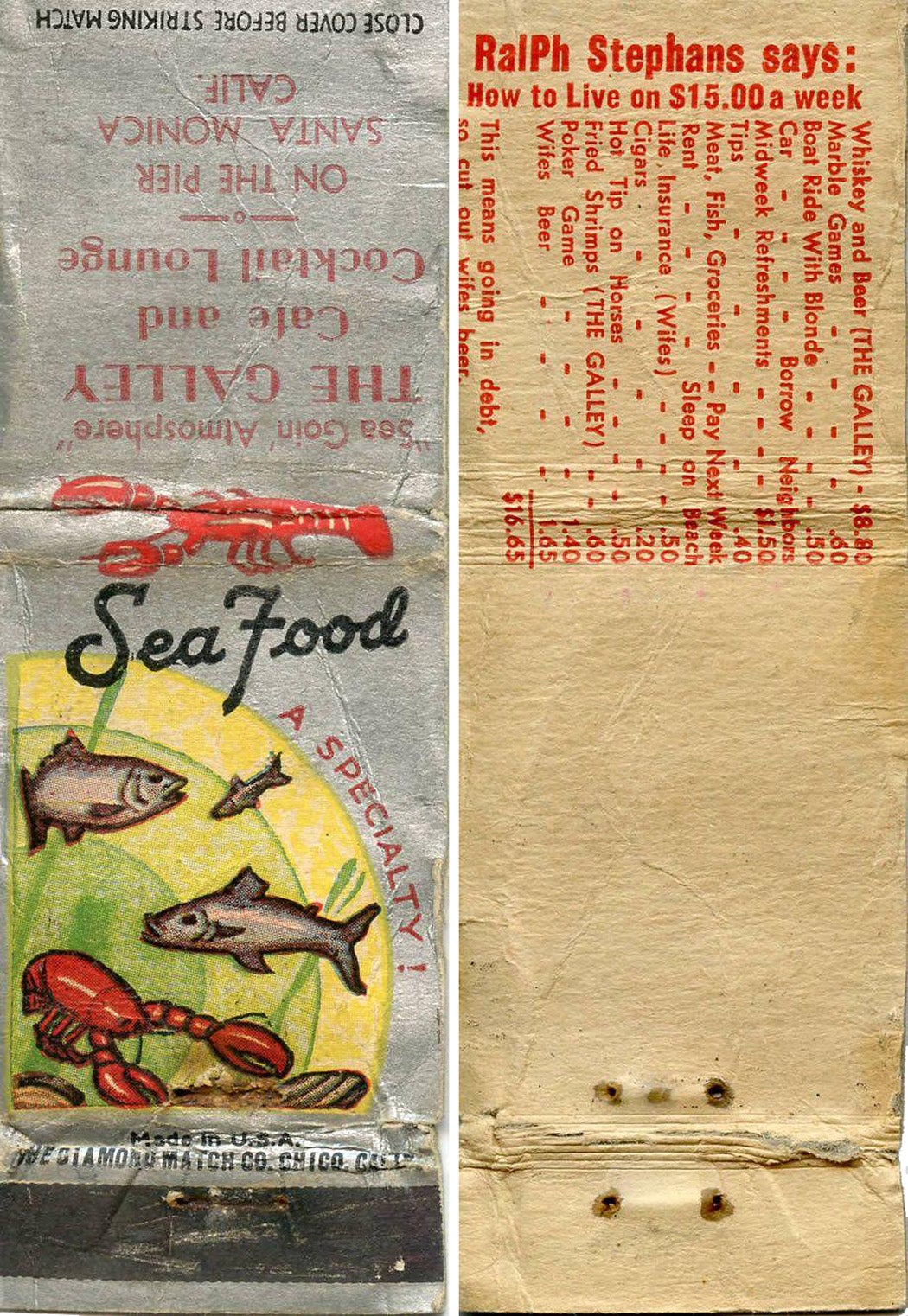
Sometimes, however, one must only look closely to see the signs of sleaze. Some matchbooks whose covers advertise apparently innocuous hotels and restaurants conceal crude jokes inside, exploiting the intimacy of the form: the inner surface, visible only to its holder, allowed establishments to make literal inside jokes whose punchlines often made clear they were meant for men. More broadly, the rise of the commercial corridor also supported the flourishing of more overtly nefarious establishments like the S. S. Rex, a mafia-run gambling ship anchored just outside of the regulated waters in Santa Monica Bay, which flourished in the late 1930s.
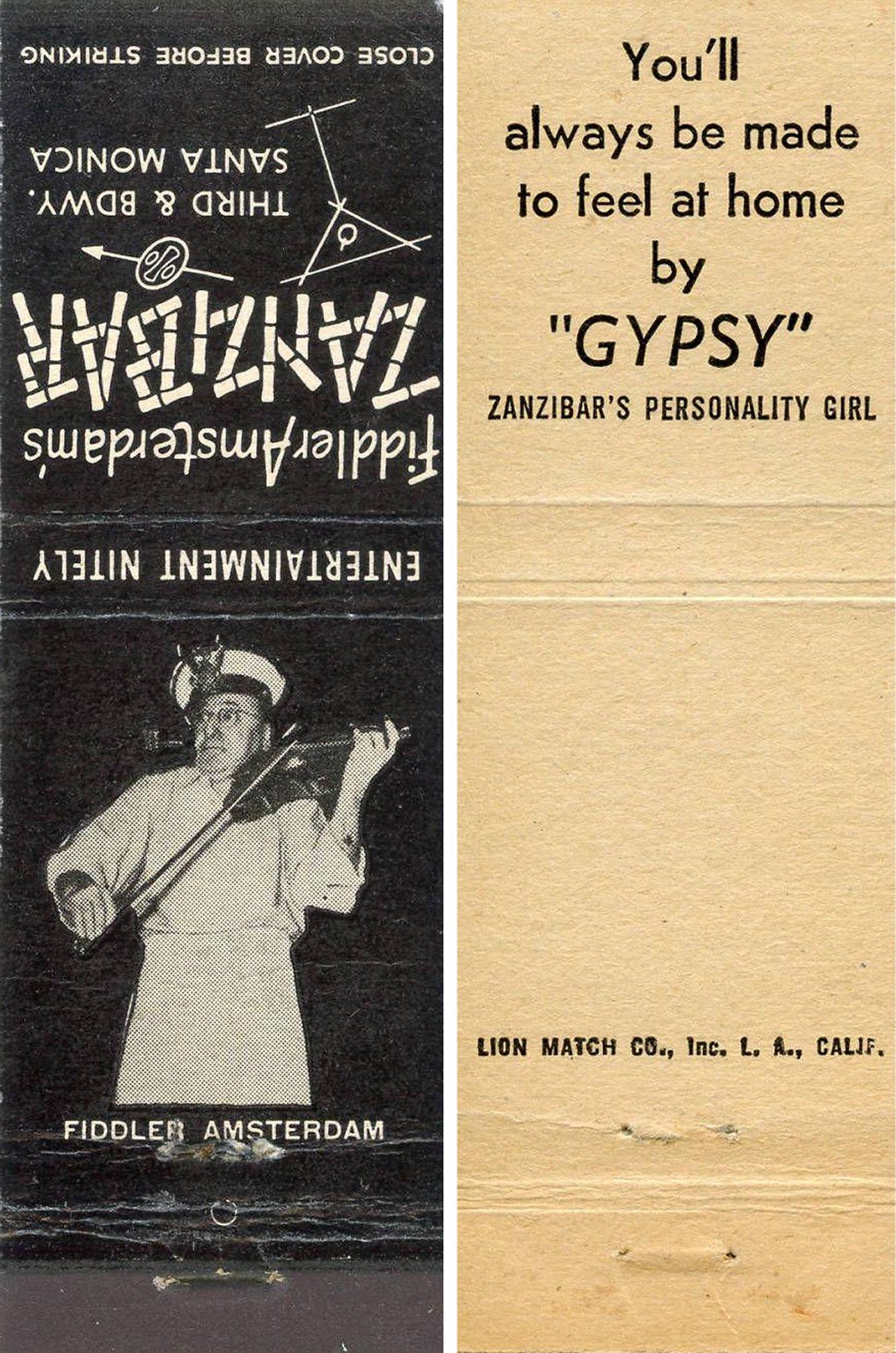
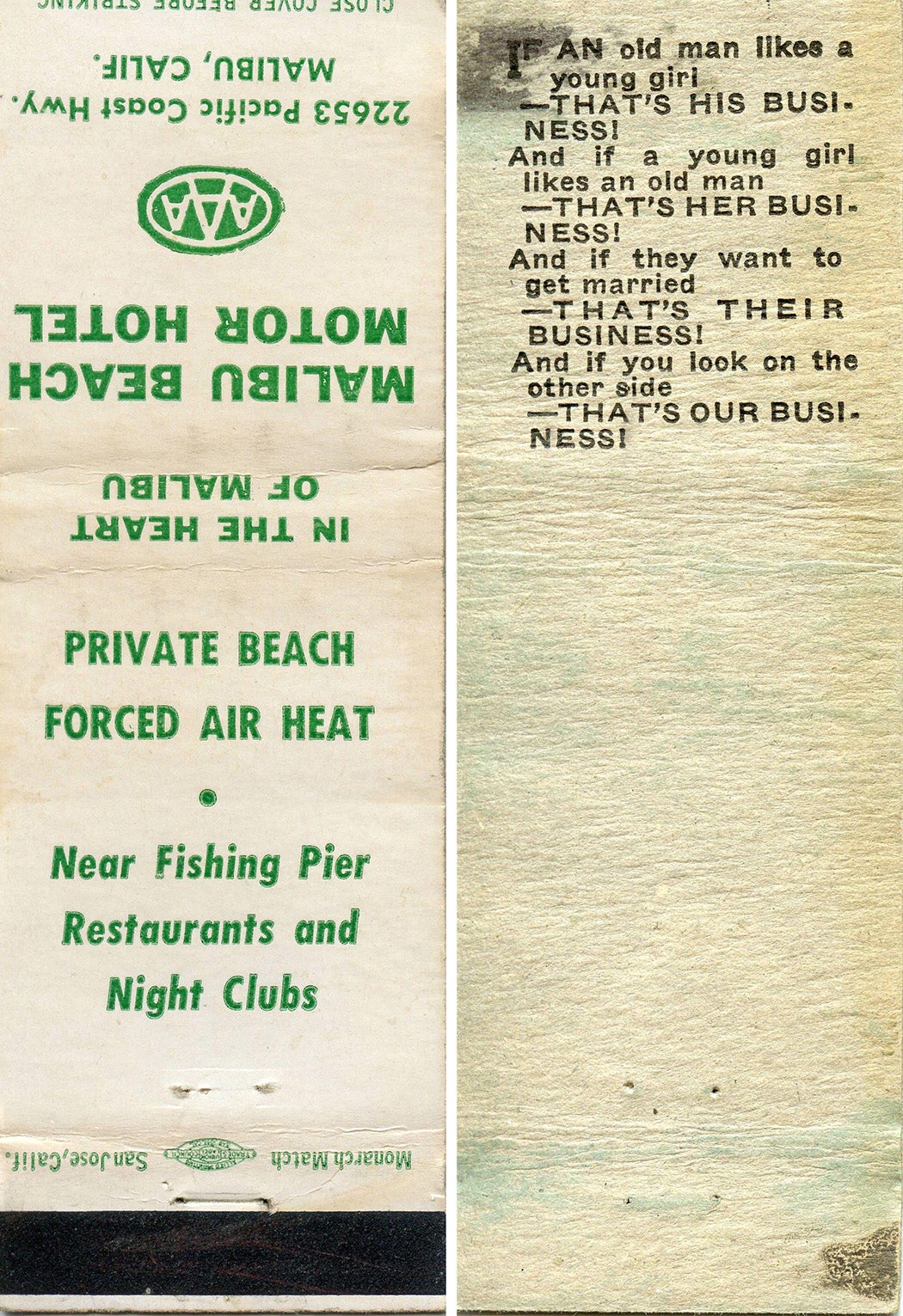
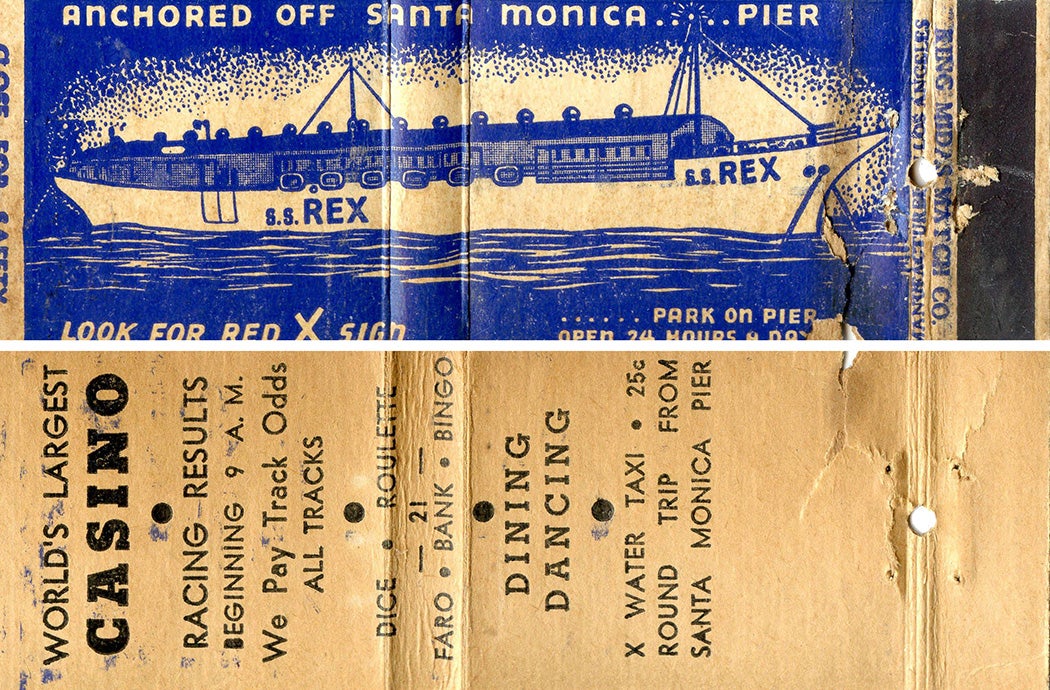
For all their insistent disposability, matchbooks almost immediately enjoyed another transformation: from throwaway to collectible. Evelyn Hovious, a Californian who began saving matchbooks during World War I and ultimately amassed over 5 million, was among the earliest recognized phillumenists, or matchbook collectors. She was also part of a broader democratization of collecting, a hobby long reserved for the wealthy that was becoming newly possible for the middle class. Mass production brought good wages, more leisure time, and an enormous array of things to collect, including the ephemera produced to promote them. In contrast to the aristocratic collectors of the past, what motivated this new wave of collectors wasn’t uniqueness or rarity so much as personal resonance: the relationship between an object and one’s own past, and the way even the cheapest throwaway can become a means of remembering.
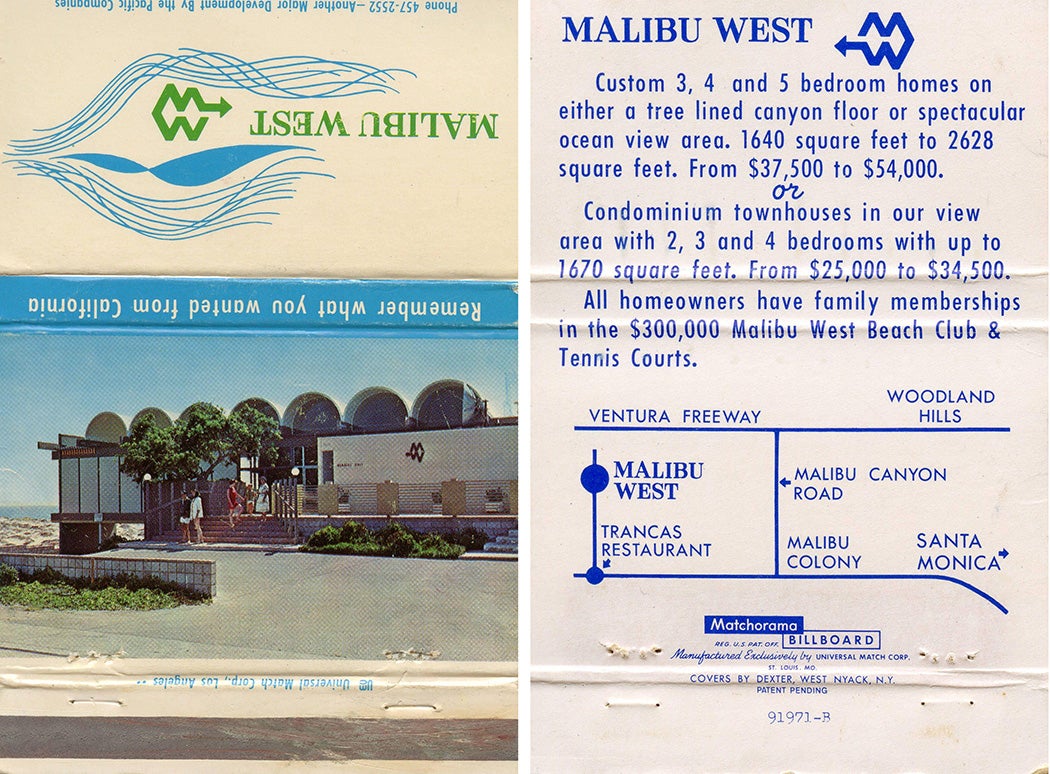
The matchbook pulled from a dead man’s pocket in a film noir is never just a matchbook, and it’s never just a clue to a single, solvable crime. Instead, it’s a window onto a whole world of ambition and weakness, pleasure and destruction, that the detective can illuminate but never fully comprehend. The Wienberg collection works in much the same way, assembling a fragmentary image of a Malibu that’s largely gone now, burned or bulldozed or simply forgotten, and the ambitions and dreams of a moment in time. There’s a particular irony in the fact that it falls to matchbooks—instruments of ignition, made to be used up and thrown away—to preserve the memory of a place that fire has repeatedly erased. But perhaps it’s fitting. “Remember what you wanted from California,” reads one matchbook advertising a development built in an area repeatedly devastated by fire. It’s an odd instruction to find on something designed to be thrown away—but that’s what the whole collection amounts to: a set of clues, modest and specific and accidentally permanent, to a place that was always promising something just out of reach.