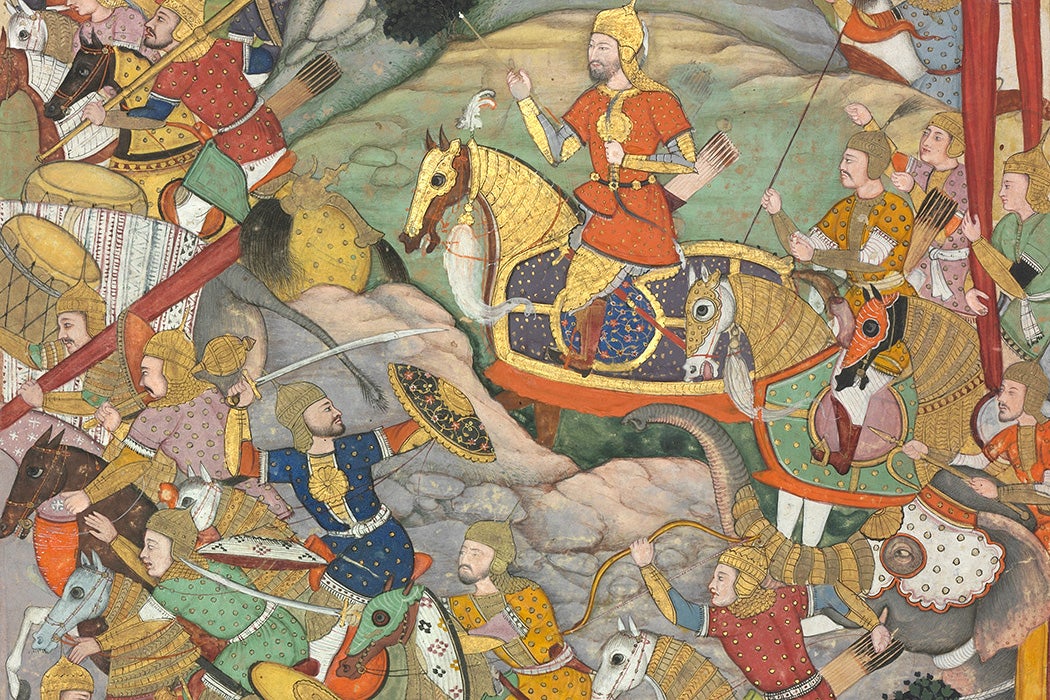
The Mughal Empire became a dominant power in South Asia from the sixteenth through the eighteenth century thanks largely to its cavalry. And, as political scientist Deepti Kumari writes, the importance of horses influenced many aspects of how the empire developed.


Kumari writes that horses were both a source of military strength and a focus of pageantry for Mughal aristocratic leaders. Imperial officers had two ranks: zat, determined by their pay rate, and sawar, reflecting the number of horsemen under their command.
However, South Asia was considered a poor area for horse breeding due to the heat and monsoons. Instead, the empire largely imported the horses it needed from Arabian, Persian, and Central Asian sources. In exchange, India exported commodities like cotton cloth, indigo, silk, sugar, slaves, spices, and medicines, including opium.
Kumari writes that horses from Central Asia mainly arrived in India over land routes, brought by merchants from nomadic cultures who traveled in caravans. This could be tough going. Transporting horses from Kandahar through Multan to the Mughal central city of Agra, for example, could mean traveling through a desert, leaving a caravan with no source of water for three to four days. Travelers more often took an alternate route across the Khyber Pass in the mountains of what is now Pakistan, even though this added an extra ten days to the journey.
More to Explore
The Supernatural Horses That Fascinated Chinese Emperors
To import horses across land routes, the Mughals built roads and set up travelers’ inns known as caravanserais. They also established diplomatic relationships with countries along the way and recruited locals to be part of the imperial machinery. When Emperor Akbar took power in 1556, he moved the empire’s capital to Lahore in an effort to exercise greater control over trade routes from Central Asia, particularly in the area around the key trading city of Kabul.
“By providing the security, Akbar improved and accelerated the bilateral caravan traffic coming in and going out of India via Kabul and Qandahar route and restored the confidence of the merchants,” Kumari writes. “This ensured a regular supply of the horses and other commodities for the Mughal army and Indian population.”
Meanwhile, horses from Arabia, Persia, and northeastern Africa mostly reached India by sea—routes that had been used since the early medieval period. The Mughals particularly valued these horses for their strength and stamina, as well as their colors and other aesthetic features.
Weekly Newsletter
This made sea ports along the western coast of the subcontinent particularly important. The trading ports were a crucial part of the imperial administration, with their own governors who regulated commercial activity and reported back to the Mughal court.
And within the empire, the Mughals encouraged horse traders by providing them with tax relief and protection while traveling. Emperor Akbar ordered the construction of special quarters for the most trusted horse-dealers to protect them from robbers or bad weather.
“The Mughals encouraged horse-trading and invested in horse-breeding because it was crucial for state building,” Kumari writes.