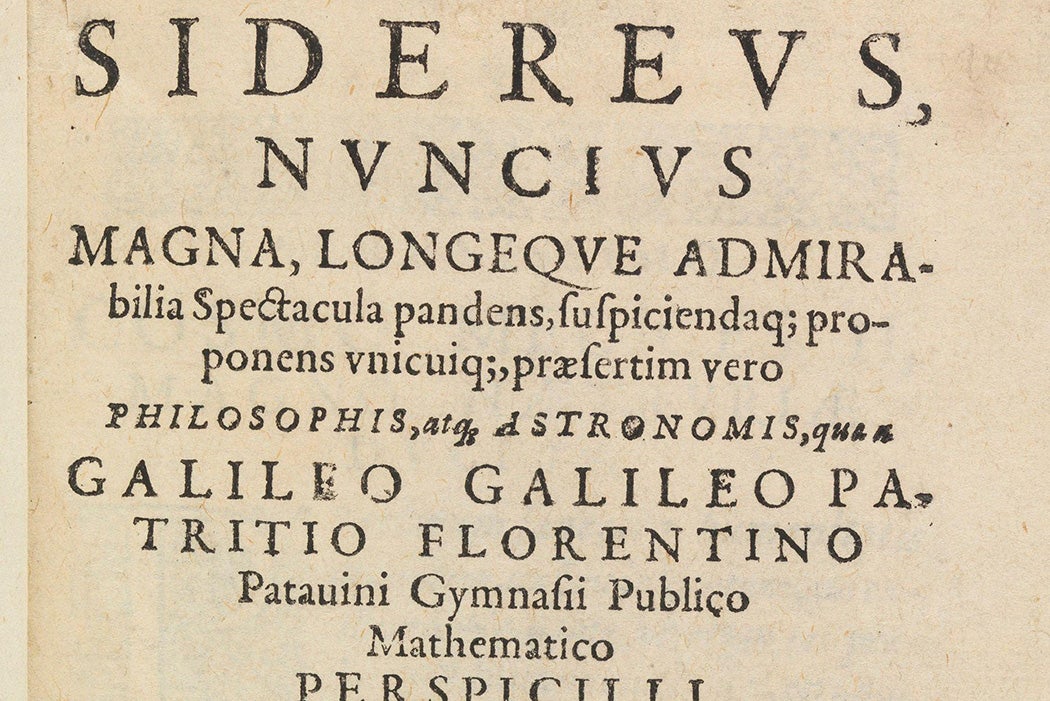
When a rare copy of Galileo Galilei’s Sidereus Nuncius came on the market in 2005, there was talk it could reach a sales price of $10 million. It was, after all, supposed to be a unique version of one of the most famous documents in the history of science—one that would be authenticated by experts as being signed and illustrated by Galileo himself.


Tech billionaires have made the history of science a very hot market, one which tends to suck volumes into private collections and away from both the purview of scholars and the eyes of the public and law enforcement. Considering the associated thefts from libraries in this story, provenance—the history of the ownership of the item in question—may also get swallowed by all the hot money.
Sidereus Nuncius is usually translated as Sidereal Messenger or Starry Messenger. It’s Galileo’s 1610 report of his examination of the night sky through a newfangled device, the telescope. In 60 pages, he described for the first time the rugged topography of the Moon; four moons orbiting Jupiter; and the gloriously remarkable fact that there were many more stars out than could be seen by the eye alone.
It was a revolutionary publication, offering up visible proof Copernicus was right: the Earth was not the center of everything. Five hundred and fifty copies of the slim, literally earth-breaking book were originally published by a Venetian printer. After some four centuries, about 150 copies of this edition are still in existence.
In 2007, two renowned Galileo experts announced the Sidereus Nuncius Martayan Lan (SNML, after the rare book dealership in New York City which purchased it for $500,000) as authentic at a press conference. The watercolor phases of the Moon were said to be Galileo’s own work, and the book was signed Io Galileo Galilei f. (meaning I, Galileo Galilei, made this). One of these experts, Horst Bredekamp, edited a two-volume study of the volume in English called Galileo’s O (2011).
“Having gleaned more information from it than from any other book ever printed, with the possible exceptions of the Gutenberg Bible and the Shakespeare First Folio,” writes scholar Nick Wilding on the Galileo’s O project, “they concluded this was indeed Galileo’s previously unknown copy.”
Except … um … it wasn’t. While other scholars had expressed doubts about the book’s authenticity, it was Wilding who, detective-like, brought together much of the evidence to show that SNML was a sophisticated twenty-first century forgery. Sophisticated, but still “riddled with errors. It is a decent forgery but no masterpiece.” (A third volume of Galileo’s O was published in 2014, subtitled “A Galileo Forgery: Unmasking the New York Sidereus Nuncius.”)
More to Explore
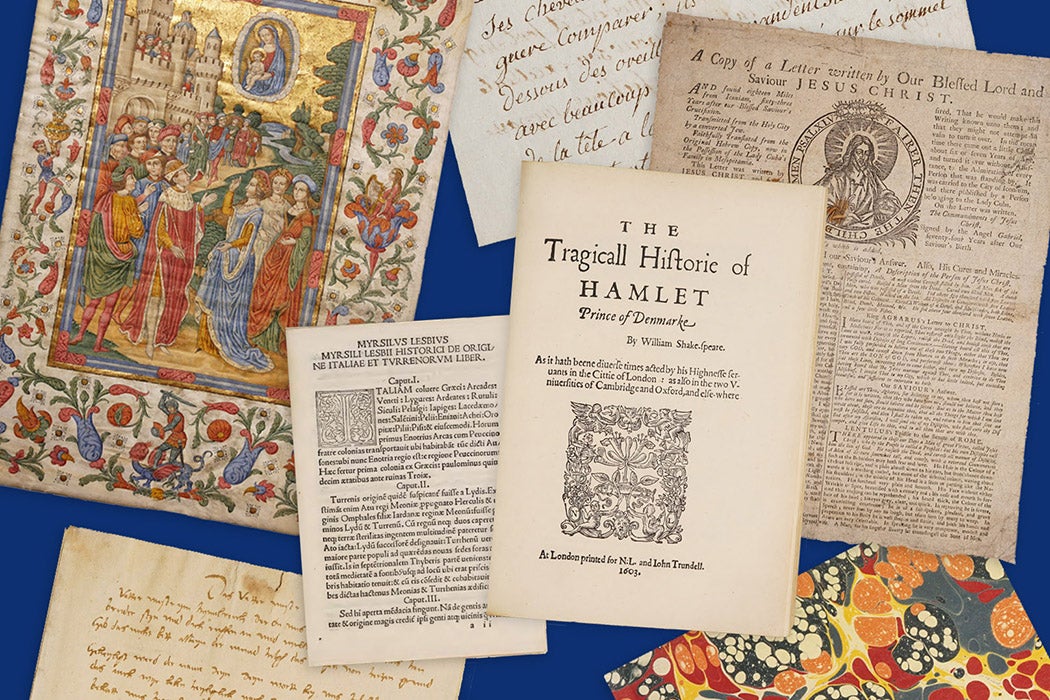
Enchanting Imposters
Wilding’s evidence seems obvious in hindsight, even to a layperson. “Forging the Moon” is a rare-book procedural worth reading in detail. (Why hasn’t this story become a movie? Perhaps because the photopolymer plate printing used to make it was already elaborated on in the best-selling 1993 novel The Club Dumas and its 1999 knockoff film adaptation, The Ninth Gate).
“The professional resistance of some book dealers to divulge information on their sources, and methodological commitment on the part of some academics to evidence emanating from the artifact itself, rather than its social context and provenance combined hermetically to seal off” this version of the Sidereus from the context of the business of dealing books, real and fake, around the world. For it turned out that this wasn’t the only Sidereus Nuncius peddled around the same time—in fact, it looked just like one (minus the signature and illustrations) that Sotheby’s failed to sell in 2005. Both were offered up by the same person, Marino Massimo De Caro, later convicted of looting an Italian library.
Two exact copies? Not likely. “Every hand-printed book is different, even copies within the same edition,” writes Wilding. Bindings, provenance, centuries of use (or abuse or neglect) all leave their marks: “dedications, ex libris scrawls, marginalia, doodles, wormholes, tears, and repairs all make each copy physically individual, not identical.”
Weekly Newsletter
"*" indicates required fields
Both of De Caro’s copies of the Sidereus had a title page blemish that turned out to match perfectly a legitimate 1964 facsimile copy of the book. In that facsimile edition, a photo retoucher had failed to correct a paper blemish that the camera read as an ink dot … and here it was again four decades later, pointing to one of the sources of the De Caro fakes.
Detailing a trail of shady library exchanges; forgeries used to replace stolen originals; originals with added forged details to increase their value; and multiple forged copies (De Caro claimed he made five copies of Sidereus Nuncius), Wilding argues that the SNML “is merely the most sophisticated example we have so far detected in a long run of forgeries, whose primary aim was to stand in as surrogates for stolen copies.” Eager to disabuse people of rooting for clever forgers and the schadenfreude of seeing experts conned, Wilding writes, “these books are the product of organized crime” undermining history and the institutions that make history possible.