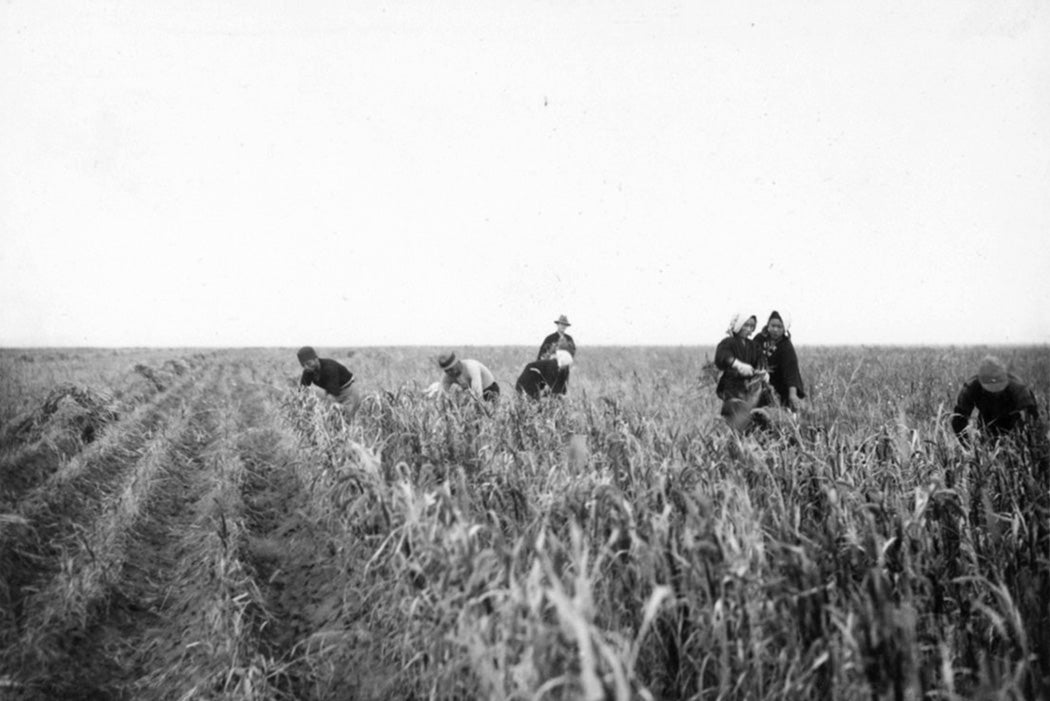
In 1941, a manifesto called the Geibun shidō yōkō—the “Prospectus for the guidance of arts and culture”—was issued by the Manchurian government and quickly reprinted in magazines. In Japanese-occupied Manchuria, art was expected to promote nationalist ideals or even propaganda. Often, that meant taking a cue from ideas and styles in mainland Japan.


Publications like the Geibun shidō yōkō made authors there conscious of being from a distant corner of the empire. Yet, as Joshua Lee Solomon notes, many were also colonial settlers in “positions of economic, cultural, and political privilege.” Solomon finds in their work an overlooked perspective that breaks from a “grand historical narrative” of simply celebrating the Japanese colonization of northeastern China.
Takagi Kyōzō is one such writer. Born in 1903 in northern Japan, Takagi moved to Manchuria in late 1928 in the hopes of bettering his fortunes. For almost two decades, he worked and wrote there, returning only after Japan’s defeat in World War II. Soon after the Geibun shidō yōkō was published, he commemorated the tenth anniversary of the Japanese conquest with a poem exclaiming: “Oh, Father Nippon! Oh, Mother Manchuria!”
“[P]etit-bourgeois Japanese writers in Manchuria like Takagi often perceived themselves as occupying a minority position within the literary and political field,” Solomon explains. Focusing on the short story “Fūjin,” or “Dust in the Wind,” he argues that Takagi was concerned with the contradiction between Japanese authors’ sense of marginalization in Manchuria and “their relative dominance over their continental neighbors” from other ethnic backgrounds.
“Fūjin,” which was published in the leading Manchuria-based journal Sakubun in 1940, draws on elements of Takagi’s life in its portrayal of the protagonist, Saruwatari Heisuke, a back-alley physician living in Manchuria with his common-law wife and two wayward children. Like much of Takagi’s work, the story can be classified as “literature of place”—a genre that Solomon notes is sometimes described as “attached to the land” or “stinking of the earth.”
“This equivalency between the literal, physical dirt of a geographic space and the sociocultural elements informing lived place is thematized throughout the works of Takagi,” he adds. Above all, Solomon notes that “Fūjin,” like much of Takagi’s oeuvre, is preoccupied with the theme of “place” or “kankyō,” which means environment.
“The title of the short story ‘Dust in the Wind’ evokes an image of the yellow sands which originate on the continent and are carried on the wind to the Japanese archipelago,” he writes.
References to this dust in Takagi’s other short stories and poems about Manchuria convey the impression of “a desolate continental wasteland, populated with various characters who are enveloped and battered by forces of nature,” as Solomon puts it.
More to Explore
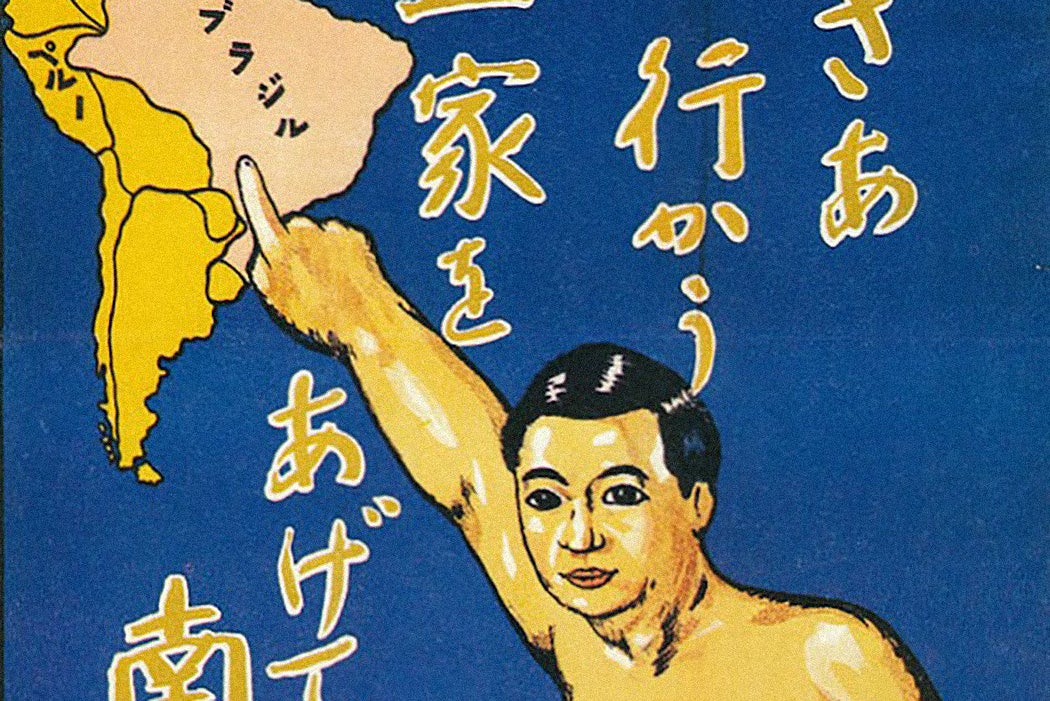
Asian South America
“Yet, the dust-in-wind image is not merely a trick used to signal geographic location or create an oppressive atmosphere,” he writes. “The main force of the image is its allusion to the powerlessness of the individual in the face of grand historical, political, and economic forces, as well as in the face of the ‘spirit’ of place.”
In the short story, the Manchurian environment seems to degrade the lives of its inhabitants, an effect that Takagi produces by “often literally de-humanizing his Japanese protagonists.”
Weekly Newsletter
One instance of such imagery is the description of Saruwatari’s wife Kiku, who is suggested to be of Korean origin, as a “white sow” because of her laziness and homely appearance. The texts contain racist depictions of Chinese, Korean, and Manchu colonial subjects, as well as “constant tacit acknowledgement of the inequities” in Manchuria.
Solomon notes that Takagi’s work doesn’t contain any central ideology, other than the theme of “submission to both environment and the father figures in his biography.”
By playing a minor role in the “complicated matrix of power” in Japanese Manchuria, Takagi occupied “a liminal space between the metropole and the subaltern,” he adds. In his settler-colonial narratives, Japanese protagonists are depicted not as heroes but as victims.
Takagi’s writing is thus, Solomon concludes, “infinitely more complex and tortuous than the simple straight-forward stories relayed via state propaganda machines.”


%22.jpg)