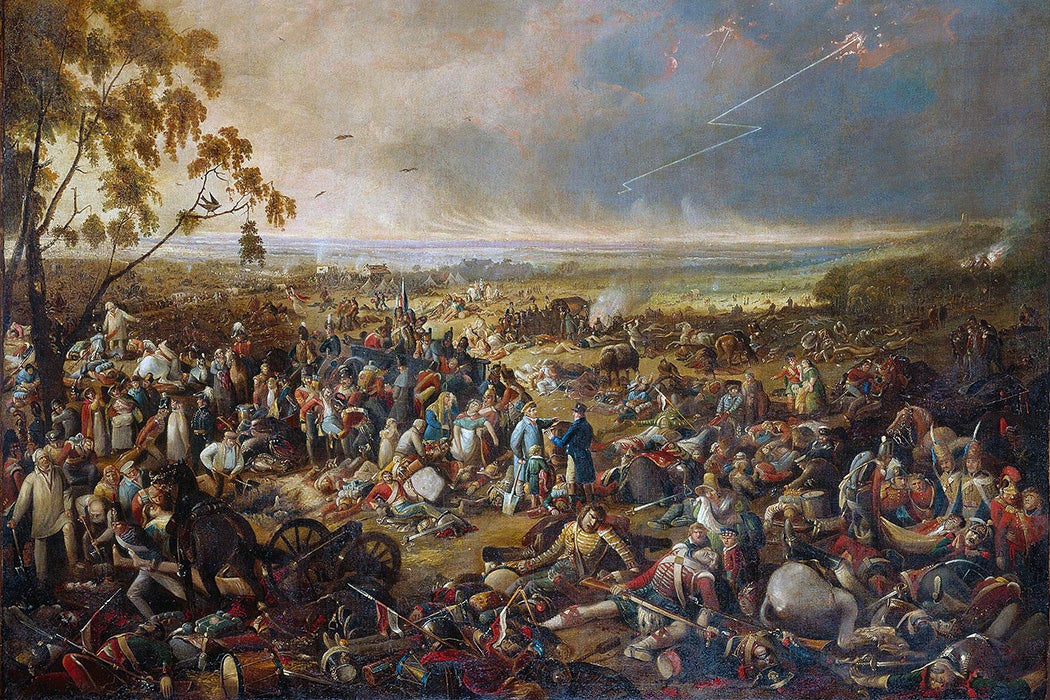
Napoleon’s historic defeat at Waterloo was closely followed by a second invasion: a wave of British tourists. The victory was immediately canonized into national myth, and everyone wanted to see the plain of Britannia’s triumph. Thackeray wrote that ships were “sailing every day, filled with men of fashion and ladies of note… going not so much to a war as to a fashionable tour.”


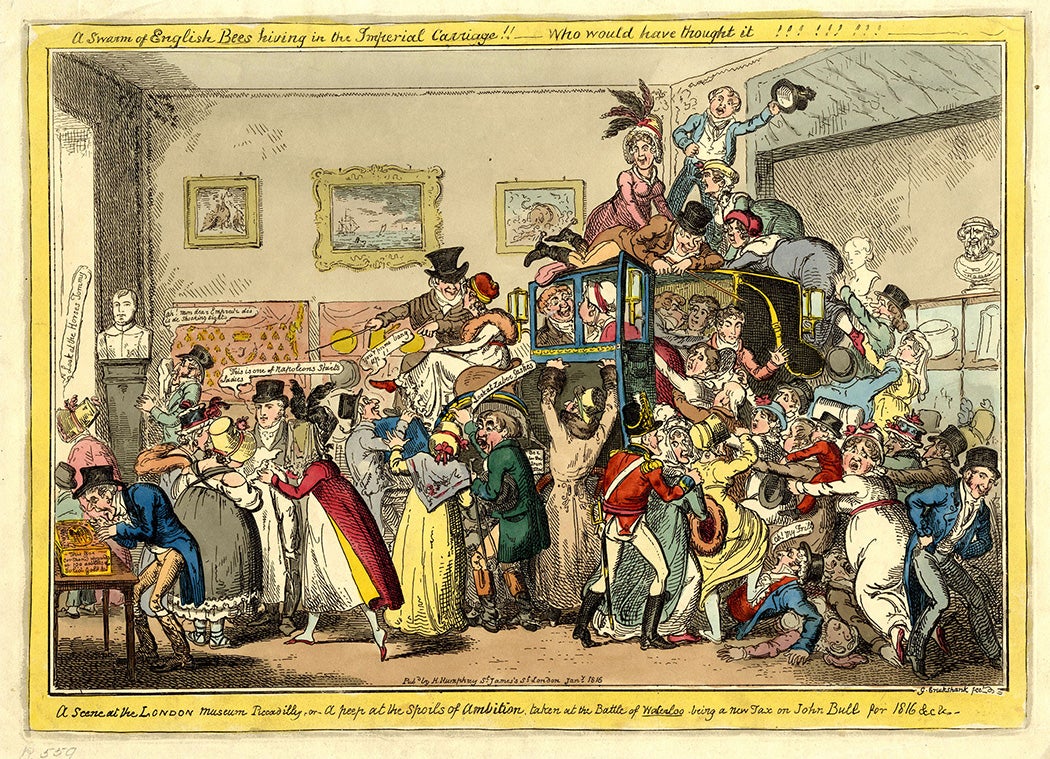
Even if you couldn’t afford the trip, history was brought home to you. Napoleon’s carriage was taken on a tour from London to Edinburgh; a print by George Cruikshank shows sightseers swarming over it like rats. A shilling would buy you the chance to stand in a panorama representing the battle, and enjoy the sight of a “mass of 50,000 French… in great confusion.”
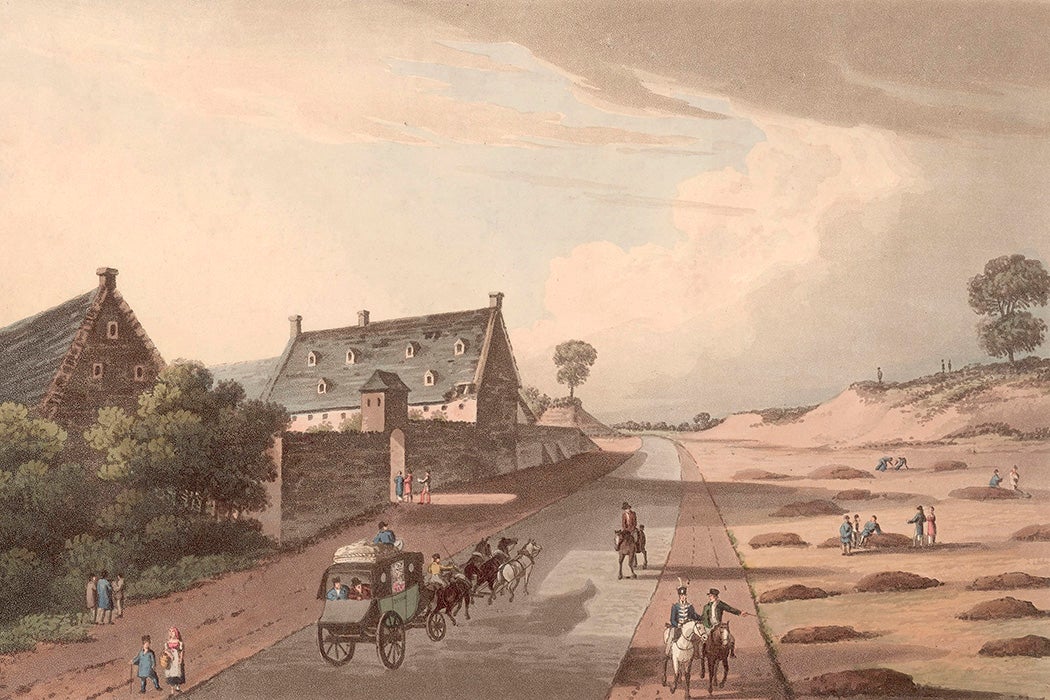
Meanwhile, at Waterloo itself, eager tourists contended with the gory remnants left behind. One early visitor, the novelist Charlotte Anne Eaton, recounted:
On the top of the ridge… we traced a long line of tremendous graves, or rather pits, into which hundreds of dead had been thrown… The effluvia which arose from them, even beneath the open canopy of heaven, was horrible…The fresh-turned clay which covered those pits betrayed how recent had been their formation. From one of them the scanty clods of earth which had covered it had in one place fallen, and the skeleton of a human face was visible.
Even as time went on, subtler markers of death remained: the crops were supposed to grow thicker and darker where the bodies lay beneath the earth.
In “Reading the Tangible Past: British Tourism, Collecting, and Memory after Waterloo,” historian Stuart Semmel explores the lust for ‘authentic’ souvenirs, and what it meant for people to hold a piece of Waterloo in their hands. Gruesome as it was, this close contact with the scene of death seemed to offer a kind of deeper historical authenticity. As Semmel writes,
Personally confronting historical relics and landscapes would, they suggested, provide a higher awareness than could any written text or graphic representation. This belief, we might say, provided the epistemological foundation for tourism and collecting.
Most people took home stray bullets and buttons, but one poet claimed to know “one honest gentleman, who has brought home a real Waterloo thumb, nail and all, which he preserves in a bottle of gin.” Sir Walter Scott, it appeared, made off with the skull of one “poor fellow,” the deceased corporal John Shaw.
This unrelenting demand for souvenirs quickly reshaped the economy around Waterloo. Locals started hawking bullets, buttons, “letters taken from the pockets of the dead.” Scott recounted that a veteran in his party was rather disgusted with how eagerly the rest of the visitors snabbled up these trifles. As historian Jolien Gijbels writes in “Tangible Memories: Waterloo Relics in the Nineteenth Century,” the sellers were canny about how to pitch their wares — marketing ‘French’ skulls to British buyers, and ‘British’ or ‘Prussian’ ones to French customers.
Weekly Newsletter
By the 1830s, there were rumors that factories were churning out “authentic battlefield souvenirs” by the thousands. No other than P.T. Barnum, himself no stranger to chicanery, was taken in:
Several months subsequent to our visit to Waterloo, I was in Birmingham, and there made the acquaintance of a firm who manufactured to order, and sent to Waterloo, barrels of ‘relics’ every year. At Waterloo these ‘relics’ are planted, and in due time dug up, and sold at large prices as precious remembrances of the great battle. Our Waterloo purchases looked rather cheap after this discovery.
In this environment, the untouched authenticity of the battlefield, which struck early visitors with awe, could not last long. One chapel on the battlefield was so frequently scrawled with visitors’ names that it had to be fully whitewashed every 5 years. The Waterloo Elm, under which the Duke of Wellington planned his strategy, survived the battle and became a symbol of enduring hope — but by 1830, it had been chopped down and converted into memorial snuffboxes and toothpick cases.


.jpg)