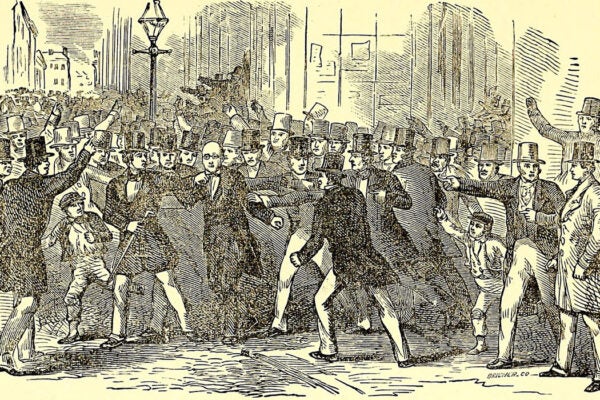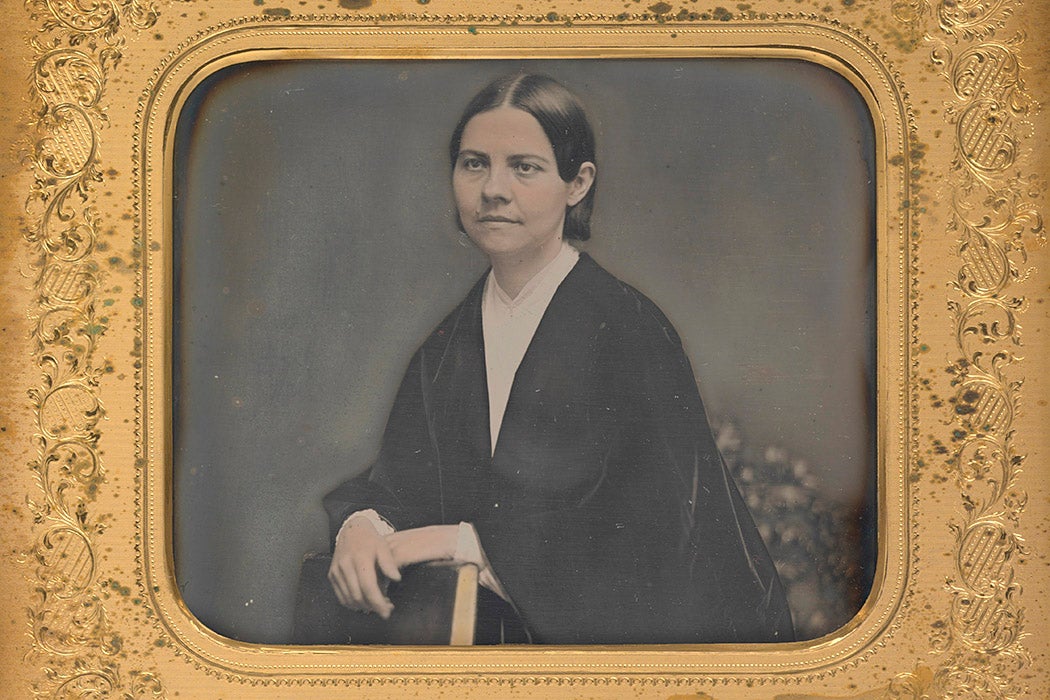
In 1856, when the mighty suffragist Lucy Stone checked into a Dayton, Ohio, hotel under her maiden name instead of that of her new husband, Henry Blackwell, a local newspaper editor, was thunderstruck. “Well, that will do!” he railed in the Dayton Journal. “We don’t offer Lucy Stone her hat, for she has doubtless got one of her own, to match her breeches! Women’s rights, forsooth! Where, we should like to know, are Mr. Blackwell’s rights?”


Stone’s famously radical decision opened the door for generations of American women who wanted to preserve their identity—and rights—in marriage. But according to Luona Lin, a research associate at the Pew Research Center, almost 80 percent of heterosexual brides surveyed in 2023 changed their names, in apparent disagreement with Stone, who decreed: “A wife should no more take her husband’s name than he should hers. My name is my identity and must not be lost.”
Stone’s declaration became the motto of the Lucy Stone League, founded in 1921 to honor Stone and encourage more married women to follow her example. Launched by Chicago Tribune journalist Ruth Hale in response to obstacles women faced using their maiden names (notably in exercising their newly won right to vote), the League didn’t so much urge women to guard their names as inform them that they weren’t legally required to drop them in matrimony. (Astonishingly, some women still don’t know this.)
According to Una Stannard’s Mrs Man, an examination of the history of married names, the group also sued government agencies over women’s right to have their pre-marital names recognized legally. The Lucy Stoners included author Fannie Hurst, playwright Anita Loos, New Yorker co-founder Jane Grant, and members of the Algonquin Round Table.
As of late 2025, pending the SAVE Act’s review in the US Senate, the Lucy Stone League has renewed relevance for Americans: The bill would require eligible voters to present proof of citizenship in order to be able to vote, which women lacking birth certificates or passports are hard pressed to provide, along with those who are immigrants and/or transgender. According to some experts, if the bill passes, millions of women would face disenfranchisement, which is exactly why the League was started over a century ago.
Weekly Newsletter
The League petered out in the following decades, and then reformed in 1951 as married women continued to have trouble getting licenses, property deeds, tax forms, and credit cards using their maiden names. The forces of second wave feminism revived it again in the ’70s, spurring more women not only to retain their names in marriage (or to hyphenate), but also, as Claudia Goldin and Maria Shim write, to use the honorific “Ms.,” which obscures marital status as does “Mr.” (Of course, many married women who found fame in that era, from Louise Glück to Cicely Tyson, kept their maiden names while they had no affiliation with the Lucy Stoners.) In the 1980s, when, for the first time, women made up more than half of the American workforce, the “situational” use of names flourished, write researchers Laurie K. Scheuble and David R. Johnson: women used their birth names at work and married names at home, a practice that continues, confusingly for all, today.
The Lucy Stone League was revived again in the post-backlash 1990s and then dissolved in the new millennium—but not because its work was done: though a handful of men began taking their wives’ names to reverse the imbalance, roughly 80 percent of women were still claiming men’s names. Some argued—and still argue—that keeping one’s name was more symbolic than practical. But it has a sticky history: “coverture,” a legal doctrine in the English common law dating back to the Middle Ages, decreed that married women had no legal identity or independence. A female child was “covered” first by her father and then by her husband, whose name veiled her previous identity. The practice travelled from England to the colonies. One of its first challenges in the US came over seventy years after the Revolutionary War. New York’s Married Women’s Property Act of 1848 was groundbreaking legislation that helped pave the way for women’s voting. Name-changing has never quite shaken its patriarchal roots (even today, some men make it a condition of marriage), especially since it perpetuates the notion that husbands are breadwinners and heads of households.
The adoption of a husband’s surname is especially perplexing for celebrities who’ve built a career on a birth name. Jennifer Lopez changed hers after her 2022 marriage to Ben Affleck (then changed it back after their recent divorce), and Beyoncé hyphenated after marrying Jay-Z in 2008. (She also named her 2013 tour the “Mrs. Carter Show World Tour.”) Social and political pressure has compelled some public figures to change their names long after their wedding day. In the 1980s, for example, Hillary Rodham became Mrs. Bill Clinton during her husband’s 1982 gubernatorial campaign, then Hillary Rodham Clinton when he ran for president, assuaging the very fears the editor of the Dayton Journal expressed about Stone in 1856: she wasn’t properly maternal, domestic, committed, or feminine. She was, in nineteenth-century parlance, “unsexed.”
Clinton’s decision to use a “double-barrel” name was a throwback to first wave feminism, when activists from Mary Church Terrell to Elizabeth Cady Stanton parked their maiden names between their given and married names. Elizabeth Cady Stanton (née Cady) promoted the practice, writing in a November 1880 issue of the Illinois newspaper The Inter Ocean that “I conjure every woman to write her full name, and if married retain her maiden name, using the husband’s simply as an affix for convenience as a family name.”
The practice endures today for couples who want a shared family name without losing the wife’s name, but the husband’s surname still travels down through the generations, while the wife’s is erased. No one refers to Clinton as Rodham or Stanton as Cady—or their children as either.
We can’t gauge the psychological effect of losing one’s name in marriage but scrapping a name in early or mid-career and building a new one clearly puts women at a professional disadvantage. For one thing, it can wipe out a legacy of achievement. In academia, for example, there’s no way for a female researcher to update papers published under a birth name, so her work disappears from archives and databases after marriage, which can impact job or grant applications. Some women double-barrel specifically to avert this.
As the author of social histories going back to the mid-nineteenth century, I’ve seen firsthand how women vanish from the historical record after surrendering their names in marriage. Genealogy.com com even hosts a page called “89 Places for Finding a Woman’s Maiden Name: A Checklist of Sources,” posted because “[d]iscovering the maiden name of a female is often the biggest problem we have in genealogy.” Similarly, the host of a UK-based family history database, Findmypast.com, addresses what it calls the “Herstory gap”: The site’s 850 million entries contain 39 million fewer women than men. If women simply held onto their names, their lineage (and in many cases their racial and ethnic birthright) could be documented along with their husbands’. The American artist Ruth Asawa, for example, kept hers partly to flag her Japanese heritage. Author Alice Walker did so in honor of her enslaved great- great- great- great-grandmother’s epic walk from Virginia to Georgia with a baby on each hip.
Certainly, people should be free to change their names for whatever reasons they choose, but it’s worth examining the consequences of the choice—especially under the Trump administration’s efforts to roll back women’s rights. The sacrifice of a surname treads unnervingly close to the Dobbs v. Jackson decision rationale that presumes, as the historian Kimberly Hamlin wrote in the Washington Post, that “women’s autonomy should place a distant second to her potential role as a mother.” The “tradwives” trend peddles the same philosophy, expressing not just a romantic indulgence in harmless domesticity, but a retreat, as writer Samhita Mukhopadhyay asserts, from public life in response to “the failures of a neoliberal workplace feminism.”
More to Explore
First Comes Love
Likewise, conservatives are pushing to eliminate no-fault divorce, a means for many women (and some men) to escape abusive marriages without having to prove the abuse—a law that, between 1976 and 1985, reduced domestic violence by about 30 percent, according to economists Betsey Stevenson and Justin Wolfers. The 2024 Texas Republican platform includes a call to rewrite the Texas Family Code to “rescind unilateral no-fault divorce laws” and “support covenant marriage,” which is binding for a lifetime—just like most marriages of the nineteenth century. (Lucy Stone’s own feminist awakening—and longstanding resistance to marriage—was partly inspired by seeing her mother permanently tethered to an abusive alcoholic husband. When Stone finally accepted Blackwell’s marriage proposal, the couple penned a “Protest,” at Blackwell’s suggestion, declaring that the marriage sanctioned neither Stone’s obedience to her husband nor Blackwell’s superiority to his wife.)
Some couples feel a shared family name is an expression of unity and that raising children would be confusing with two family names at play, writes legal scholar Elizabeth F. Emens. Others argue that women are, for the most part, assigned men’s names at birth anyway, so taking another in marriage is no great concession to the patriarchy. But by the time women marry, a whole new identity has accrued around a birth name—so much so for some renegades, like the writer Olive Schreiner and the sculptor Adelaide Johnson, that they persuaded their husbands to take their names. Perhaps the most compelling reason for assuming a new a name comes from women who were abused or neglected by fathers (or families) whose names they’re happy to discard.
Today, in the age of gender fluidity and LGBTQ+ rights, the adoption of men’s names, just like the honorific “Mrs.” (and the creaky term “maiden name”) seems especially dated in its embrace of heteronormative tradition. Though many same sex partners change their names to accord their marriage more social and legal legitimacy, others decline to precisely because of the sexist baggage it carries. (As one hetero refusenik put it: ”He didn`t adopt me, he married me.”)
Some of the most interesting name changes are also among the most unusual. The poet Julia de Burgos doubled down on her “maiden” identity after her first divorce by not only reclaiming her name (Burgos), but adding “de” (“of”) before it to underscore her full autonomy. In Mrs Man, Stannard describes the case of Jennie Jerome; after Jerome’s second divorce, following two name changes, she reverted to her first married name, Lady Randolph Churchill, keeping it even after her third marriage because since then, as she told a friend, “I have made a name for myself.”
Once tradition shifted in the late nineteenth century, married names fueled a spicy gender war: When New York Tribune founder Horace Greeley was to deliver a report at the 1867-1868 New York Constitutional Convention opposing women’s suffrage, Elizabeth Cady Stanton arranged for a pro-suffrage petition to be read beforehand. The petition opened with a list of supporters, topped by the name of Greeley’s suffragist wife, Mary Cheney Greeley—identified as “Mrs. Horace Greeley,” which provoked laughter from the gallery and left him fuming. When he confronted Stanton at the reception asking why she’d done it, she answered, “I wanted all the world to know that it was the wife of Horace Greeley who protested against her husband’s report.” As Stannard reports, Greeley promptly ordered his newspaper to thereafter call Stanton by a name she loathed: “Mrs. Henry Stanton.”
Writer Rebecca Traister has noted that changing a name in marriage at this point in history is simply not necessary—“in fact, it is a bizarre and anachronistic thing,” she says, with no material purpose. Even some women who are primary breadwinners inexplicably do it, often by default. Some feel that not doing so is a political act they’ll have to defend and explain later—something men are never asked to do after making the same choice.
But for many women, myself included, the decision isn’t a decision—or even a matter of discussion. When I was married in 1992, keeping my name had little to do with family, finances, or feminism. A September 1972 Glamour magazine reader explained why in a roundtable on the topic. “What’s in a name?” she asked.
“Me.”