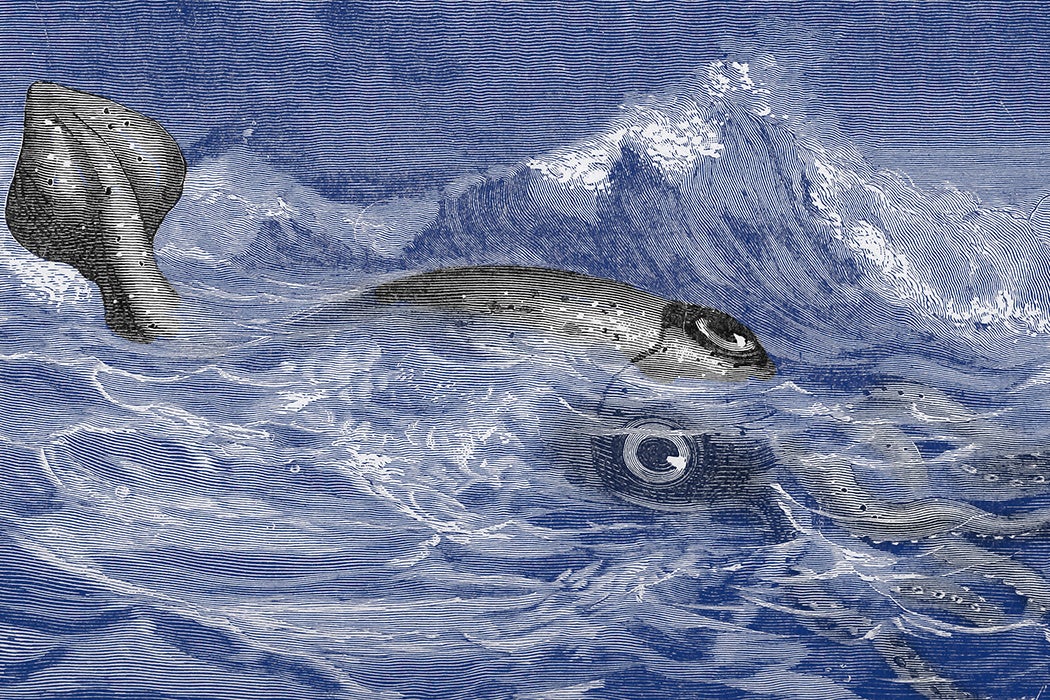
For more than half a century, the story of a giant squid attack on the survivors of a sunken troop ship during World War II has made the rounds. It sounded plausible because Architeuthis dux, to give the squid its formal name, was shrouded in mystery and fantasy.


Historian Jonathan Dyer picks apart the story as an urban legend. This much seems factual: Second Lieutenant R.E.G. Cox of the Indian Army survived the sinking of the troop ship Britannia in March 1941. He and others clung to a raft for five days before being rescued. One of the men was lost at sea after an attack by a sea creature of some kind. There’s the rub. Nineteen years after the incident,
Cox claimed that during his time in the water, a giant squid took one man off the raft, and then attacked him. Luckily, the squid released its grip on Cox… Cox would later point to scars he had, as well as two contemporary newspaper articles, as proof of the encounter.
Actually, as Dyer shows, those near-contemporary newspaper articles were anything but definitive proof.
In the News Chronicle, published seven months after the rescue, Cox said the raft was initially attacked by a stinging octopus, and that the lost man, severed by a shark, was finished off by a manta ray. Under a picture of the young lieutenant is the quote “I was seized by an octopus…” Neither Cox nor the reporter seemed to know that 1) octopuses (and squid) don’t have stingers, and 2) manta rays are filter-feeders, not man-eaters. Dyer notes that Cox may well have been confused by the mental and physical trauma of the sinking and the deprivations of five days adrift.
A month later, in November 1941, the Illustrated London News detailed the incident for its readers. Here, a Portuguese man-of-war was responsible for Cox’s wounds. Cox said the attack stung like a “million bees.” With their long stinging tentacles, these big siphonophores do seem like the most likely suspects.
More to Explore
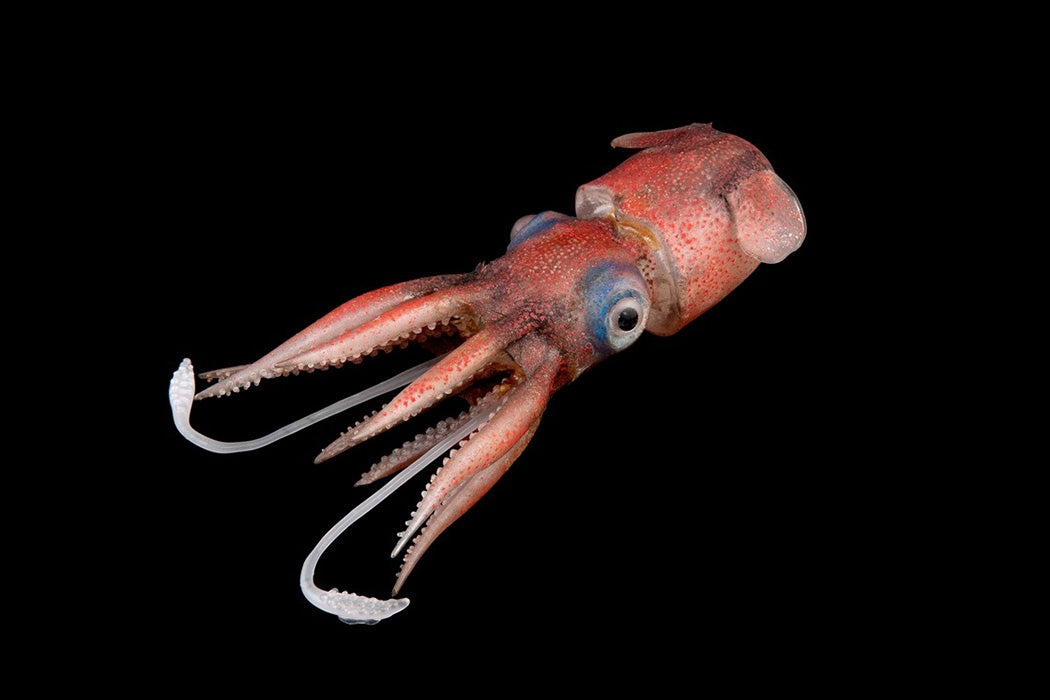
The Delicate Science-Art of the Blaschka Invertebrate Collection
A second eye-witness account published in 1960 said the survivors had “several visits by Portuguese admirals,” another name for man-of-wars, which stung them during the night. A third source detailed a conversation with Cox in the Spanish hospital where they were recovering after the rescue; according to him, Cox detailed his perilous encounter with a “jellyfish.”
Neither the original two journalistic accounts nor the two other eyewitness accounts mention any giant squids. The squid in the narrative doesn’t show up until 1960, when popular science writer Frank W. Lane’s Kingdom of the Octopus tells a new version of Cox’s experience as a case study of the dangers of cephalopods. How did the jellyfish turn into a squid? Dyer suggests Cox may have been convinced by a biologist friend that his wounds were the result of a squid attack.
Dyer also notes that one of the illustrations accompanying the original Illustrated London News article showed a “devil fish,” another name for a manta ray, approaching the raft. Arthur C. Clarke’s Mysterious World (1980) episode “Monsters of the Deep” used this image for its version of the Cox story with the ray “surreptitiously cut out.”
Cox died in 1971, nine years before Mysterious World told his big squid story. In the episode, Cox’s story is related by a third party, none other than his biologist friend. As Dyer notes, the essence of an urban legend is that it’s always told at a remove; this happened to a friend of mine… In this case, the third party might have been the person who convinced Cox his attacker was a giant squid.
Weekly Newsletter
Whatever made Cox change his story, the new version had feet, if eight arms and two tentacles. Bernard Heuvelmans, “widely believed to be the father of cryptozoology,” the pseudoscientific study of “hidden animals,” took up Cox’s later version as confirmation of his belief that giant squids attacked humans. Peter Benchley’s novel Beast (1991), about a giant squid threatening Bermuda (we’re gonna need a bigger island!), uses Cox’s squid story for historical context. Meanwhile, Cox’s revised story was being retold in nonfiction books at least into the first decade of the twenty-first century. The story even made it to children’s books about sea creatures.
Dyer concludes by stating that giant squids don’t feed at the surface, where they’re found only if sick or dying of suffocation. He cautions that you can’t rule out every alleged giant squid attack, however unlikely, as a libel against squids without further investigation, but considers this particular oft-repeated story to be definitively legendary.