“And the raven, never flitting, still is sitting, still is sitting/ On the pallid bust of Pallas just above my chamber door.”


Like its titular character, Edgar Allan Poe’s poem The Raven has lurked in the minds of readers since 1845. Just as the poem’s narrator ponders over the meaning of “nevermore,” readers might be puzzled by the poem’s meaning. If you listen to Poe, however, the poem’s purpose was simple: to create a creeping melancholy when reading its rhythmic rhymes.
In an essay titled “The Philosophy of Composition,” Poe explained his writing process. It contradicted all romantic wisdom surrounding poetry. He wanted to evoke an emotion, he wrote, and created a formula to evoke it. Whether or not you take him seriously, argues historian John Tresch, the essay hints at a deep relationship between Poe and nineteenth-century technology.
Poe’s world was one of rapid technological change. Steam engines powered factories and trains, while Charles Babbage’s Difference Engine mechanized calculation. Journalism was not far behind—the steam press and new copying techniques powered the rise of magazines.
Tresch quotes Poe’s reflection that “The whole tendency of the age is Magazine-ward…We now demand the light artillery of the intellect; we need the curt, the condensed, the pointed, the readily diffused.” He described himself as a “magazinist,” and worked as a writer, editor, and typesetter.
To many poets at the time, writing could be natural or mechanical, literary or scientific. Poe broke down those distinctions. “Poe’s work took the machine as its subject,” Tresch argues, to “exploit unsettled anxieties about human progress and mechanization.”
More to Explore
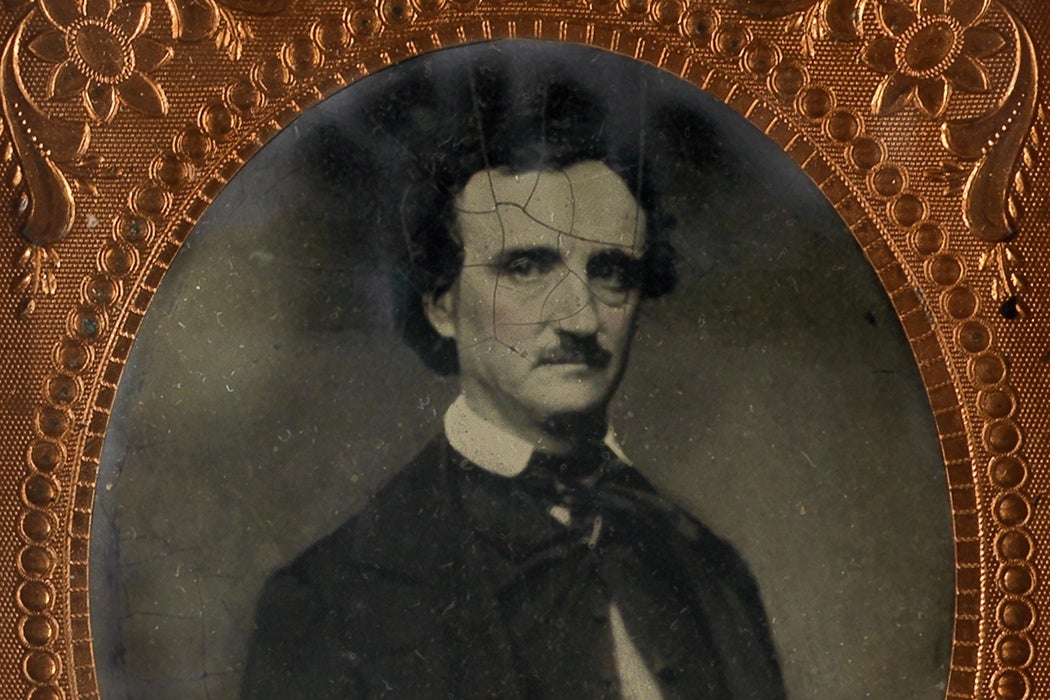
Edgar Allan Poe and the Power of a Portrait
In the story “X-ing a Paragrab,” a typesetter’s mechanical work takes center stage. Poe took interest in cryptography, soliciting codes to decipher from his readers. He satirized the formulaic construction of articles in Blackwood’s Magazine. But Poe had a tendency to undercut his own satire with more satire, Tresch explains, in a sort of “recurrent logical architecture.”
Poe dabbled in scientific writing and science fiction, sometimes blurring the lines between the two. Inspired by the Sun’s Moon hoax, Poe crafted his own hoax about a balloon flight from Europe to America. He also debunked the “mechanical Turk,” a chess-playing automaton controlled by a hidden operator, contrasting it with Babbage’s machines—though he believed that, if the chess player were real, it would have been more impressive. In this comparison, Tresch writes, Poe uses “rhetorical sleight-of-hand” to place “the infallible mechanical reasoner” above any artificial creation.
Weekly Newsletter
Poe wrote that “accident or intuition” played no role in The Raven’s composition, and instead “the work proceeded…with the precision and rigid consequence of a mathematical problem.” The significance of “nevermore”? Long o and r sounds were useful for a melancholy refrain.
Some poets read satire into his essay, while critics thought Poe was simply a hack. Tresch believes the truth went beyond either interpretation. “By focusing on the production of effects,” he writes, “Poe’s works demonstrate, enact and redirect the machine’s capacity to incite terror and wonder.”