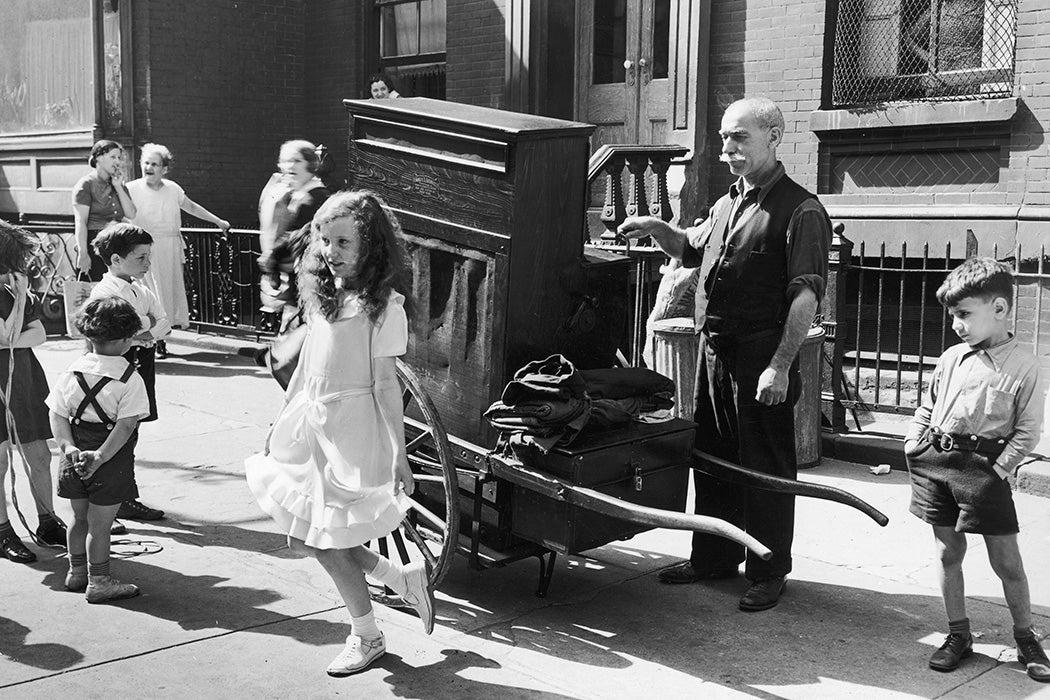
Whether that guy playing the guitar on a crowded city sidewalk is a welcome form of entertainment or an annoyance is surely a matter of taste. But, as historian Robert Hawkins writes, in 1930s New York, it also raised questions like what an efficient, productive city should look like and what constitutes legitimate work.


Hawkins writes that Mayor Fiorello LaGuardia, who took office in 1934, sought to modernize the city, clearing streets for commerce and reducing noise. Pushcart peddlers were moved to designated market areas. Honking from the growing number of cars on the streets led to an antinoise campaign. (It used the slogan “A noiseless auto is as pleasant as a speechless mother-in-law,” though the city also put part of the blame on pedestrians for getting in the way of auto traffic.)
The antinoise effort was inextricable from the question of productivity. LaGuardia told the public that the city government would distinguish between “necessary” noise—industrial machinery and the clamor of garbage and milk trucks, for example—and unnecessary noise such as dance hall music, blaring radios, and loud conversations among night workers.
At the same time, Hawkins writes, another form of rationalization in this Depression era was transforming relief for people without jobs, replacing disorderly street begging with a government benefits system designed to support the “deserving” poor while pushing laggards into productive work.
Street musicians stood at the intersection of all these issues. Not only did they produce sound, but they encouraged “unproductive” gathering of people on the sidewalks. And they blurred the line between work and begging.
“The confusion simultaneously cast doubt upon the effectiveness of relief and, by evidencing unmanaged poverty and informal labor, compromised the city’s facade of social modernization as well,” Hawkins writes.
More to Explore
Who Lived in Greenwich Village before the Bohemians?
LaGuardia argued that the musicians blocked traffic, encouraged children to walk into the streets, and were no longer necessary given the availability of radio, records, and free public concerts provided by legitimate New Deal musicians. And so, in 1935, the city quietly stopped licensing street musicians, turning legitimate performers into vagrants.
Many New York residents wrote to the mayor in protest. Some argued that it was preferable for musicians to perform for audiences who could choose to willingly pay them rather than accept government relief. As one letter to the mayor put it, “Hurdy-gurdy players are not beggars.… they work and are paid for it by the donations of an enjoying public.”
Weekly Newsletter
Another writer argued that buskers represented “the one musical note in the whole clang of NY City.” And yet another identified the entire noise-abatement process as an elite, effeminate project, telling the mayor, “I had hoped you were a man and not a sissy.”
Hawkins writes that the conflict was not only a fight over New York’s street culture but also “dramatized the tension between the creation of a social safety net via New Deal relief policies and the value many citizens continued to place on economic individualism.”