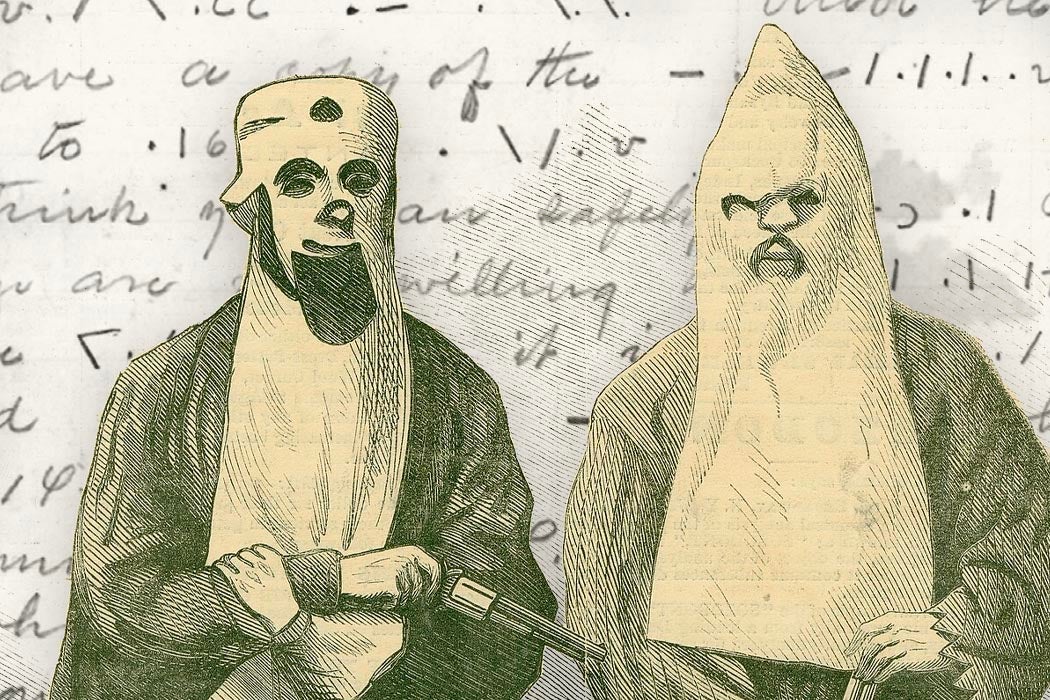
Looking at the years after the Civil War, many scholars have viewed the first iteration of the Ku Klux Klan as a collection of local groups of angry white men that popped up to wage racial violence with little coordination. But historian Bradley D. Proctor argues that a ciphered letter from one wealthy southern man to his brother paints a different picture.


The KKK began in Pulaski, Tennessee, where, in 1866, a group of young men from prominent white families formed a fraternal organization with goofy costumes, rituals, and titles. As the Republican Party gained power in the state, threatening the reemergence of white rule after the Civil War, the group began terrorizing Republicans and Black citizens generally.
But how did the Klan spread across the South? Was it simply local groups of white supremacists taking inspiration from media reports about the violence in Tennessee?
The letter Proctor investigates—one of a very limited number of documents from the Reconstruction-era KKK—comes from the collection of Iredell Jones, the son of a politically active family of South Carolina enslavers who served in the Confederate Army and then in the KKK. Dated October 23, 1868, it consists almost entirely of dots and dashes, with a few scattered English phrases.
Proctor went looking for a key to the cipher and eventually found it—not in anything from Jones or his fellow South Carolina Klansmen but in a document from Pulaski, Tennessee. A man named R. J. Brunson, who said he joined the Klan soon after its foundation, left behind a handwritten document called “Cypher Code Used by the Klan in Secret Correspondence.”
The key worked, and Proctor discovered that the letter was written by Jones’s brother, Johnston Jones, who lived in Hillsboro, North Carolina. The message was a request to send the Klan “constitution” to a former Confederate lieutenant colonel so that he could organize a local den of the Klan.
More to Explore
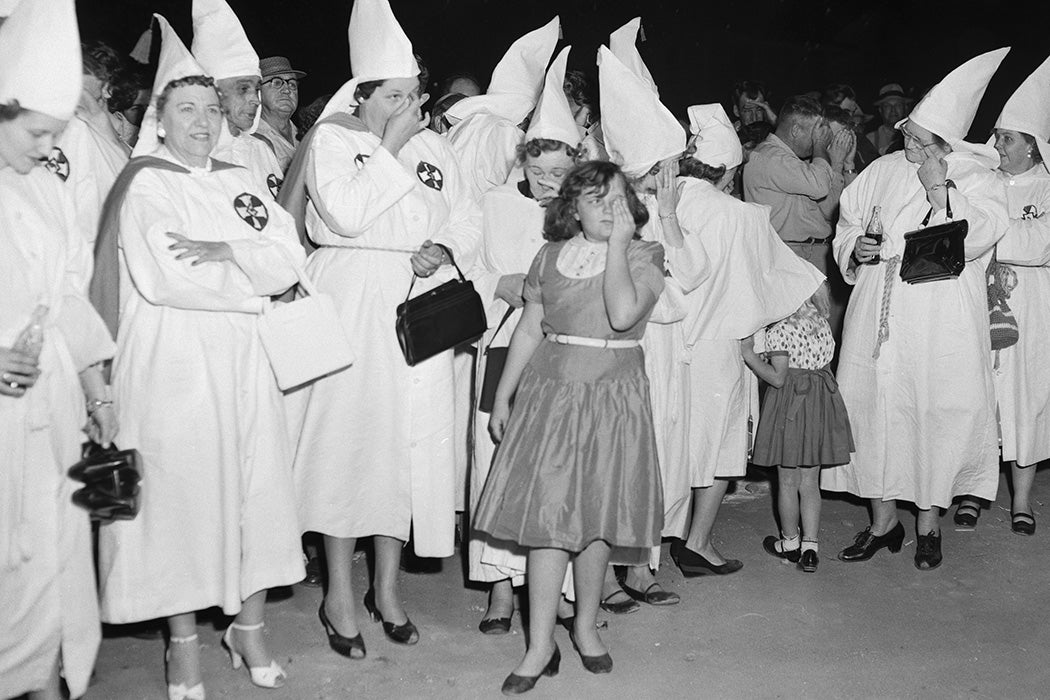
A Brief History of the Women’s KKK
Proctor writes that this suggests several things about the KKK: Elites like the Joneses had a secret network to help seed dens in different parts of the Carolinas; these dens were united by a shared constitution; and the network included the original Klan in Tennessee, at least to the extent that they used its encryption method.
Proctor argues that it’s important not to overstate the unified nature of the KKK. The ciphered letter and other evidence suggest a structure much like some modern terrorist organizations, in which the heads of local cells are responsible to a hierarchical leadership structure even while mostly operating independently.
Weekly Newsletter
One purpose of that KKK hierarchy, Proctor writes, was to channel white violence into the suppression of Black votes and other goals of the moneyed southern elite.
“Elite Klansmen, like the Joneses, were particularly worried about how nonelite white southerners might use violence to settle private scores or establish claims to control of southern society,” he writes.
The answer they found was violence that wasn’t just racist but also organized for a particular political project.
Support JSTOR Daily! Join our membership program on Patreon today.