What happens when ideologies are destroyed? When beliefs that shaped generations dissolve overnight? In the wreckage of old traditions, new symbols are created, and meaning is projected onto what was previously trivial. But not all of these new symbols are coherent or easily legible. Some are outright weird. Few events in history demonstrate the absurdity of political symbolism as clearly as the Mao Mango Mania that swept China during the infancy of the Cultural Revolution.


In 1966, Mao Zedong, Chairman of the Communist Party and China’s supreme leader, set in motion the Great Proletarian Cultural Revolution, a campaign to realign China with his revolutionary vision. His goal was to transform society, both economically and ideologically, by purging everything deemed traditional or capitalist. Over the next ten years, the Cultural Revolution changed the country in profound and painful ways, leading to more than a million estimated deaths as well as to immense human suffering.
Historian Lü Xiuyuan describes the period between 1966 and 1968 as the most destructive years of the entire movement. Following Mao’s directive to destroy the “Four Olds” (ideas, cultures, customs, and habits), his paramilitary youth groups, the Red Guards, swept the country with violence. They identified, tortured, and killed so-called “counterrevolutionaries,” raided temples and schools, and destroyed priceless artifacts. In 1968, university campuses, middle schools, and other public spaces became the sites of bloody battles, not only between Red Guards and alleged counterrevolutionaries but also between revolutionary factions. The chaos of the “Red Terror” couldn’t continue indefinitely, so Mao determined that Chinese workers would help suppress the Red Guard, restore order, and continue the revolution in a more measured manner. In this endeavor, Mao was helped, improbably, by a box of yellow-fleshed fruit.
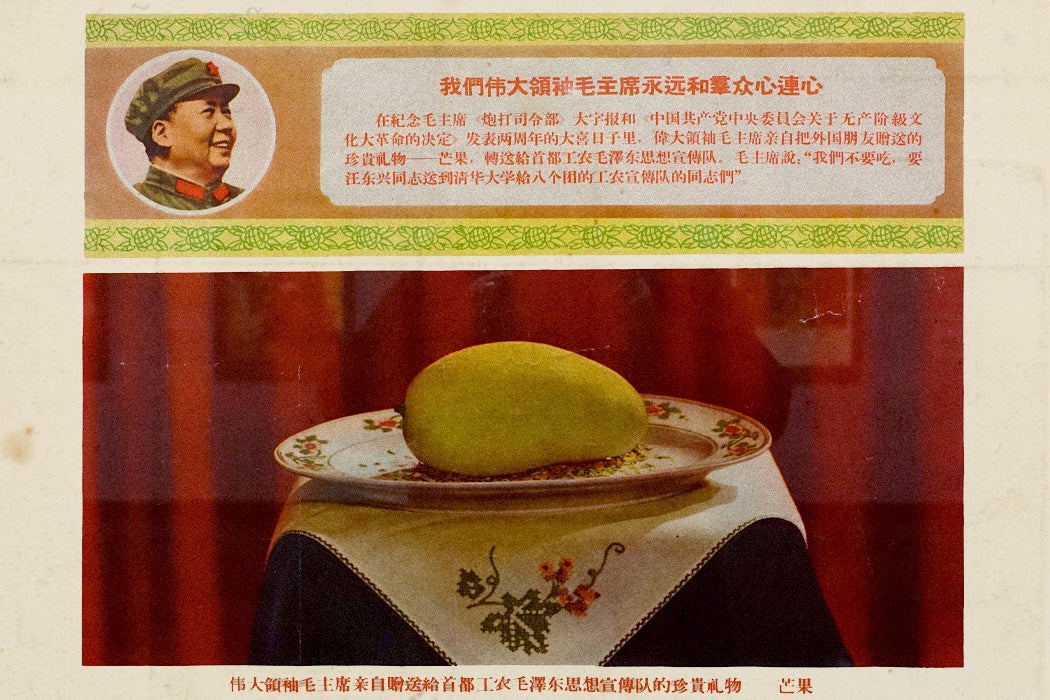
In August 1968, a visiting foreign minister from Pakistan, Mian Arshad Hussain, gave Mao a box of mangoes as a gift during a state visit. Presenting mangoes has a long tradition in Pakistan, but in China, the fruit was virtually unknown. Mao passed the box to workers occupying the Tsinghua campus in Beijing, who were attempting to control the Red Guards stationed there. The scholar of Chinese visual culture Alfreda Murck writes that the mangoes carried an implicit message: from now on, the workers, not the Red Guards, would be in charge of education and the transformation of China in Mao’s image.
According to Murck, even Mao could not have anticipated the consequences of his gift. Because the mangoes came from the supreme leader, they were transformed, in the eyes of the workers, from a simple fruit into an object endowed with attributes of the divine. William H. Hinton, the author of Fanshen, compiled eyewitness accounts of workers who reported staying up all night, touching the mangoes, and marveling at their new station as protégés of the Chairman. Using the momentum, the official party cadres concocted a propaganda campaign surrounding the mangoes, workers, and Mao, and in doing so, according to the political scientist Richard Baum, effectively signed “the death warrant of the Red Guards.”
Weekly Newsletter
Quickly, the Red Guards were disbanded, many of them sent for reeducation in the countryside where they labored and lived alongside rural peasants. By contrast, the workers who received Mao’s mangoes, a sign of his favor, were energized and became Cultural Revolution leaders. Yet, their promotion was an illusion. True power lay with the People’s Liberation Army. Despite, or because of that, the workers—and the mangoes—played a significant role in official propaganda in the months to come.
When the workers returned to their factories after putting down the Red Guards, Mao had a fresh mango delivered to them. Workers held welcoming ceremonies for the fruit, preserved it in wax, placed it on altars, and bowed to it when walking by. In one factory, the fruit was boiled down into sacred mango water; each devotee drank a spoonful. From there on, the cult of the mango escalated. Wax and even plastic mangoes were quickly produced in Chinese factories and appeared all over the country, often displayed in glass cases. Images of the mango adorned plates, wedding gifts, and cigarette packages. It was stitched onto blankets, and propaganda teams armed with wax replicas were sent into the remotest corners of the country to spread its lore. More than seventy different types of mango badges to stitch onto clothes were given away for free or sold at a low price to those who couldn’t afford more expensive mango-themed items. Alongside the mangoes were mentions of Mao’s selflessness and love for the people (though no reference to the fate of the Red Guards), and many badges bore the slogan “With each mango profound kindness.” As Murck notes, for several weeks, the state-run paper People’s Daily published mango-themed poems such as:
Seeing that golden mango
Was as if seeing the great leader Chairman Mao!
Standing before that golden mango
Was just like standing beside Chairman Mao
During the 1968 National Day parade in Beijing, the mango was front and center. At least three mango-themed floats participated in the parade, decorated with slogans that emphasized the significance of the working class, as well as a colossal white statue of Mao. The parade reinforced the importance of Mao as the supreme leader and the mango as a symbol of his power.
According to development studies scholar Xing Li, Mao viewed ideology as the primary means of mobilizing the masses and driving change, putting special emphasis on themes such as dedication, self-sacrifice, and hard work. The mango was a perfect vessel for Mao’s “love” for the workers. Unlike already established symbols such as the peony, peach, or pomegranate, the mango had no preexisting meaning in China and, importantly, no association with emperors or divinity. Quickly, rumors spread that mango trees only blossom every century—or every thousand years, according to others—and that eating the fruit would bring about a long life, similar to the peaches of immortality that feature prominently in Chinese legends. Mao’s refusal to keep the mangoes for himself was therefore seen as a great sacrifice on behalf of his people.
The veneration of the mango coincided with a high point in Mao’s personality cult. In the 1960s, one billion copies of the “Little Red Book,” a collection of Mao’s quotes, were printed. The book had to be waved and quoted at the beginning of each workday and whenever someone made a political statement. Mao was everywhere. And so were his mangoes. They became inextricably linked, and criticism of one meant criticism of the other. Murck tells of a dentist in Sichuan province, for example, who, after seeing a mango paraded through his town, said that the fruit resembled a sweet potato. He was arrested, tried as a counterrevolutionary, marched through the streets, and executed. His children were sent to the countryside for reeducation. Given the serious consequences of even the slightest criticism, it’s impossible to say how many people genuinely participated in the mango cult and how many complied out of fear.
More to Explore
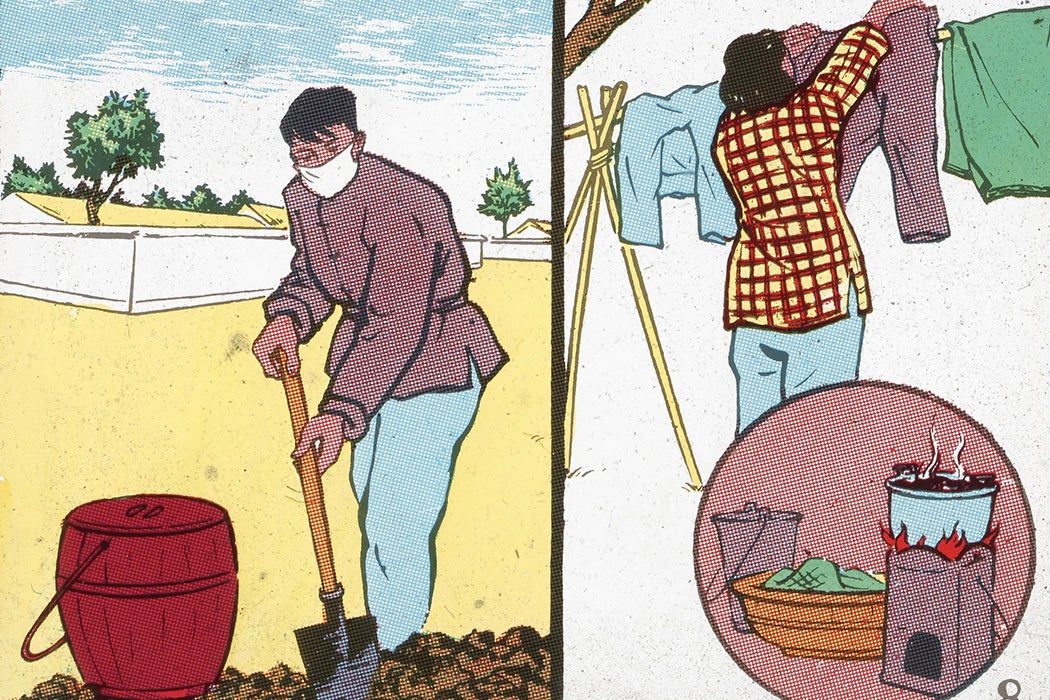
These Posters from Mao’s China Taught Public Health Awareness
Political movements need symbols to foster cohesion and emotional connection, but for these to thrive and remain, they must have at least some internal logic, cultural coherence, or tradition. The mango was an artificial symbol, created randomly, and the people’s devotion to the fruit must have been at least partially performative. By 1969, the mango cult had already begun to decline; it was no longer featured in official campaigns, although the sheer volume of mango-themed products ensured that it didn’t disappear entirely until the mid-1970s. After Mao’s death in 1976 and the 1980s reassessment of his personality cult, it became acceptable to discard mango ephemera that some Chinese still kept in their homes, or more prudently, to repurpose the wax mangoes as candles. Because the mango was so closely linked to Mao, it couldn’t remain a meaningful symbol without him.
Still, the mango as a political symbol never entirely faded. US-based Chinese author Ha Jin, who served in the Chinese army at the time of the Cultural Revolution and has been an outspoken critic of the Chinese government, wrote in his 2019 poem “A Sacred Mango:”
The mango was exhibited in the center of the hall.
We lined up to look at it
and to show our gratitude and respect.But that night some curious child tasted the fruit
and was not caught.
Our mayor, frightened and outraged, said,
“Damn it, if I knew which son of a rabbit bit the mango
I would turn his whole family
into counter-revolutionaries!”But what could we do?
We substituted a wooden mango for a real one.
For Ha Jin, as for others, the mango remains not a sign of Mao’s power, but a reminder of the Cultural Revolution’s absurdity and the arbitrary labeling of counterrevolutionaries. Despite being a short-lived propaganda tool, the mango’s symbolism endures as a testament to the irrationality of Mao’s extreme personality cult.
Commercial production of the mango in China began around that time, but only really accelerated in the 1980s. Although some people still recall the mango cult and spoke about it in their interviews with Murck, today the meaning of this particular fruit is largely forgotten, and the mango, far from symbolizing Mao’s eternal love and sacrifice for the working class, has transformed once again. This time, into a refreshing summer treat.