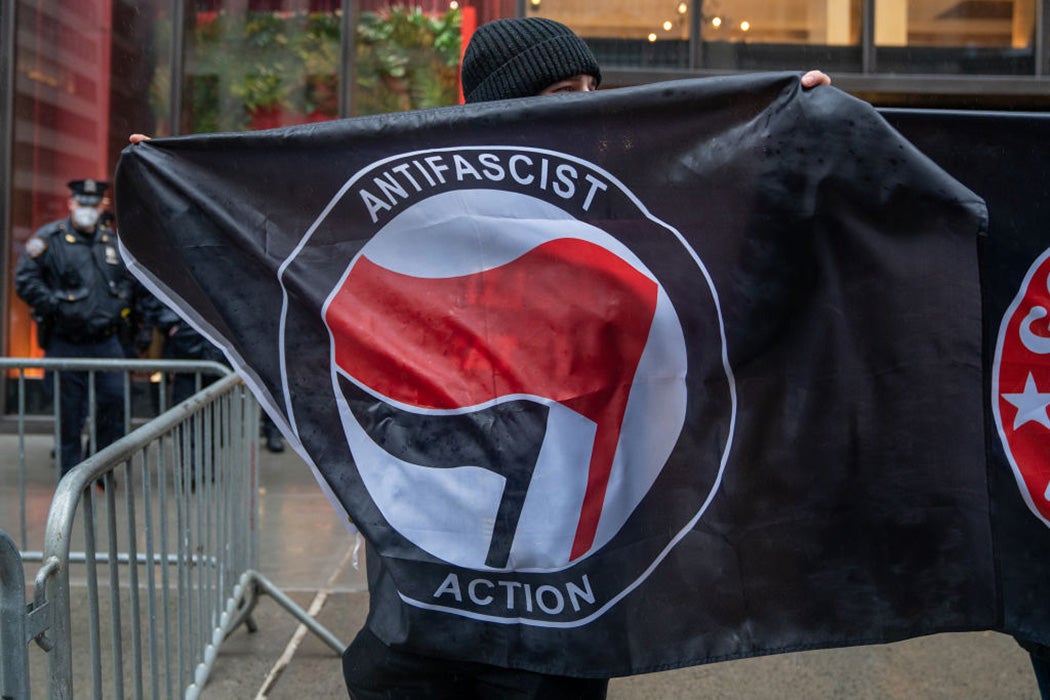
During its first year, the second Trump administration has frequently described a range of opposing forces as “Antifa,” which it has characterized as a domestic terrorist group. But as historian Nigel Copsey and sociologist Samuel Merrill explored during the first Trump administration, Antifa groups are not only small, locally organized, and unconnected to the Democratic Party or mainstream nonprofit groups, but also generally resistant to the use of violence except as a limited, defensive tactic.


Copsey and Merrill note that the term “antifa,” short for anti-fascist, comes from the 1930s German Antifaschistische Aktion. But, unlike that Communist Party-sponsored organization, Antifa groups in the U.S. today are autonomous, ad hoc groups that exist for the narrow purpose of confronting white supremacists and other fascists.
Copsey and Merrill focus particularly on Rose City Antifa (RCA), one of the more high-profile local groups. They note that its members are typically between 25 and 35 years old, mostly white, and split fairly evenly by gender, with LGBTQ+ people well represented. Becoming an RCA member is a six-month process designed to ensure that members share values and are willing and able to work together.
While RCA and other Antifa groups are often connected with larger webs of activists engaged in different kinds of action, they themselves are essentially a defensive force rather than one focused on winning elections, fomenting revolution, or any other forward-looking goals. Their tactics often involve putting their “bodies on the line” to stop fascists from promoting their ideology, rather than relying on political or legal action.
More to Explore
Laughing With the Fascists
The common Antifa slogan “by any means necessary” explicitly declines to reject violence as a possible method. And some members carry guns and provide firearms training, often arguing that there is a valid role for weapons in community self-defense, especially for people of color.
However, Copsey and Merrill find that, in practice, RCA and similar groups tend to view violence as a poor choice. They define fascist—a notoriously difficult concept to pin down—as innately involving the use of violence and threats of violence, from street attacks on people of color to genocide. In contrast, Antifa members attempt to stick to tactics that harmonize with their anti-authoritarian and humanist values.
Weekly Newsletter
They also worry that the use of offensive violence would play into “false equivalency” depictions by media and politicians, invite state repression, and attract activists who are fascinated by violence, particularly chauvinistic men. When one local Antifa group was seen as focusing excessively on guns and a militaristic aesthetic in 2017, the movement as a whole ostracized it.
RCA and other Antifa groups sometimes rhetorically celebrate punching Nazis, but in practice they’re more likely to expose the identities of right-wing extremists online in an effort to get them fired or otherwise socially shunned.
“The collective identity of Antifa as an anarchist and left-libertarian radical social movement is clearly setting boundaries when it comes to escalating violence,” Copsey and Merrill conclude.