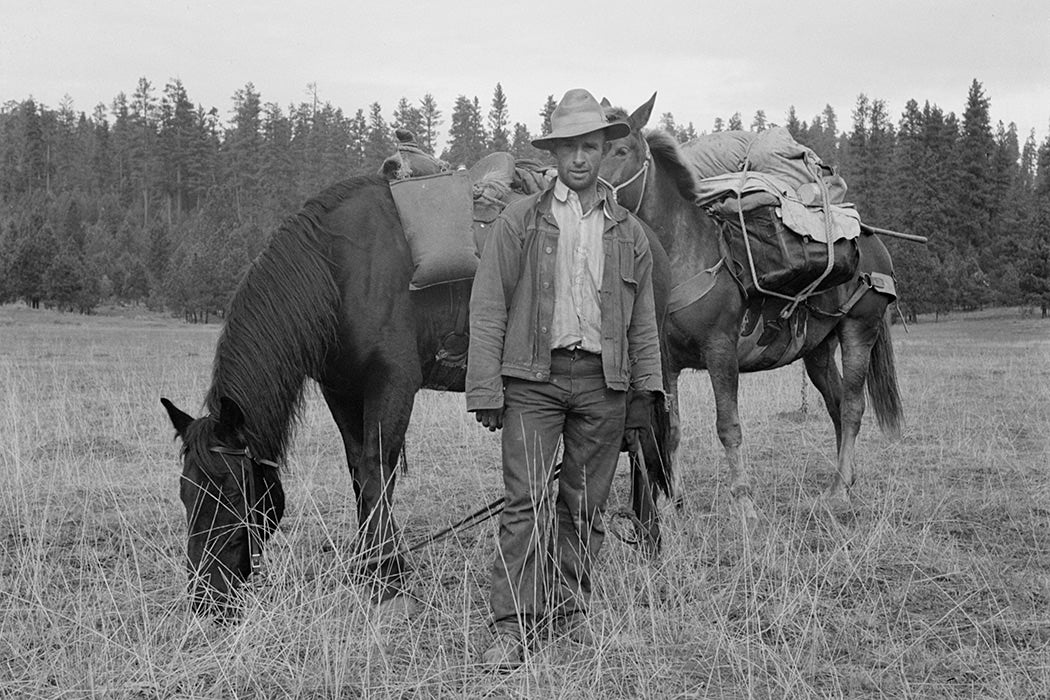
Basque sheepherders are outsized figures of the American West. Romanticized as lonely masters of the range, these supposedly intuitive shepherds were mythologized with a “Basqueness” that was “ancient, mysterious, and above all, Indigenous,” in the words of historian Mariel Aquino.


Aquino explores how the Western wool industry’s “preference for Basque herders arose not from Basques’ particular expertise but from narratives of their ancient origins and racial distinctiveness.” She notes that both non-Basques and Basques perpetuated these narratives of the “Indians of Europe” who became the “new Natives of the West.”
In the Western Pyrenees, Basque Country is made up of four provinces in Spain and three in France. It is roughly the size of New Jersey. The Basques are a distinct ethnic group with a language unrelated to most other European languages. Basque nationalism arose in the late nineteenth century, giving a distinct flavor to Basque identity: racially, these nationalists called themselves the first or indigenous people of Europe.
When Basques started coming to America in the second half of the nineteenth century, they were thought of as Spanish or French, albeit with a “strange dialect.” If they spoke Spanish they were treated as such (poorly). By the 1930s, they had been transformed: now they were thought of as the most ancient Europeans, “ur-sheepherders” who did things the same way their ancestors had done millennia ago. They were understood as being utterly distinct from “Latin” people. They had become the “pure aborigines of Europe,” if not the oldest race in the world, with sheepherding in their blood.
This “cultural assumption” had serious effects: in essence, they were accorded a much closer relationship to Whiteness than other southern Europeans.
While the Spanish were severely restricted by quotas in the 1920s, exceptions were made for Basques. Through the 1940s, there were a series of Congressional Sheepherder’s Laws that gave individual Basques permission to stay in the U.S. The 1952 Omnibus Immigration Bill made them “skilled workers” bypassing quotas on the Spanish and the French. (Basque migration dwindled in the 1980s when conditions in Spain “reached a point that economic immigration was no longer attractive.”)
The Basque/sheepherding connection in the West was so strong that second-generation Basque Americans would be surprised by how few sheep they came across in Basque Country itself. In fact, plenty of Basques who came to America had never seen sheep before.
More to Explore
It’s doubtful that any had experience in the kind of open-range herding practiced in the West—unless they had started sheepherding in the Argentine Pampas, like brothers Pedro and Bernardo Altube. The Altubes came north for the California Gold Rush. They didn’t strike gold, but they did build an empire of sheep, calling back to Basque Country for workers who they paid in livestock after two- or three-year contracts, thus seeding more kinship-network associations with sheepherding.
The notion that Basque sheepherding was “atavistic” or even genetic was of course a fantasy, a piece of the racialization of Basque labor in America. This racialization wasn’t nearly as harsh or restrictive as that forced on agricultural/labor migrants of color like Mexicans, South Asians, or Chinese. Some Basques even rose to become large-scale woolgrowers, “to the point that a significant proportion of the membership of the mid-century Range Associations were Basques or Basque-descended.”
Basque Whiteness was a distinct benefit: Aquino argues this case “helps us better understand how Whiteness could be established explicitly through narrative constructions.”
Weekly Newsletter
“Both Basque and non-Basque Americans were profoundly affected by narratives of ancient Basqueness. For non-Basque Americans, these narratives created an exotic worker that offered no racial threat; for Basque Americans, they represented a way to belong to the American landscape without having to become racialized others.”
In Europe, this constructed ancient history “was mobilized to argue for political sovereignty; in the United States, it freed Basques from stereotypes of laziness, temper, and passion and enabled them to invoke the romance of Indigeneity.”
This idea of Basque Indigeneity saw Basque and non-Basque Americans alike making connections “between their own Indigeneity and that of Indigenous Americans.” The western landscape was said to be just like the Pyrenees, as if the Basques had migrated from one homeland to another. What Aquino calls “a new romance of Native people in the American West” was crafted; “this time, however, the Natives were White.”