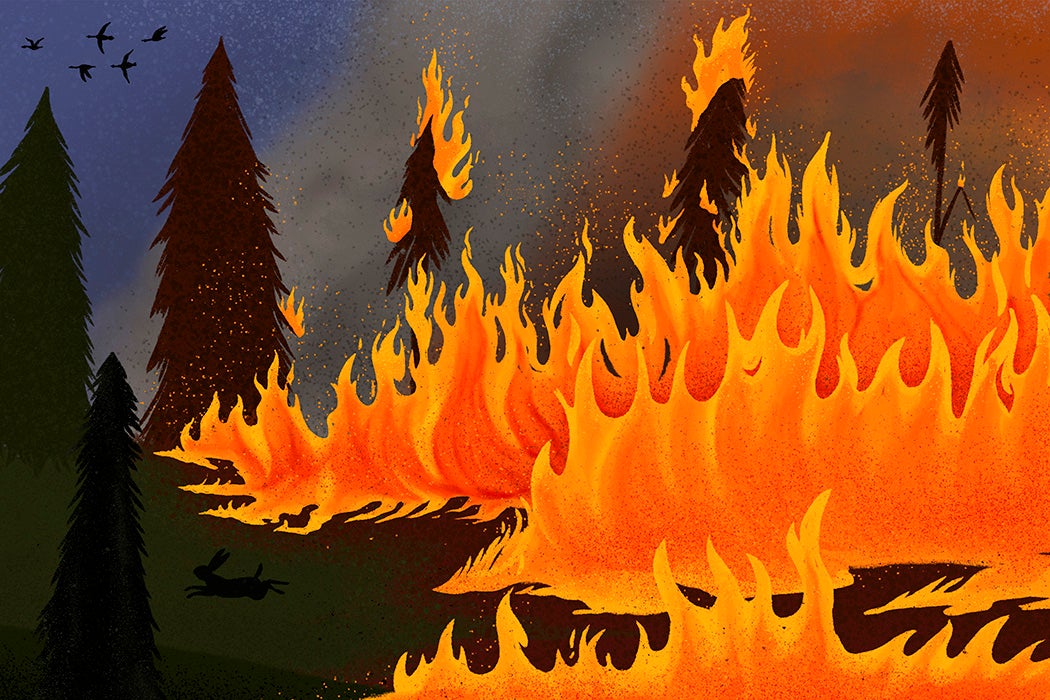
In recent years, wildfires have made headlines for devastating much of the western United States and Canada. Looking for ways to better understand this decimation, scientists have turned to an earlier period known as the Medieval Climate Anomaly, when parts of North America saw notable increases in temperature and wildfires.


Definition Dilemma
The identification of the Medieval Climate Anomaly depends on a revised understanding of a longstanding theory about a climatic pattern. In 2003, Raymond S. Bradley, Malcolm K. Hughes, and Henry F. Diaz credited climatologist Hubert Lamb for introducing the concept of a Medieval Warm Epoch in 1965 in reference to “evidence for warm, dry summers and mild winters centered around 1100 to 1200 AD” in Western Europe. Yet, despite his observations about Europe, Lamb didn’t extrapolate the patterns he observed and apply them elsewhere in the world, nor did he try to see if his observations about the High Middle Ages (eleventh through fourteenth centuries) were relevant to the early Middle Ages (the fifth through tenth centuries).
Today, scientists more commonly use Medieval Climate Anomaly (MCA), coined by Scott Stine, to refer to the period between approximately 950 to 1250. Current theories about the warming period acknowledge that some areas across the world may have experienced climatic variations during these centuries, but historians disagree on the exact range of time the MCA covers.
To get a clearer understanding, I spoke with Raymond S. Bradley, Director of the Climate System Research Center at the University of Massachusetts Amherst. Bradley explains that scholars still use the label and theory rather loosely.
Weekly Newsletter
“Often people will have a study of lake sediments or tree rings or speleothems [mineral deposits formed in caves], whatever it is, that they will label ‘Medieval Climate Anomaly,’” he says, “even though it might be a completely different time period from the original definition of the term….They call it the Medieval Climate Anomaly, but it’s not the same period, and it varies from different parts of the world.”
In the Intergovernmental Panel on Climate Change (IPCC)’s 2001 report, scientists note, “Medieval warmth appears, in large part, to have been restricted to areas in and neighboring the North Atlantic.” Despite this murkiness in terminology, scientists generally agree that an identifiable shift in climate patterns with a marked temperature increase occurred in Western Europe and North America in the Middle Ages.
Causes and Correlations of the MCA
What might have caused these climate shifts? There are two major phenomena connected to the MCA: the North Atlantic Oscillation (NAO) and a lack of volcanic eruptions. The former concerns atmospheric pressure differentials between the low pressure North Atlantic and the higher pressure subtropical Atlantic. Strong positive phases of the NAO—when the pressure difference is high—tend to be associated with increased temperatures and precipitation in much of the United States and northern Europe, according to the National Oceanic and Atmospheric Administration (NOAA). But this warmth “appears to be associated with prevailing La Niña-like conditions,” according to a research team led by professor of dendrochronology Valérie Trouet. Their study, along with others, suggest such a weather pattern resulted in increased drought conditions in the western United States during the Middle Ages.
As for volcanoes, a proliferation of eruptions can lead to colder weather. During the MCA, the fact of fewer eruptions might have contributed to warmer oceans and thus a warmer planet. It was, Bradley says, “a quiet period geologically.” In a 2025 interview, Nicholas Graham of the Hydrologic Research Center told me that once large eruptions began to occur more frequently in the thirteenth century, they “really initiated the step down into the Little Ice Age or, you could say, it terminated the Medieval Warm Period.” The Little Ice Age (LIA), taking place from the fourteenth through nineteenth centuries, saw a pattern of cooling temperatures.
More to Explore
The Climate Canvasses of the Little Ice Age
So, the attributable causes of medieval climate change differ from those behind modern, anthropogenic climate. Before the industrialized era, Bradley explains, though there were occasional warm intervals across the world, “when you average it all out across the globe, you don’t really see the same compelling warm interval that you see today, where everywhere the entire planet is warmer.” The causes of climate change in the twenty-first century—increased overall concentrations of CO2—are unrelated to the causes of regional temperature during the medieval period.
Wild, Wild Wildfires
Though the causes of rising temperatures across the planet may be different than during the MCA, at least one of the effects is the same: an increase in wildfires. However, the number of wildfires in the MCA was lower than it is now. Examining boreal forests in Alaska, Ryan Kelly and fellow scholars noted in a 2013 study, “warm and dry climatic conditions resulted in peak biomass burning” during the MCA. Yet, there are more fires today than there were during the MCA, as the modern era “is characterized by exceptionally high fire frequency and biomass burning.”
Counting fires of the MCA is a daunting task, but using historical bio-evidence, scientists can make a good estimation. For instance, Philip Higuera, Bryan N. Shuman, and Kyra D. Wolf use tree-ring and lake sediment records to study how often Rocky Mountain subalpine forests burned in the early MCA. Between 770 and 870 (slightly before the period Stine designates as the MCA), Northern Hemisphere temperatures were about 0.3 °C higher than the twentieth-century average. Analyzing “a unique network of paleofire records spanning the past 2,000 [years],” the team shows that that temperature increase correlates with an increase in wildfires.
Higuera and colleagues also compared the rate of burning between the years 2000 and 2020 to the rate from 770 to 870 by examining fire rotation periods (FRPs), which record how long it takes a past fire to burn an area the same size as the area burned in the twenty-first century. The lower the FRP, the faster an area burns, so higher FRPs are desirable for areas prone to wildfire. Higuera et al. show that periods prior to the late twentieth and early twenty-first centuries had higher FRPs.
FRPs begin to dip—and fires to burn more rapidly—in the twenty-first century. The period between 2000 to 2020 had a median FRP of 117, which the scientists note “represents nearly a doubling of the average rate of burning” over the past two millennia. This FRP is even lower than that from the century between 770 and 870 (about 150), indicating modern wildfires are happening more rapidly now than in the MCA.
MCA, Wildfires, and Temperatures
But what role does rising temperatures play in all this? In a 2015 study, W. John Calder and fellow researchers observe a positive correlation between temperature and the median percentage of sites burned. They examined sediment found in lakes located near wildfires that burned during the MCA. When wildfires rage within one to three kilometers of a lake, the sediment reaches a peak in charcoal accumulation, “preserv[ing] a signal of the fire.” By obtaining examples of multiple instances of charcoal accumulation, the team can better understand any “regional changes in biomass burned.”
Calder et al. collected sediment cores from a subalpine forest area in and around the Mount Zirkel Wilderness in Colorado. Here, vegetation has remained relatively consistent across two millennia. This helped the team to control for additional variables that could otherwise skew their results. Examining sediment records from nearby lakes, they found that the percentage of sites burned per century and the amount of charcoal in lakes rose during the early MCA. They estimate a median of 83 percent of the sites examined burned between approximately 885 to 985 CE. In that same period, temperatures increased by up to 32.9°F.
Eventually, though temperatures remained elevated for another 250 years, the number of wildfires decreased, but the study’s authors are not clear on why. The team notes that the areas they studied burned more in the MCA than they have today, implying this yet could change, since “temperatures have only been comparable to the MCA for the past few decades.”
Temperatures Then vs. Now
Late twentieth-century and MCA temperatures are comparable. Mann et al. note in a 2008 study that high temperatures from around 960 correspond roughly to temperatures around 1980. But what does that look like? According to the IPCC’s 2007 report, the period with hottest temperatures prior to the twentieth century probably lasted from 950 and 1110 CE. During that hot span, the IPCC estimated the temperatures weren’t as high as they are now; those temperatures were about 32.18°F and 32.36°F lower than the mean temperatures achieved between 1961 to 1990.
Using government data of average temperatures in the twentieth century, I have calculated that average temperature during the MCA would have been about 51.94° F. As a result, I postulated that MCA peak temperatures could have been between 19.58 and 19.76° lower than modern ones. As Malcolm Hughes notes in an e-mail interview, in fact “temperature conditions for the Great Basin, and much of the rest of the US West, in the MCA were notably cooler than in the 20th century, let alone the 21st century.” While the MCA’s peak temperatures may have been a bit comparable to modern ones, its average temperatures, then, would have been significantly lower than modern temperatures.
In the MCA, increased temperatures meant an increase in devastating fires, so it stands to reason the same problem will take place with elevated temperatures across the globe today. From that we can learn that areas not previously predisposed to wildfires may start to experience this kind of devastation. NASA notes that, that in areas varied as Colorado and East Africa, wildfire season now stretches beyond the summer well into the fall. In 2015, the organization found that “fire weather seasons have lengthened across one quarter of Earth’s vegetated surface.” An examination of the MCA suggests we can predict that this trend will continue, and it’s possible—and even likely—that the crisis of a wildfire may turn from a geographically isolated catastrophe to a prevailing problem for much of the world.