In February 1961, it was revealed that the Congolese independence leader Patrice Lumumba, the first Prime Minister of the new Democratic Republic of the Congo, had been executed the month before. Rebel Congolese allied with Belgium, rulers of the Congo from 1885–1960, and the American CIA had conspired to kill one of the shining stars of the newly liberated African continent. The operation proceeded under instructions from President Eisenhower.


Postcolonial African, Asian, and other “nonaligned nations” made up a strong contingent in the UN General Assembly, but not in the all-important Security Council. In battling rebels during the “Congo Crisis,” Lumumba had been denied help from the Security Council, so had turned to the Soviet Union. This thickened the situation, overlaying decolonization, the battle to control Congo’s uranium resources, and Cold War antagonisms. The USSR was then making much of supporting liberation movements in what was becoming called the “Third World.”
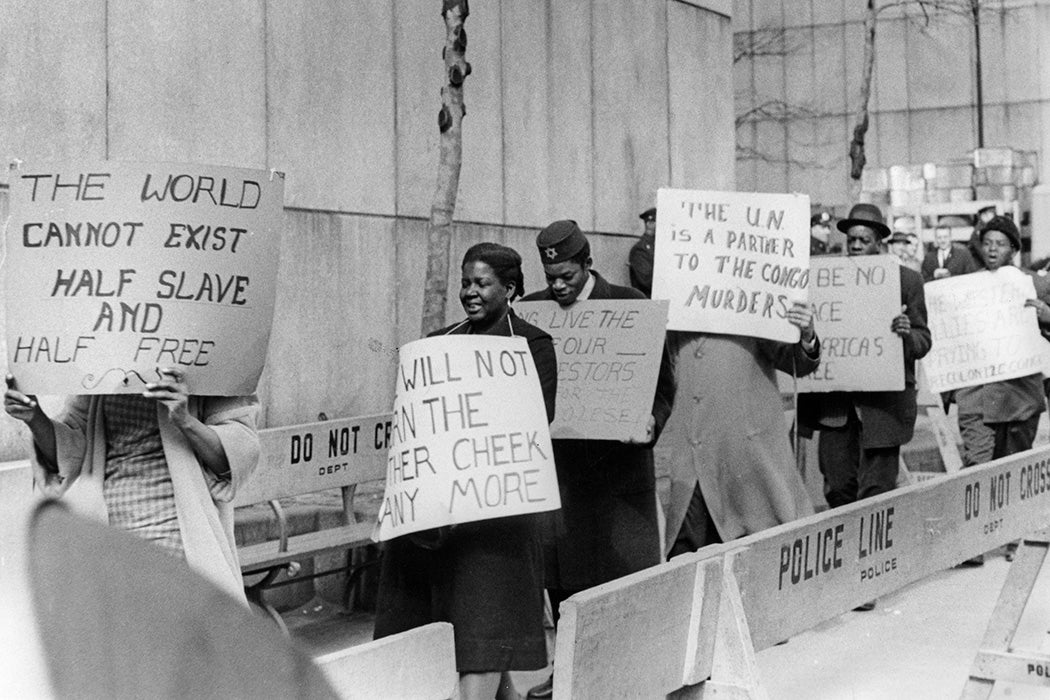
On February 15, as America’s brand new UN Ambassador, Adlai E. Stevenson, began to defend the Security Council’s questionable handling of the “Congo Crisis,” between 50–60 Black Americans dressed in black in honor of Lumumba stood in the gallery in silent protest. It didn’t stay silent for long.
“A fight (‘riot’) ensued as security personnel attempted to suppress the protesters, setting off ‘the most violent demonstration in UN history,’” writes scholar Njoroge Njoroge. The protest “represented a significant shift in Black activism from passive nonviolence to a more aggressive militancy, an ideological shift that demonstrated the increasing internationalization of the black liberation movement.”
“Lumumba became Emmett Till” said a commentator at the time, quoted by Njoroge. African Americans fighting for full citizenship in the United States and Africans fighting for independence on the continent were increasingly connecting their struggles across a global diaspora. The violent response of white power helped sharpen those connections—and, in turn, gave them a soundtrack.
Among the UN demonstrators were poet Maya Angelou, writer LeRoi Jones (later Amiri Baraka), singer Abbey Lincoln, and drummer Max Roach. What Njoroge calls a new configuration of “activists, artist and musicians” had begun to broaden the “political front of the black liberation movement.”
More to Explore
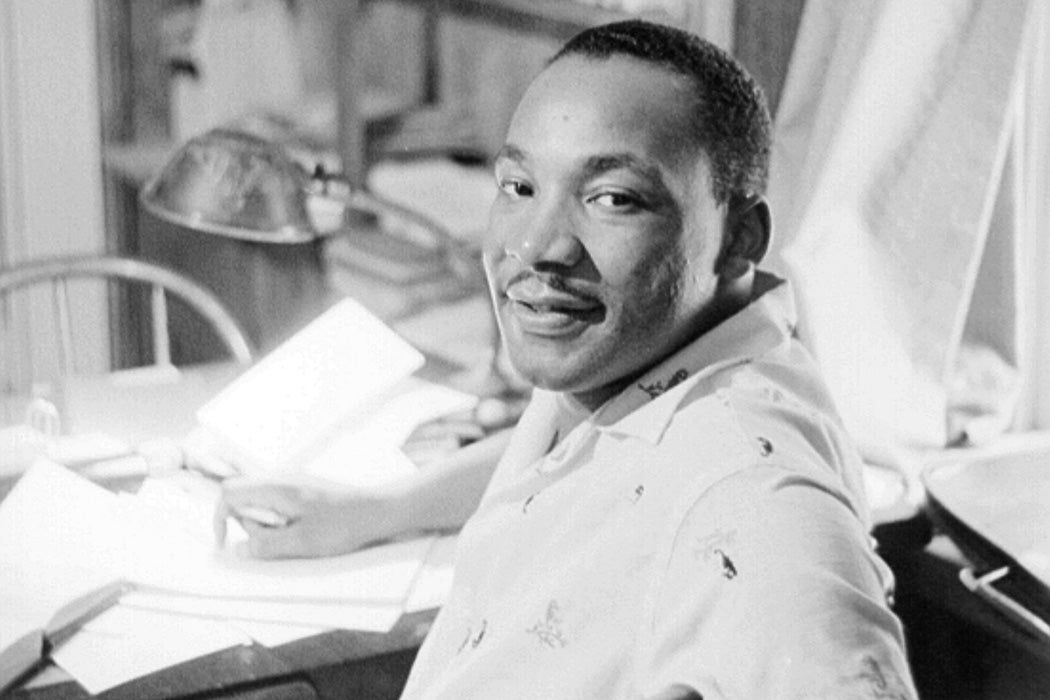
Why MLK Believed Jazz Was the Perfect Soundtrack for Civil Rights
Njoroge gives greater context to Black musicians like Lincoln, Roach, Dizzy Gillespie, Miles Davis, Randy Weston, and others who “strove to realize the artistic potential and creative possibilities that were emerging in tandem with anti-colonial efforts and the civil rights movement. The desire for freedom in the political context of decolonization paralleled searches for spiritual and aesthetic freedom in music.”
The pan-African political movement was paralleled by a pan-African musical moment. Njoroge cites Gillespie’s album Afro (1954); Davis’ 1954 recording of “Walkin’”; Weston’s big band album Uhuru Africa (1960); and the Roach/Oscar Brown Jr./Lincoln collaboration We Insist! Freedom Now Suite (1960), among other seminal works, as examples. These were created amidst the ferment of the Civil Rights struggle: sit-ins across North Carolina, the Sharpeville Massacre in apartheid South Africa, the admission of seventeen new African states to the UN in 1960, and intensifying musical exchanges across the African diaspora.
Weekly Newsletter
“Black musical dialogue in the era of decolonization engaged Africa, the diaspora, and the Third World in a polyrhythmic and multivocal discourse. […] The fact that this moment of the movement proved evanescent politically invalidates neither the experience of its possibilities nor the consciousness necessary to attempt it.”
The UN protest over Lumumba’s murder notably makes up the finale of 2024’s Soundtrack to a Coup d’Etat. Belgian documentarian Johan Grimonprez’s film follows both Lumumba’s short-lived career and concurrent “goodwill” tours by Black musicians serving as US cultural ambassadors in Africa. Some, like Nina Simone, were unknowingly funded by the CIA. Representing the best of America on the Cold War cultural front, figures such as Simone, Gillespie, and Louis Armstrong embodied a stark paradox. They were from a nation in which they remained second-class citizens, even as that nation’s leaders determined that figures like Lumumba threatened the American way of life—defined, in part, by access to uranium for nuclear weapons.