As part of our Perspectives on Public Space series, Sara Ivry speaks with Joshua Citarella, an artist, internet culture writer, and host of Doomscroll, a video podcast exploring online culture and politics in the 21st century. Links to some of the research mentioned in the conversation can be found at the bottom of the page.
Transcript
Sara Ivry: Hi, everybody, I’m Sara Ivry, the features editor at JSTOR Daily. At this point, I’d bet that lots of people I know, if not every single person I know, has an email address. Email addresses are like keys. You need one to get in somewhere: to government websites, to sign up for healthcare, or to eBay, to bid on some rare baseball card, and you definitely need one to be part of what seems like an ever-growing number of social media spaces: Facebook, Bluesky, Snapchat, and so on. Though these social media spaces may be enormous—in fact, the number of Facebook users is now estimated to be upwards of 3 billion people worldwide—they are not public spaces. Public space, in an ideal form, has no barrier to entry. Everyone’s welcome. And that raises the question of what public space is in digital terms.
That’s what we’re talking about with Joshua Citarella in this installment of the JSTOR Daily podcast series on public space. Joshua is an artist and writer and the host of a podcast called Doomscroll. He’s done a lot of thinking and publishing on digital public space and what it could be. Joshua, welcome.
Joshua Citarella: Hi, Sarah. Thanks for having me.
Ivry: Now a lot of people would say that given how many millions of people are on social media that it does constitute public space. What do you say to that?
Citarella: I mean one definition does not follow from the other. You can have, I mean, a lot of people interact with private commodities, entities every single day. I think that we have a very impoverished definition of what public means today. And I would attribute that, you know, I guess to really start the ball rolling here, we have lived through, people of our age at least, have lived through forty years of neoliberal policy in which there has been, I would say, an intentional conflation of what private and public actually means.
Ivry: Well, how do you define it when you talk about public space and specifically public space in the digital realm?
Citarella: I think there’s a myriad of proposals of what public digital space means. I think mostly what we’ve seen in the last few years are proposals that more so land in the realm of cooperative ownership. This was a much debated and explored topic in a lot of the Web3 conversations where you, myself, a dozen other people, we could all be part owners in a platform, and if you could extend that to everybody, you would have something that was fully owned by all of its participants.
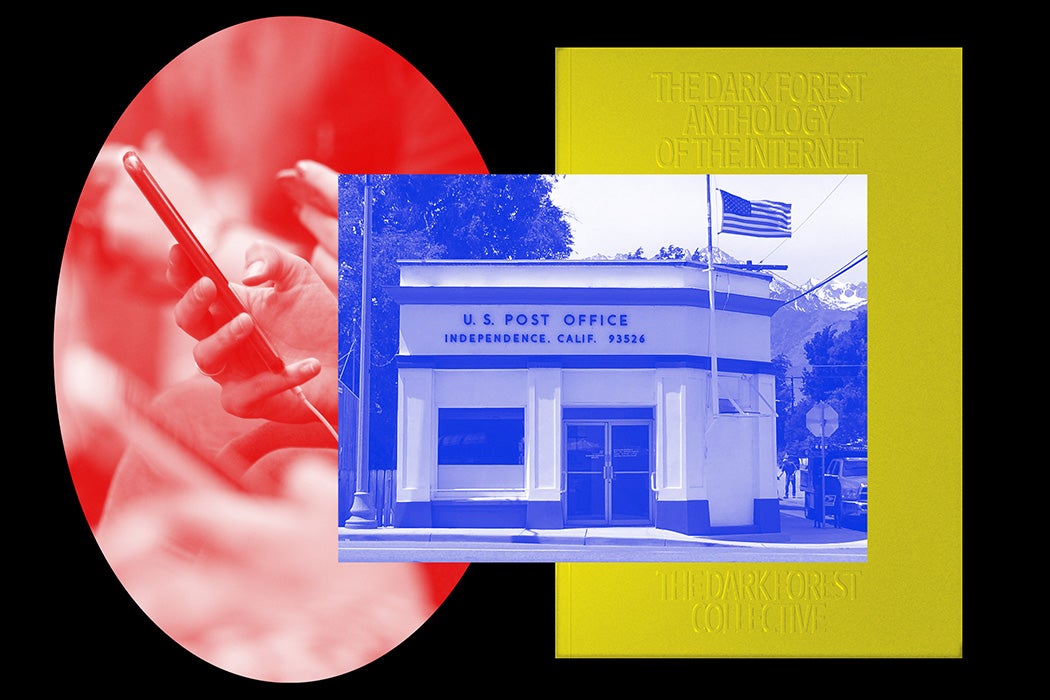
And some of those ideas, I think, were very much compelling. But for me, I think the premier example of a public institution is the post office. It’s not something that can be sold. There’s ways to interact with it in terms of various user fees. Every single person in the society transacts, or interacts, with this entity in some way. And that to me, I think, is a much more kind of robust definition of what public means. It’s not just that you’re welcomed into the space, I would say that you are conscripted into the space, that your involvement with those institutions is mandatory in some way.
Weekly Newsletter
Ivry: The digital spaces where people congregate now, like Facebook, like Twitter or X, are huge. People are there all the time, they spend all day there, what have you, they’re run by corporations or private entities. What are the threats that exist there to, kind of, public engagement and communal engagement just by virtue of the fact of how they’re set up?
Citarella: It’s, I mean, this has been a roller coaster of a ride that we’ve all been on for just about the last decade. I’m old enough now to remember that during the time of, let’s say, Occupy Wall Street and the Arab Spring around 2011, this was right before the mass adoption curve of Facebook and similar platforms in 2012, where there’s just a J-curve of adoption, and next thing you know, everybody is on there, your mom, dad, aunt, uncle, and so on. The narrative around these platforms was immensely, immensely different, that they were going to be a liberatory force, they were going to give everyone a voice, you know, democracy was sure to follow, this would overthrow corrupt dictatorships, and so on and so forth. And I feel like now, within a little over a decade, the narrative around how these platforms operate is completely different. It’s a full 180, in that the platform itself is corroding democracy in some way and we have, you know, the epidemic of fake news and conspiracies, and there’s an unmistakable media narrative flip around these topics.
I would say that for right now, the immediate pressure that these privately owned platforms place upon the functioning of our political institutions is the threat to democratic consensus because there is no shared media in which people have a perception of what they’re even discussing in terms of the state, the important issues, things that are just factually incorrect versions of reality that don’t map to each other. So, democratic consensus, I think, is the most clear and recognizable threat.
But there are other things that are equally important, but I think less discussed, which are the ability to implement regulatory controls. Famously, when Facebook was growing in that very aggressive adoption curve around 2012, Mark Zuckerberg had a phrase that was “move fast and break things.” It just so turns out that some of the things that they broke were the regulatory practices and the legal parameters around which basically every economy, every sector of the economy now functions. In, you know, in plain cases, many of these platform economies just lobbied the government to change the rules after they broke them. They rewrote the laws in many cases. So, regulatory control is much easier to accomplish if the state is in charge of these institutions, perhaps. So, yeah, I think there is a kind of difficult relationship between the private sector where, you know, whenever these things are privately owned, they do have strong overpowering incentives to break the law in some cases and to skirt regulation.
And then I think the last thing I would mention here, which is maybe a more sticky topic that we could get into a bit later, but there are significant questions about user privacy, how to protect things like medical information, how to protect people’s preferences, identities, and so on, but then also what this data can and can’t be used for, how to compose society, how to do large forms of investment and planning, and, yeah, a kind of long horizon of what individual data sovereignty might mean and when that is desirable or not.
So yeah, those are my kind of three main points for my proposal of public platforms as digital institutions, which is democratic consensus, user privacy, and regulatory control. I would say those are the three most significant.
Ivry: Back in 2023, you wrote an essay, a speculative essay called “A Public Option for Social Media.” And in this hypothetical public option for social media, it would be state run, and it would be called StateBook. Can you tell us a little bit about this idea of StateBook? What would it be? How would it work? And why are you laughing?
Citarella: That’s, I mean, it’s a, it feels a little bit silly but like most things on the internet in the last few years, it starts as a joke and then you realize, actually, it could be quite important. StateBook was a kind of hyperbolic meme or an exaggeration that myself and a few friends in reading groups, probably back around 2011, came up with, which was, just as a thought experiment, you know, Facebook is very new at this time: What if the United States government decided to, overnight, nationalize Facebook and make it a digital division of the post office. What would that look like? How would that fundamentally transform the platform of Facebook and then the institution of the post office?
And so that kind of spurred this long form investigation of just really trying to articulate what the difference between private and public solutions are and the unique things that become available once you are no longer constrained by the parameters of the private sector. There’s a lot of things in society for which markets just fail to function, they fail to allocate resources or to accomplish what you need them to do. And so those are the spaces in which the public sector really needs to step in.
And so, in 2023, this was a kind of joke that was entertained by myself and a few other scholars, academics, or what have you. But maybe as an exercise, it would be useful to kind of play the whole thing out and to come up with a policy prescription and get really granular down to the cost of digital stamps and just how exactly you would build this thing and then all the functions that it would perform. So, StateBook was, yeah, my attempt to kind of, in as serious and silly way as possible, to explain how that public institution would work.
I would say that the most heightened example at which a lot of people started to ask these questions many, many years later, was the COVID-19 pandemic, in which unemployment benefits were rolled out at an unprecedented scale and to interact with these state services to claim resources that, in a legal sense, already belonged to you. You own these resources, and you’re interacting with a website in which to claim them, but they are, in a meaningful sense, already yours as per the law. You had to have a private email address somewhere. So that means, if we just think about how this is practically functioning in a kind of value creation sense, that for you to interact with the government to get stuff that you already own, you need to produce advertising revenue for Google. If you have a Gmail address, they are scraping your data, they’re learning more about you, they’re selling that to advertisers. And that is a necessary part of the interaction of you going to your government to get something that’s already yours.
That seemed like a really odd thing to have to deal with. And so, you know, if we had—roll back the clock way back when—if you had nationalized Facebook, if you had some form of a public alternative, what a real public platform would look like, I would make every state benefit claimable through a verified address at your_name@usps.gov. And yeah, if you got your unemployment benefits, if you filed your taxes, if you registered to vote, all through this single portal or platform that was run as a public institution, I think that would go a long way to solve some of the perverse incentives that we’ve set up in the last few years requiring people to interact with some of these private platforms.
More to Explore
The Post Office and Privacy
Now, I think the important thing to mention for StateBook is that, as is the case with a lot of these platforms, the social component is what encourages people to get onboarded, because they want to obviously connect with their family and friends, which is why we all join social media. But that is not the end goal of it. Where the end goal of something like Facebook is to get everybody on there to create a platform in which social interaction is trackable, can be surveilled, and then to generate new advertising insights from mining all those small social interactions, StateBook is offering the bare bones of a social media component as the attractive onboarding service to get you into a portal in which you can interact with all of these other state services, which will then be behind this kind of closed, walled garden, that if you’re trying to file your taxes through an H&R Block—not to single them out or any of these Turbo Tax type of people, maybe H&R Block should be singled out because they lobbied the IRS to not implement this feature—but it is a fairly simple technical task to be able to pre-fill out your tax filings once a year. And all of those things should be behind the walled garden of a public platform. And yeah, same thing as you go to the DMV, to register to vote. So, you know, you’ll get on there to see, like, your cousin’s baby pictures and things like that. That makes it very attractive to join, but we’re really kind of onboarding people into having these digital public space interactions.
And I think the last thing that I would say about it is that there has been an enormous discussion and rhetoric around how competitive these platforms need to be, and why a lot of their unscrupulous behavior is permissible because there is real competition, especially at the early years of different network effects and needing to saturate the market. And well, if platform A doesn’t do it, then platform B will, and we’ve kind of set up this permission structure in which generally everything is permissible, whether it is literally illegal in some cases or it is just socially corrosive, but we’ve given these platforms basically unfettered license to behave in any way that they want, because this is the competitive, coercive laws of the market, and it’s just unavoidable. And they’ve got to scale otherwise they’re going to go under and go out of business.
I think my favorite part of the proposal for StateBook is that its market saturation rate is 100 percent. It’s literally the government, and every citizen has a profile that’s verified under their name, and everybody is a part of it. There’s no rush to onboard people, because you’re already given it as your right of citizenship at birth. And so all of a sudden, once you have everyone involved in a mandatory level, you don’t have to entertain any of these like, “Well, Facebook had to sell this data to this company because they had to expand, and if they didn’t expand then the company would go under,” and just all of these kind of constraints of like why we should excuse all of their socially corrosive and predatory behavior. Everybody’s already a part of it. It’s affordable. And yeah, you start to eliminate a lot of those problems when you give yourself license to start thinking of this thing as a public institution rather than a private platform.
Ivry: But if you’re saying that you don’t need to onboard because it’s just sort of a function of being born a citizen, you are then excluding a huge population in the United States who are not citizens. So how do you reconcile the idea of a public space which then is so incredibly exclusionary?
Citarella: You are. It’s linked to citizenship. And there’s no easy way around that. This, to me, is a legal problem, in which you need to make pathways to citizenship. And when those people have the full rights of citizens, then they’re able to be additionally organized in their workplace and claim public services and all things like this.
But, to get really meta here for a moment, forgive this framing, I promise this will make sense: The end dream of the Silicon Valley software designers is to create something that is now referred to as a “network state.” So, for maybe some of our listeners who haven’t come across this previously, one of the main proponents behind this is a guy named Balaji Srinivasan. He is a Silicon Valley investor. He’s also a very outspoken proponent of these ideas on social media. The network state is a non-contiguous affiliation of people, meaning in different places around the globe, that form themselves into a state-like structure. There are different interpretations of this. But essentially, what this looks like is creating new layers of sovereignty on top of contiguous geopolitically defined nation-states as we have known them up until now.
So, to give a little bit of history here, because I want to respond to this meaningfully and linking it to citizenship is a very significant consideration here. In 1644, there is something called the Thirty Years’ War, which is a trade dispute between the Dutch and the Germans. And this is resolved in what we now call the Treaty of Westphalia. And this defines, in historical terms, the cartography of geopolitically defined lines on a map, ideas of nation-states, that the Netherlands exists here, France exists there, and Germany exists there. And basically, up until, like, the 2010s, that was how statecraft functioned, that was how economies functioned. And then as more and more of the economy has drifted into this, let’s say, digital sphere, above the Westphalian nation-state model, it has become increasingly, increasingly difficult to regulate.
Now, the vision of a lot of the, let’s say more ideologically clear sections of Silicon Valley, the Peter Thiels of the world, the Curtis Yarvins of the world, is to basically break apart nation-states as we have known them into a crisscross of special economic zone patchworks facilitating capital flight to drain nation-states of their resources, meaning it’s increasingly difficult to tax them, and then to emaciate their social democratic welfare states. Now, this has been explicitly the goal of neoliberal theorists for half a century. If you go back, roll back the clock, you can just look at their own writings and theories about it, that this would be how they out compete social democracy and, you know, in the 1970s and ’80s, the neoliberal theorists, you know, the kind of vanguard of liberalism and market tyranny, are more worried about the social democratic European countries than they are about the Soviet Union, because this can actually really pose a threat to what their vision of the world is, which is one that is completely absent any democratic input. I mean, literally, you will not be able to vote. They refer to it as—Srinivasan is especially outspoken about this—as voting with your feet, meaning that if you don’t like the laws within this sovereignty, you can exit. There’s a foundational text for this called Exit, Voice, and Loyalty by Albert Hirschman if people are interested in the idea.
But, what I see that turning into is, basically, you have a difficult decision to make, which is we can, on moral grounds, based on the horrific, punishing, and unjust immigration system that we have now, that you can try to allow the state to erode and to wither and to pave the way for this patchwork of liberal tyranny of just pure market governance where every transaction takes place in a global marketplace that is functionally borderless. You can give people that type of liberty and subject them to no recognizable form of democracy, no form of workplace organization, just being a proletarianized subject—to adjust my Marxist hat here for a moment—or we can deal with the difficult political problem of having a functional immigration process, and we can start to lean back into what I would argue is the only thing that has ever meaningfully stood up to the process of neoliberalization since it began in the 1930s, late 1930s, and that is the state. Public institutions, the state, its ability to constrain capital and to use the unique functions that are available to it.
So, I would much rather, at the end of my kind of long dichotomy here that I’m setting up, I would much rather be engaged in the political struggle of reforming our immigration service and the rules around that than to kind of throw my lot into a fully market-governed society in which maybe if we’re lucky there’s a few cooperative structures. But yeah, that seems like a kind of necessary task to confront right now.
Ivry: How did you get interested in all this? Was there a particular experience that you had in your online life that got you thinking about digital public space and digital private space and the border between them?
Citarella: My background comes from the art world. I’ve taught in a variety of different educational institutions, universities, I’ve lectured at a number of museums. My peer group within the art world was referred to as post-internet. It’s a little bit of a confusing term, but essentially that meant: all of us who came up with up with social media. They came up with Facebook and Instagram and all these different platforms. And so the media theory that we would discuss in those spaces were these large-scale questions of what public and private meant and what these platform technologies would do to the future of our societies.
So, you know, imagine, roll back the clock to 2011, and having known a handful of people who had, you know, a penny or two of Bitcoin because they were internet nerds, all of a sudden, that was now worth $1,000. And people thought, “Well, this is kind of a big deal. I wonder what this technology might lead to.” And so there’s a series of probably ten years of curators, technology critics, and some were software designers, some of these people have gone on to be founders of tech platforms themselves, ironically, having these future-casting discussions about what these technologies were going to lead to, and I think what we, the position we all found ourselves in at that time was that there was not a legitimate trustworthy institutional expert to go to because this phenomenon had just occurred and no one had had the chance to write the dissertation or an academic paper on it yet. So, we were kind of figuring out and problem-solving these things in real time. Those to me have been, I think, the most exciting discussions, intellectual debates, that I had been a part of. And it just so turns out that a few of those insights had been really, really important for the events that happened in the years following.
Ivry: Last year, a book came out called The Dark Forest Anthology of the Internet, and you contributed an essay to it. I’d love it if you could tell us what the dark forest theory of the internet is, and where does it intersect with questions about digital, public, and private space?
Citarella: Yeah, there’s a few interesting overlaps there. So, I should probably mention that the dark forest, to give a little bit of the history of this term, this has now become a piece of internet lore. A friend of Mine, a co-founder of the platform Kickstarter, now co-founder of the platform MetaLabel, Yancey Strickler wrote this essay in, I believe, 2019, called “The Dark Forest Theory of the Internet.” People may have come across Fermi’s Paradox, the writer Cixin Liu, there’s a very popular series out now that has this name, and that is a direct inspiration for Yancey’s essay, but the idea is that: We have not yet found aliens in the universe. Should we presume that they do not exist? And actually, if you assume that there is maybe a threat out in the universe, it is a logical conclusion to hide yourself so that you can’t be discovered. And thus, the reason why we’ve not come into contact with intelligent life elsewhere in the universe is because there’s a lot of threats and people want to hide themselves to stay safe.
So, extrapolate that experience onto the social media dynamics that were present around that time, in which expressing certain opinions or being clipped out of context or someone retweeting something you said who has a slightly different interpretation. All of those things had kind of, you know, second-, third-, and fourth-order knock-on effects that created huge spikes, and in some cases really steep consequences, for people in their place of employment or socially, professionally, what have you. And, basically, what we learned from that early era of these utopian horizons for social media is that, you know, it didn’t really work out that everyone was liberated and then, you know, democracy was sure to follow and then social media platforms ushered in utopia. It was precisely the opposite in that the insane attention dynamics and the tyranny of ad-driven monetization for every single platform just resulted in absolute chaos that was shredding the social fabric and also destroying meaningful creative communities and all sorts of things like this.
So, Yancey recognized, I think appropriately at that time, that people retreated from the big what he calls “clear net,” meaning open social media platforms that are free to use, free to post, Instagram, Twitter, things like this that are ad driven, retreated from that to private digital spaces. And so, there’s a whole wide spectrum of what those spaces are. Practically speaking, we’re talking about Telegram groups, or we’re talking about Discord servers, even private listservs, group chats, things like this, but a gate-kept space in which it’s you and a handful of people that are curated selection dedicated to a certain topic. And maybe if you release an essay or post a joke or make a meme, network effects are limited to the 20 to 2,000 people that you have in this private chat.
But its opportunity is for what we call “context collapse”—it’s a term coined by Dana Boyd, who’s the founder of Data and Society—its ability to be recontextualized and in some cases, miscontextualized, and have new meaning attributed to it, that is also removed as well. And so I think is the benefits of participating in these big open social media platforms have receded in the past few years. A lot of people have just found much more meaningful interactions and what I would argue is a new form of institution building in these gate-kept digital private spaces. So, I am today, the founder, senior editor, and apparently the janitor because I have to clean up after everybody as well. I’m the founder of this organization called Do Not Research, which is a now a registered 501(c)(3) organization in New York State that began as a Discord server, has functioned as a blog, has published the work of around, let’s say, 350 artists, creative writers, people from various disciplines over the course of its, you know, three-year existence. We’ve published three different anthology books, and we have a budget for community activities, and we even have an educational component now. But, you know, these are things that people from accredited universities and accomplished artists are now coming over to what used to be a kind of chill, funny, shitposting Discord server in which people got up to, you know, quite rigorous reading groups and intellectual debates And now there’s an educational component that is training the next cohort.
So, yeah, it’s a kind of para-institutional spaces as you might call it and all of those things have been able to germinate uniquely in dark forest spaces where that type of organization, concentrated expertise into a certain set of topics, and gatekeeping, essentially, had been impossible in over a decade of open social media.
Ivry: What do you, as a future- caster of sorts, what are some positive developments in the social media space that you can identify?
Citarella: Hmm. Oh, boy, it’s well, it’s not been a great time for social media. I think there’s an incredible irony that has opened up in the last few years where—I can’t recall if it’s Emma Goldman or Sylvia Federici—but there’s an iconic Marxist feminist paper called “Wages for Housework” that argued that women have not been liberated in the development of capitalism and that they still exist in many cases in a feudal relationship to the husband in which the work they do in the house and child-rearing and so on is not waged. And so essentially the husband is the tyrant, is the lord, of that household.
Now, a curator, Laurel Ptak, who I believe is currently at the New Museum now in New York She was previously a blogger on tumblr. She ran a tremendously influential blog called iheartphotograph, which was—it really set the stage for what new media and photography was in the early 2010s—she wrote in 2012 this very important essay called “Wages for Facebook,” in which she made a similar argument and said that the users are the people who produce the value of these networks, and that they should be compensated for all of the advertising revenue that they’re generating, all of the insights that they’re generating through this enormous creation of data, because, you know, if you had the full infrastructure of Facebook, Instagram, Twitter, and so on, but you don’t have talented, creative, or interesting people posting stuff there, no one’s going to get onboarded, no one’s going to come and use the service.
So, what she proposes is basically to take a slice of advertising revenue and to distribute that to the creators because they are participating in value production in that way. We now see some of that happening. I regret to inform you that I literally got an invoice from Meta where they paid me a penny. Like, it is the, there is literally not a lower increment in which you could even generate a PDF to say that here’s how much money we owe you for the vertical videos that you posted. So, you know, we could I think we could use a raise, increase our wages, but we have seen some transformation—this is the optimistic part—some transformation to the monetization systems of these big platforms and I would say that vastly preferable to the ad-driven models of the past few years are things like Patreon and Substack and all sorts of other services in which every competing platform, such as Meta versus X versus Google, they’ve all got their own kind of universe, their walled gardens of social media. Amazon is another version of this where they have Twitch, the Washington Post, Whole Foods, and of course Amazon’s logistics, that those worlds have begun to introduce different forms of monetization which allows you to kind of incrementally offset the socially corrosive part of just having everything driven by advertising, meaning infinite race for scale, most sensationalist, outrageous hot take that you can possibly imagine, and not worrying about what kind of damage this cast onto the rest of society.
So, yeah, I feel like we have, in a kind of diagrammatic structural sense, scraped the bottom of the valley for how bad social media design could get, not to say that the social problems are fixed at all. But clearly, there are much more interesting, robust, and meaningful structures being built as we’ve introduced these new forms of monetization, and essentially allocating social media’s resources differently. So yeah, I think subscriptions, user fees, things like this are much preferable to the ad model. And I see all of those things as a positive development.
Ivry: Josh Citarella, thank you so much for talking with us.
Citarella: Thanks, Sara. This is a really important topic, and I’m glad you guys are diving into these subjects. Thank you so much.
Ivry: Joshus Citarella is the host of Doomscroll, which is a podcast. He’s also got a substack by that same name, and you be sure to check them both out. Our conversation today is part of a series about public space that we’ve produced at JSTOR Daily. We’ve got other great episodes examining public lands, urban landscape architecture, and ways of engaging communities in the cultivation of public spaces that everyone can enjoy. You can find all of this as well as transcripts of each episode on our website, which is daily.jstor.org. This podcast is produced by Julie Subrin and me, Sara Ivry. We got help from with help from JSTOR Daily’s JR Johnson-Roehr and Jonathan Aprea. JSTOR Daily is a project of ITHAKA, a non-profit institution, and JSTOR. Thank you so much for joining us.
Editor’s Note: When this conversation was recorded, Sara Ivry served as Features Editor at JSTOR Daily. She has since moved on from the publication. We’re grateful for her thoughtful work and the care she brought to this series.