Why is so much of the “public space” in cities actually private? What should be a contradiction in terms began, urban and regional planning scholar Jermey Németh tells us, with New York City’s zoning incentive program of 1961. From there it spread around the country, “particularly in fast-growing US hubs like Phoenix, Houston, and Miami,” and influenced similar private–public schemes in Europe and beyond.


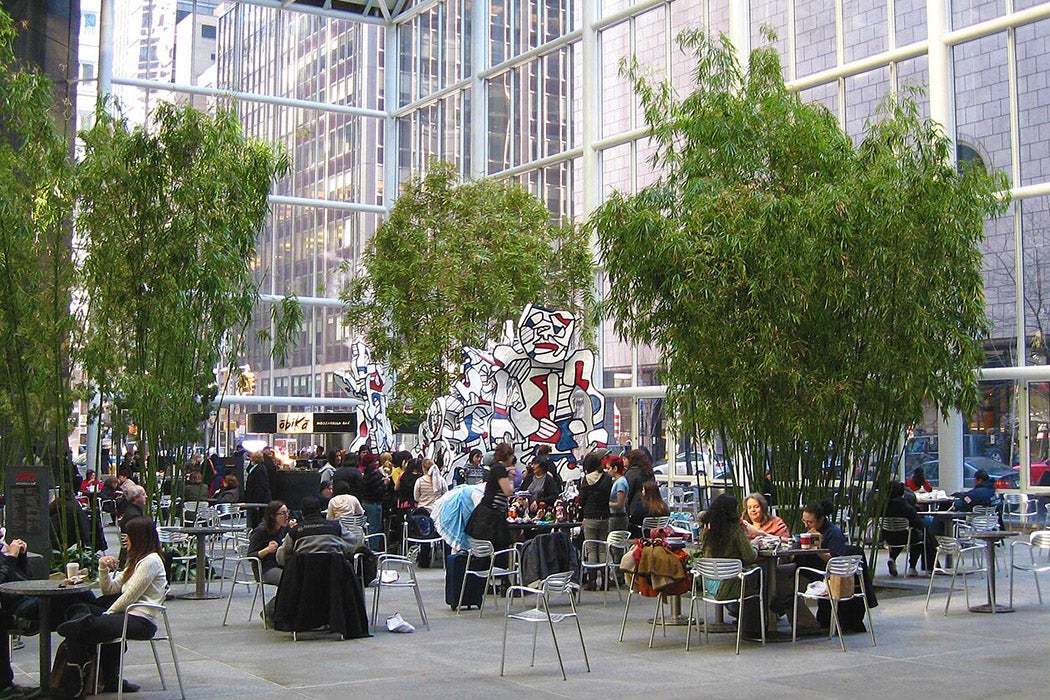
It works like this: in exchange for floor area ratio “bonuses”—that is, building bigger than regular zoning allows for—developers add “publicly accessible spaces” like plazas, arcades, and atriums adjacent to, or inside of, or, in the case of Lower Manhattan’s Elevated Acre, atop their developments.
The bigger floor-area ratios translate into increased profits, because these ratios equal more rents. So-called public spaces like these also have the potential of garnering goodwill and positive PR. It’s a win-win for developers and landlords alike.
But what about for the rest of us, for society, for democracy, for the “right to the city”—the idea that not all urban space should be commodified or controlled by capital?
There are now over 590 such privately owned public spaces in NYC according to the nyc.gov website. Known by the folksy acronym POPS, they make up “over 3.8 million square feet of public space—equivalent to nine Bryant Parks or Union Squares,” in the city’s own words.
Equivalent in area, perhaps, but not quite the same. For this “public space” isn’t owned by the municipality in the name of the people. POPS aren’t parks or other civic spaces. As Németh notes, the private entities that run them are not “legally obligated to accommodate free speech, religious activity or unmediated political expression.” POPS are not, in short, agoras, the ancient Greek-derived ideal of the public gathering place where democracy flourishes.
More to Explore

Greening Philly’s Neglected Lots
POPS are managed with a range of rules and regulations that aren’t universal, aren’t vetted by the people’s representatives, and don’t fall under the checks and balances of democratic governance. There’s no public accountability or transparency. Németh writes that courts have declared that they are definitely not public forums, reducing the “effectiveness of political dialogue by zoning and segregating speech and protest in privately owned public spaces.”
Because of this, POPS have been criticized for “restricting social interaction, constraining individual liberties, and excluding certain undesirable populations.” Németh’s research “lends some support to this criticism” and finds that “such spaces contribute to, or perhaps accelerate, the demise of an inclusive public realm.”
Németh’s in-depth study of Midtown Manhattan POPS shows “robust combinations of techniques to control who uses the space and how.” He categorizes seven main management approaches to these spaces, including fortress environments, panoptic spaces, consumption spaces (for a public that can pay to play), and small-scale design (spikes on ledges, for instance, to make places inhospitable). All together, these approaches allow “private owners to use subjective regulation, interdictory design and heavy-handed surveillance to filter, segment, position and order the public.”
Weekly Newsletter
Additionally, since POPS are “attached” to a building, they are concentrated in areas the private sector is interested in investing in. The incentive program thus “serves to widen the gap between more and less valuable neighborhoods and between upper- and lower-income residents.” As in so many other cases, the “market” ignores the poor and privileges the already well-off. POPS reinforce these social/class/race distinctions with private security, which doesn’t operate under the rules of municipal police. Notes Németh, “Owners or managers of publicly accessible spaces consistently prioritize security concerns over social interaction.”
“The right of private parties to exclude certain individuals and groups from publicly accessible spaces is a question of citizenship,” stresses Németh. “The denial of access to, or inclusion in, publicly accessible space then becomes a denial of citizenship and representation in our collective public forums.”