Reminders of our collective past are always present. Europe is interspersed with statues, large stone monuments to the dead of the great wars that raged on the continent, stretching back to ancient times. The Hiroshima Peace Memorial, a ruined former exhibition hall where the atomic bomb exploded above, stands as a chilling testament to the devastation nuclear weapons bring. The site of the World Trade Center now houses two pools surrounded by bronze walls etched with the names of those killed in the attacks of September 11, 2001. The names upon the Cenotaph Monument in central London mark one of the spots where the nation commemorates the casualties in the First World War. These are collective repositories of memory in societies informing themselves about their own history.


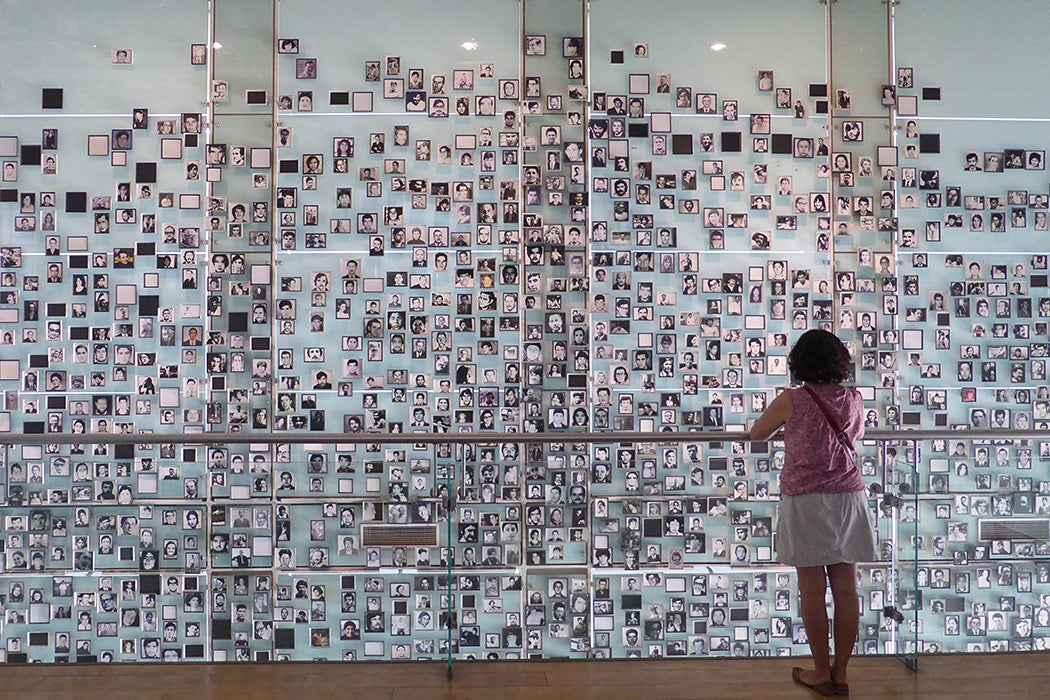
In Chile’s capital, Santiago, the Museum of Memory and Human Rights chronicles the crimes against Chileans during the seventeen years of Augusto Pinochet’s dictatorship (1973–1990). During that period, more than 40,000 people were tortured or executed according to Amnesty International; an additional 1,469 people were disappeared. Few Chileans today can deny the impact Pinochet’s junta had, and its long reach keeps the wound it produced raw even now, more than three decades on.
Although Pinochet’s legacy splits public opinion, often along ideological lines, the collective remembrance of the regime’s crimes is entangled within the country’s shift toward democracy in the 1990s after Pinochet stepped down from the presidency. Remembering its victims became the undercurrent of a nation wanting reconciliation with itself—for the most part, Chileans wanted to not forget the horrors.
During his reign, Pinochet and his junta had similarly taken memory into account—but as a tool of oppression. They targeted individuals who acknowledged and yearned for the socialist aspects of the country’s past. Many of these individuals fled Chile after Pinochet’s ascent; in a discussion on the matter from 2023, migration expert Patrick Taran cited UN estimates that 200,000 refugees, exiles, and asylees from the country dispersed across the globe after the coup.
“Being able to remember becomes a political act,” writes Rosemary Barbera, a human rights activist and scholar of social work, in reference to the experiences of a small community in Santiago during the Pinochet years. “Knowledge is a significant form of power, and when memory can be controlled, knowledge is likewise controlled and becomes subjugated.”
“Being denied memory is a form of abuse,” Barbera states.
In a sense, Pinochet himself concurred, asserting five years after his exit from power, “It is best to remain silent and to forget. It is the only thing to do: we must forget. And forgetting does not occur by opening cases, putting people in jail.”
The act of invoking memory—in defiance of Pinochet’s direction—would lead to justice, but only after his regime had let go of power and the country’s democratic institutions were allowed to flourish again.
Weekly Newsletter
Pinochet’s rise came via military coup on an earlier fateful September 11, this one in 1973. Orchestrated by various military heads, Pinochet led the coup; soldiers fired in the streets of Santiago and planes overhead bombed and strafed the presidential palace, then occupied by Salvador Allende. As the first elected Marxist president in Chile’s liberal democratic history, Allende represented a threat to US socioeconomic hegemony during the Cold War when capitalist and communist ideologies inflamed wars and coups across the globe, particularly in Latin America. With the help of the CIA, Pinochet was installed in power and then unleashed the secret police and military to carry out violent crackdowns and bloody reprisals against Allende associates and anyone on the political left. Allende himself died during the coup, though whether he was murdered on behalf of Pinochet or committed suicide is uncertain.
Historian Steve J. Stern explains in Reckoning with Pinochet: The Memory Questions in Democratic Chile, 1989–2006 that events like these create what he calls memory knots, which are varied forms of triggers that serve as reminders of trauma. These can include sites of humanity, such as human rights activists drawing attention to past events; sites in time, like politically charged anniversaries (September 11th in both the USA and Chile’s case); and physical or geographical sites, including torture centers or mass graves that project issues of memory into the public domain.
As Rosalind Bresnahan, a scholar of Latin America and communication studies, writes in an appraisal of Stern’s work, “[The] Ways of understanding the major events of recent Chilean history (the Allende government, the coup, and the dictatorship) … shape the ways in which loose (personal) memories become integrated into broader frameworks of social understanding.”
In 1988, Pinochet stepped down from power following a plebiscite, though he retained his position as commander-in-chief of the army until 1998; thereafter he was a senator for life. In 1989, journalist Patricia Verdugo published Los Zarpazos del Puma (The Claws of the Puma) detailing the activities of one of Pinochet’s generals, Sergio Arellano Stark, who was appointed one of his personal delegates in October 1973. Stark helicoptered from one province to another, Verdugo reports, murdering political opponents and Allende supporters with the help of a group of soldiers collectively known as the Caravan of Death. In June 1990, the Los Angeles Times reported that twenty well-preserved bodies of the disappeared were found in Chile’s northern deserts. A confrontation with the crimes of the past was unavoidable—forgetting them impossible.
Bresnahan identifies the myriad triggers that stirred up Chileans in the period when their country transitioned to democracy. “Demonstrations, books, television reports, and other memory knots,” she writes, “forced public confrontation with truths that many Chileans would have preferred to lock inside a closed memory box.”
At the same time, Chileans started to demand justice for the many people killed, disappeared, exiled, and tortured under Pinochet. The 1990s became a time of convergence of democratic institutions and reconciliation with the horrors of the past, which had been impossible to speak of during the previous two decades.
More to Explore
How the Union Lost the Remembrance War
Patricio Aylwin, elected president in late 1989, led this charge. His inauguration took place in March 1990 in the national stadium, a decision of momentous intentionality and import; the stadium had been notorious in the Pinochet years, serving as a detention center where the military warehoused hundreds of prisoners.
Aylwin had made himself clear from the start that reconciliation was a paramount objective of his administration, built, as he said in his inaugural speech, on “the foundations of mutual respect, the unrestricted rule of truth, the validity of law and the constant search for justice.”
Wives of disappeared husbands performed Chile’s national dance, the Cueca, at the inauguration ceremony. Shortly thereafter, in September, Allende’s body was disinterred from the coastal city of Viña del Mar and reburied in the general cemetery to rest alongside other democratically elected presidents of the past. Nearby, a memorial wall went up, a monument to those thousands of people affected by the dictatorship.
While bold, the decision to keep Pinochet in charge of the army while the country endeavored to restore democracy and promote transparency was risky. A smooth political transition required keeping the military appeased, and the quest for truth, as Stern puts it, was “an explosive that could shatter an effective and stable transition.”
A month after taking office, Aylwin established the National Commission on Truth and Reconciliation—known as the Rettig Commission—to address human rights violations and shed light on the state’s responsibility in the commission of these crimes.
The Rettig Commission found that 2,279 people had died; some of those casualties were classified as disappeared, others as victims of execution. The commission’s finding led to the passage of a law in 1992 which paid reparations to family members of the victims. Still in charge of the military at the time, Pinochet was able to thwart attempts at judicial action against specific perpetrators. He also was able to push through an amnesty decree that barred the prosecution of human rights crimes committed from 1973 to 1978, according to a report from Human Rights Watch.
Pinochet’s decree was in essence an admission of guilt by the government that would lead to the coalescing of the memory of trauma and healing into one.
Roughly two decades after the formation of the Rettig Commission, historians Franck Gaudichaud and Mariana Ortega Breña asserted, “Many families of desaparecidos (disappeared) and political victims continue to revere the memory of those who fell during the dictatorship. Given the prevailing impunity and the limitations of both Chilean and international justice, it is apparent that the memory of repression has direct consequences in the political arena.”
Beginning in 1994, a new phase of tension developed between the civilian government, now led by President Eduardo Frei and the military. During Frei’s first month in office, three former police agents were sentenced in the 1985 murder of three communist activists. In 1993, Pedro Espinoza, chief of operations of the Chilean secret police (DINA) under Pinochet, was found guilty of the 1976 assassination of an Allende-era politician. With the help of the military, Espinoza fled to avoid immediate conviction.
Within Chile such developments gave rise to greater optimism regarding the deliverance of justice not just within the country’s borders but overseas as well. Cases against Pinochet associates who’d fled Chile and were accused of crimes including assassinations and disappearing people were being prosecuted in Argentina, France, and Italy. Chile’s violent past was being invoked both domestically and internationally.
Pinochet himself was arrested in London in 1998 on torture and murder charges brought by a Spanish court. The arrest of a former head of state for crimes against humanity in another country was significant in international law. It placed issues of memory at center stage within Chile, making the heinous misdeeds of Pinochet and his team impossible to ignore. Tito Tricot, who’d been imprisoned under Pinochet, took up this matter in an open letter to the Guardian newspaper on April 8, 1999, writing “Up until this day—26 years after the military coup—distraught relatives of the disappeared keep asking the same question: Where are they? They have tirelessly walked up and down the country looking for their loved ones; they have searched rivers and mountains, empty mines and secret mass graves.”
Indeed, Pinochet’s arrest, writes political scientist Alexander Wilde, “made abundantly clear the ways in which its transitional politics remains captive to symbols of its conflictive past and to the unresolved issues of human rights.”
After nearly a year and a half under house arrest, Pinochet returned to Chile to await further trial before he was released due to ill health. He died at age ninety-one in 2006, and though he was never convicted, his associates continued to be prosecuted, in large part thanks to the 2004 publication of the National Commission on Political Imprisonment and Torture Report, familiarly known as the Valech Report. It detailed the fates of 38,254 Chileans who had been imprisoned—and most of them tortured—for political reasons in the Pinochet years.
Today Chile still struggles with its ghosts, and although reconciliation was a high priority for the post-Pinochet governments, putting human rights and justice above much else, the political divisions created by the coup continue to cause societal fractures. While Pinochet demanded silence, Chile’s citizens responded with remembrance. Truth commissions, public memorials, and international trials became the apparatus of national reckoning. Memory, in this case, was justice delayed but not denied.