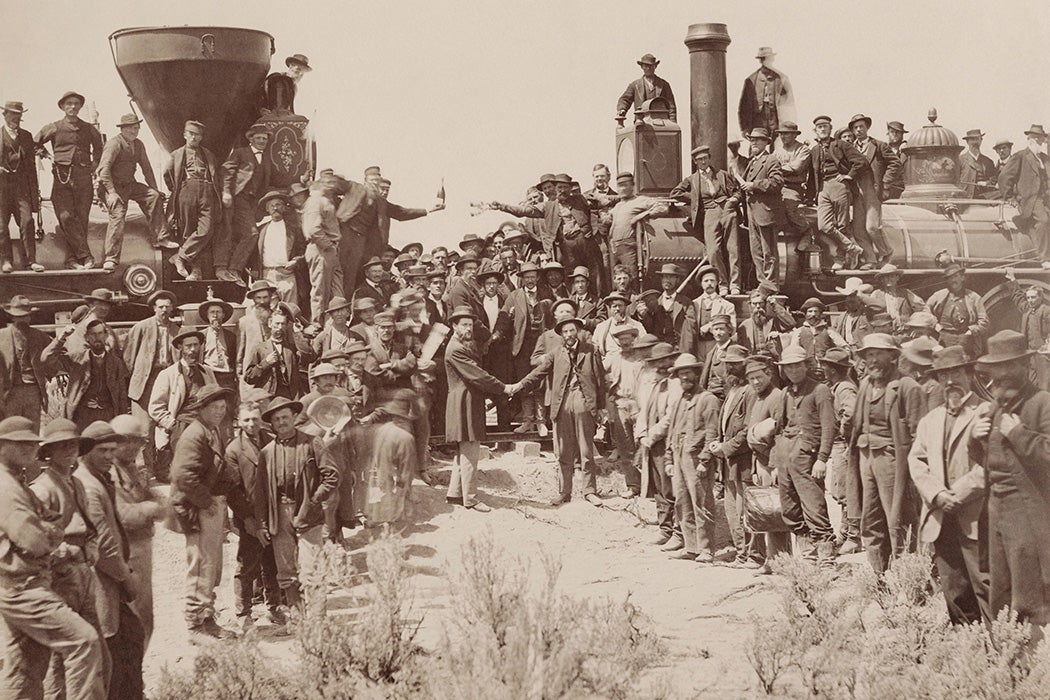
Railroads and photography were intertwined technologies in the making of the American West. The railroads stitched together the coasts on May 10, 1869, when the Central Pacific, expanding from the west, and the Union Pacific, built out from the east, connected at Promontory Summit in Utah Territory. Meanwhile, photographers, often working directly for the railroad companies, helped promote settlement and tourism by portraying the western landscape as what historian Alessandra Link calls an “unpeopled Eden.”


“Photographers, corporate agents, authors, newspaper editors, and publishers made railroad photographs available and unavailable for public consumption—and they made these decisions with a clear goal in mind.”
What some have called the “golden age of landscape photography” also served to promote conquest. This now iconic imagery of the American West was based on the “deliberate suppression or alteration” of scenes that included people. Native Americans were edited and curated out—of the camera frame, at the editorial desk, on the illustrator’s pad, and on the lecture circuit. When Indigenous people were portrayed, they were typically depicted as anti-modern figures giving way to technology and fading away into extinction.
Take the famous photograph of the driving of the ceremonial golden spike uniting the railroad companies. Union Pacific photographer Andrew J. Russell captured the celebration of handshake and champagne. This wasn’t just a union of railroads, however. Just a few years after the trauma of the Civil War, the event was portrayed as a national moment of healing. It was a unification of the Union itself, “from sea to shining sea” as Katharine Lee Bates would later phrase it in the song “America the Beautiful.” That was, of course, a Union of white people: the Chinese laborers who laid much of the track are nowhere in evidence in Russell’s crowded scene. Also absent are the inhabitants of the region.
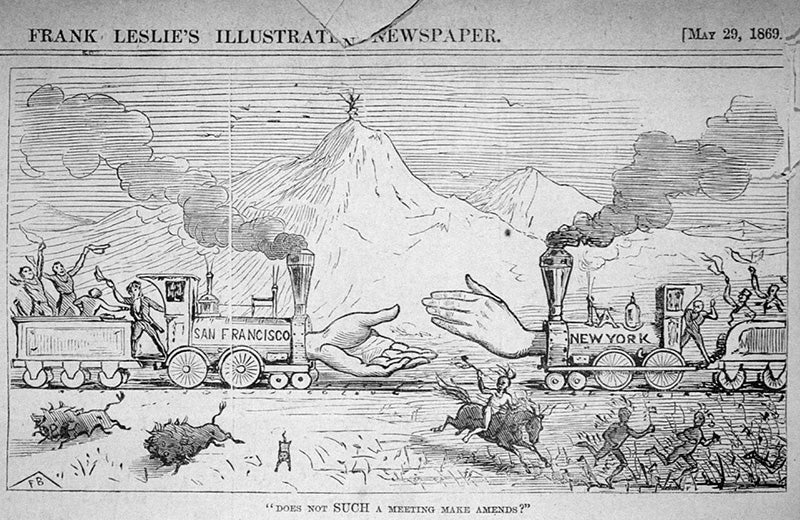
Yet when Russell’s photograph was adapted by an artist for Frank Leslie’s Illustrated Weekly, a popular New York-based publication that translated photographs into cheaper-to-publish engravings and lithographs, there were Indians in the scene. They, and the bison, are shown fleeing what the newspaper labeled a making of “amends” between competing corporations and the recently warring factions of the Civil War. As Link notes, there were no amends for the peoples whose lands were being overrun.
More to Explore
Visualizing History
“Euro-Americans considered the few photographs of Indians that entered print media to be contributions to the salvage of Indigenous cultures destined to vanish in the looming exhaust of the locomotive.”
Link looks at photographers Russell, William Henry Jackson, and Alfred A. Hart. All either worked directly for the railroad companies or sold them many pictures. She notes that the wet-plate technology they used meant that these images were a far cry from later snapshots or the insta-ubiquity of cell phone cameras. Photographers had to transport heavy glass plates, heavy chemicals, and hooded boxes or tents for developing. Exposure times could last thirty minutes, so conscious framing and posing were the order of the day.
Weekly Newsletter
They actually took lots of pictures of Native people, “but many did not find their way into the photographers’ published work.” Photographs as “tangible proof of Native presence,” continues Link, didn’t go with all the talk of Indians “passing away,” with “remnants” on reservations, and with their replacement by settler colonialists. Russell, who clearly knew better, called the vast plains “unpeopled.”
In the hands of distant publishers, photographs also became the manipulated “baseline” for illustrators “to plant a particular image of Native peoples in the American imagination.” Indian portraits, too, were typically studio-based, meaning that individuals were literally removed from any landscape.
Link writes that in 1866, as the Union Pacific celebrated reaching the 100th meridian, a trainload of executives and celebrities were entertained by a staged attack by hired Pawnee pretending to be Sioux. Before Wild West shows and long before the movies, the West as spectacle was being enacted on the railroad tracks.