Looking back at the era of the American Revolution, we often view the southern colonies and their dependence on enslavement as rural and old-fashioned, in contrast to the urban proto-capitalism of the North. The reality was more complicated, as historian Gregory E. O’Malley explores from the vantage point of Charleston, South Carolina.


Of the more than 300,000 enslaved people whose port of entry into the US (or colonies that would become the US) is documented, nearly half arrived in Charleston.
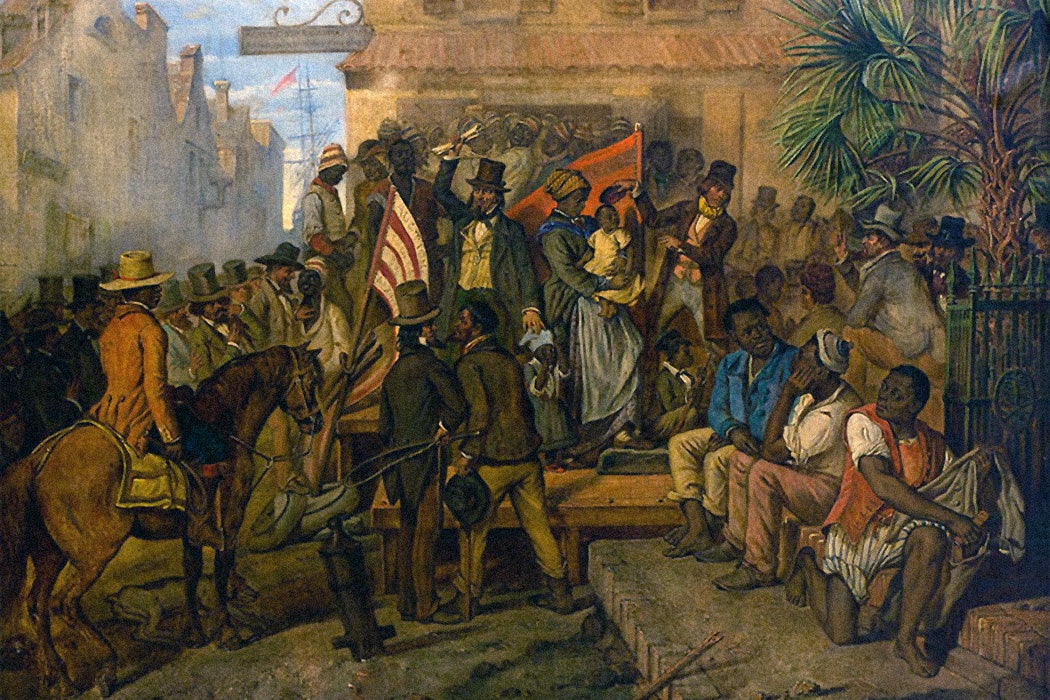
Judged by market value alone, the Charleston port’s purpose was not primarily human trafficking—imported British goods were worth more than the African captives who came through the city. But O’Malley writes that this is deceiving. With land and capital relatively abundant, labor was the crucial missing factor for planters across the South. Wealthy plantation owners traveled a great distance to meet arriving ships carrying enslaved people and invest fortunes in their human cargo. And workers—many of them enslaved—also arrived in town, bringing food and firewood to inns and taverns and helping to deliver newly arrived captives to the plantations. This convergence of people drew other economic activity, creating niches for shopkeepers, doctors, and lawyers.
“More than anything else on the calendar, the arrival of slave ships brought the colonial Lowcountry community together and stimulated local commerce,” O’Malley writes.
In some ways, Charleston was less like Boston or New York than other British centers of human trafficking—Bridgetown, Barbados, or Kingston, Jamaica, for example. In 1774, it had a population of about 13,000, about half of them enslaved or free people of African descent.
O’Malley writes that the wealth and status hierarchy was extremely visible. Merchants in fine suits rode in carriages or on sedan chairs while enslaved people lugging carts and crates wore dirty, threadbare clothing and could be publicly whipped or burned to death for misbehavior.
More to Explore
The US Army as a Slaveholding Institution
And the horrors of the Middle Passage were intensely present. In the spring of 1769, Charleston residents complained that ships carrying enslaved people had dropped so many bodies of captive Africans into the harbor that it created a putrid smell and a public health hazard.
The urban environment built on enslavement created social and economic links to other parts of the world. A person arriving in bondage might meet people of many ethnicities and languages from various African communities and from the Caribbean, as well as enslaved people born in South Carolina.
Weekly Newsletter
"*" indicates required fields
Meanwhile, even prior to industrialization, the trafficking of enslaved people helped build a merchant capitalist class that leveraged investment in human beings to expand trading networks. For example, London-based dry goods merchants sometimes extended credit to slave traders, profiting from the loans’ interest while also forging valuable ties in the enslavement economy.
“Although slavery is sometimes cast as premodern, understanding the importance of the slave trade to a wide variety of Charleston’s merchants, artisans, and professionals suggests the synergy between the traffic in people and the town’s growth,” O’Malley writes.