In the 1950s and 1960s, thousands of Korean children were sent abroad to be adopted—a controversial practice that has come under scrutiny and criticism in recent years.


Susie Woo suggests that American enthusiasm for these transnational adoptions could have been bolstered, surprisingly, by the media coverage of touring Korean children’s choirs.
Popular narratives about child choristers and Korean adoptees “centered on American futures and situated average American citizens as catalysts for that change,” she says.
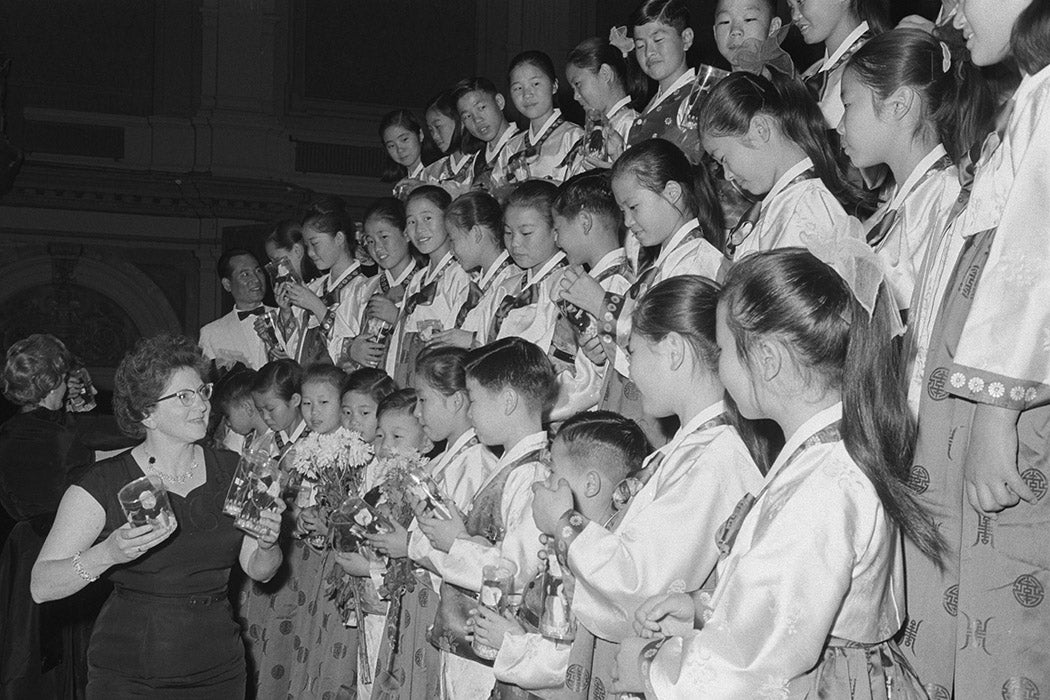
Woo, who studies race, immigration, and the Cold War, points to the Korean Children’s Choir’s 1954 visit to the United States, which saw twenty-five singers take more than fifty cities by storm and win over listeners from senators to Mamie Eisenhower.
South Korean authorities were keen for the choir to project a positive image of their country, which could win continued American support for the regime of Syngman Rhee.
“The children sang songs, including American classics, in multiple languages while dressed in traditional Korean hanboks,” Woo explains. “A perfect blend of East and West, the choir offered proof of Korea’s transition and recovery yet remained sufficiently oriental to draw American audiences.”
The need for the Korean Children’s Choir to appear “sufficiently oriental” was so integral to their public image that the children were always photographed in hanboks—even after they received a donation of haute couture coats and other winter attire.
But while the Korean Children’s Choir was put together to drum up US support for Korean independence and reunification, American audiences also had other concerns in mind.
Woo notes that the troupe consisted almost entirely of girls aged six to twelve, which “helped the choir symbolize a childlike and feminized South Korea in need of American protection.”
By performing in the United States, the Korean Children’s Choir literally distanced American audiences from a war front where American troops had been engaged in combat. Instead, ordinary Americans were encouraged to think of themselves in more innocent terms, as philanthropists providing benevolent support to victims of communism.
The Korean Children’s Choir tour raised $10 million for war reconstruction efforts. Woo adds, “Through donations, thousands of average Americans participated in a figurative adoption narrative…that made the possibility of actual adoptions seem less strange.”
Evangelical Christians had been trying to place Korean children in Christian American homes since the early 1950s. The interest in adoption saw an upsurge in the same period, fanned by media reports that showed adoptees “alongside white adoptive parents enjoying television, telephones, and ice cream cones—all the consumer comforts of America.”
By the late 1950s, the interdenominational Christian organization World Vision was sponsoring a “Korean Orphan Choir,” which had marquee appearances at the Rose Parade in Pasadena in 1961 and at Carnegie Hall in New York in 1962.
More to Explore

A “Genre-Bending” Poetic Journey through Modern Korean History
Unlike the hanboks of the previous decade, the Korean Orphan Choir wore Western-style clothing, and sang Christian hymns in English, such as “The Lord Is My Shepherd.”
“The choirs and concurrent adoptee narratives effectively paved an uncomplicated path for adoptions by suggesting that Koreanness would not hinder a child’s Americanization,” Woo suggests. “In fact, it was the children’s very Koreanness that made them ideal adoptees.”
Weekly Newsletter
The popular narrative around these performances also encouraged Americans to equate choir members with tragic “double orphans” who had lost both parents to war.
For instance, the three Korean adults who accompanied the Korean Children’s Choir on their tour were left out of press photographs. This absence contributes to what Woo calls “the fiction that surrounded Korean War adoptions—namely, that all adoptees were parentless.”
In fact, many Korean children were sent for adoption in the United States despite having living relatives, if not at least one parent. Last year, a report found that the transnational adoption process had featured systemic human rights violations for decades.
Still, Woo concludes that the children’s choirs opened the door to the transnational adoption trend, as their performances “deepened existing American sentiment for Korean children by giving them an opportunity to participate in the transformation of Korean children on US soil.”