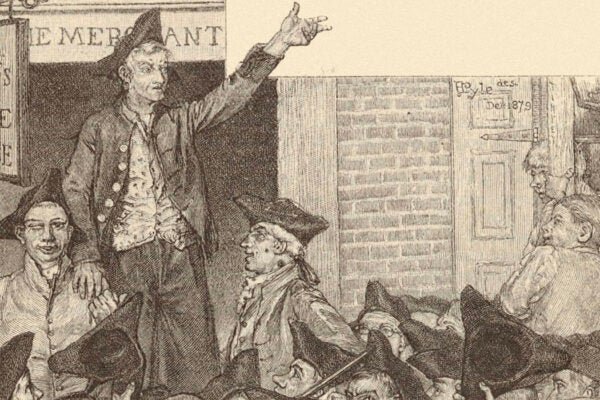
Americans express high levels of skepticism about things defined as “political,” but that doesn’t necessarily keep them from seeking to influence public life and the operation of government. How do these things go together? Elizabeth Bennett, Peter Taylor Klein, Stephanie Savell, Alissa Cordner, and Gianpaolo Baiocchi use ethnography of seven civic groups to show how “disavowal of the political” can facilitate civic engagement—with an asterisk.


The researchers—an anthropologist, a political scientist, and three sociologists—conducted ethnographic research at seven civic organizations in Providence, Rhode Island, including neighborhood associations, social justice organizations, and groups of “civic innovators.” They found patterns of disavowal of politics—often explicit statements like “I’m a nonpolitical guy, big time. I don’t think it matters”—even as people tried to influence policy and political culture.
Yet these disavowals were not leading people to be less engaged. In fact, the researchers argue, “disavowal can be productive of civic engagement.”
Disavowal is part of an attempt “to resolve the ambiguity that people experience when their expectations about how politics ought to function are contradicted by how they believe political decisions actually take place.” By resolving that ambiguity, disavowal makes it easier to participate. The researchers identified three such forms of ambiguity.
First, people may disavow politics because they fundamentally question the political process and effectiveness of government. This may take the form of seeing government as inadequate to fulfilling people’s needs; as nostalgia for an imagined past in which people relied on their communities rather than the government; or as a call for major structural change.
Second, some disavowals frame politics as serving narrow special interests rather than a broader common good.
More to Explore

Audacity and Gaslights: Empowering or Zombifying Citizens?
Third, people see politics as conflict-ridden, and seek to promote civility over conflict, as when, “a volunteer who teaches civic skills to students in public schools said his organization’s lesson plans ‘avoid politically charged issues.'”
Disavowing politics only facilitates certain kinds of civic engagement, though. “Divorcing the concept of ‘politics’ from the everyday work of active citizenship involves trade-offs,” the researchers argue, “such as excluding marginalized groups and minimizing the value of conflict in democratic debate.”
Weekly Newsletter
For instance, in meetings about the Providence public schools, discussion focused on what would be best for “all kids.” Advocacy for Black students—who had higher drop-out rates—was seen as overly political and narrowly self-interested, even though the focus on “all kids” had the effect of not addressing Black kids’ needs.
Similarly, efforts to draw attention to inequality and other uncomfortable subjects can be rejected as too conflictual, disruptive of civic harmony. But without that conflict, systemic change is unlikely.
Disavowal, then, “allows individuals and civic groups to deepen their sense of community and to harness that community for political activity.” At the same time, its “constraints present challenges to people and groups aiming to address inequality. This is because taking on inequality is both contentious and implies advocacy for less privileged groups.”