The easternmost Canadian province of Newfoundland and Labrador is home to a Chinese community of fewer than 2,000 people, yet the lion dance holds outsized sway there. In fact, the traditional art form was introduced not long after a community association was established in 1976, and is still practiced despite dwindling troupe numbers. Folklore studies scholar Mu Li observes, “In many ways, the lion dance serves as an open forum for individuals of Chinese descent to strengthen or challenge their … notion of being Chinese and the ‘authentic’ Chinese culture, and to develop their own version of Chineseness.”


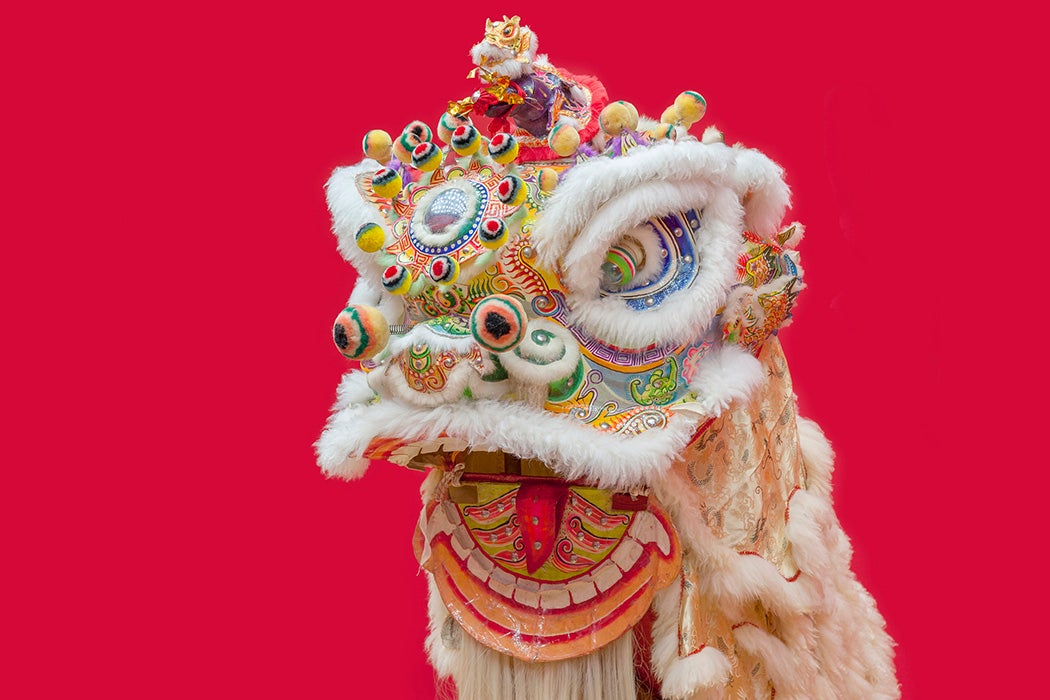
The traditional lion dance draws on martial arts techniques and features pairs of dancers in stylized lion costumes moving to the rhythm of a drum, gongs, and cymbals. Li characterizes the art form as “frequently the most explicit and important marker of Chinese culture in overseas (southern) Chinese communities,” and also as a symbol of multiculturalism accessible to non-Chinese drawn to the noise and bright colors.
“Due to its role as a base for negotiating and (re)constructing identities of individuals of Chinese descent, the lion dance … becomes an inseparable part of individual perceptions of diasporic Chineseness in Newfoundland,” Li notes.
Li’s ethnographic fieldwork involved numerous interviews with locals, who recall the enthusiasm with which Chinese Newfoundlanders took up lion dance—especially after a visiting Toronto-based expert held workshops in 1984. The following decade became “the peak time of lion dancing in Newfoundland,” according to Li, who argues that lion dancing fostered a sense of “a culturally united Chinese community” in the area. This is because most early Chinese Canadian settlers, who arrived in Newfoundland from 1895 onward, hailed from the Pearl River Delta that encompasses Guangzhou and Hong Kong, also the birthplace of southern-style lion dance.
The lessons from master practitioner Luk Gan Wing strengthened Newfoundland residents’ lion dance moves. One Newfoundland performer—who, like Luk, claimed to be a disciple of the southern Chinese kung fu legend Wong Fei Hung—recalled that Luk “taught us the right way of performing the traditional Chinese lion dance.” By “the right way,” the informant meant the way affiliates of the Wong Fei Hung school learn and perform the lion dance, where an unbroken lineage is vital.
More to Explore
When the Dust Settles in Colonial Manchurian Writing
In steering the Newfoundland community toward that style, Luk’s workshop “allowed Chinese lion dance in Newfoundland to regain some of its ‘historical authenticity,’” Li contends. But he adds that the Wong Fei Hung style “is only one of many kung fu styles in southern China.” Over time, historical authenticity became less important to local practitioners.
By the early 2000s, a new generation of younger performers had embraced the art form—and were more willing to accept changes in performance. Li explains, “The new generation of Chinese lion dancers differs from earlier Cantonese dancers, who strictly observed the lion dancing traditions as they learned them in Canton or Hong Kong.”
Performers may wear nontraditional costumes—such as trousers with patterns that match the lions’ heads, rather than plain martial arts pants—or divide drumbeats into simpler units. They have added cheeky modern touches, replacing the accompanying “big-head Buddha” character with a panda and choreographing a dance to K-pop hit “Gangnam Style.”
Weekly Newsletter
“[T]his new generation of lion dancers has more freedom to create their own new tradition,” Li says. He adds that historical authenticity is no longer a priority, because “performers do not consider locally performed lion dancing as a cultural survival of the ancestral country.” He further notes that, because of their diverse backgrounds, “it may be misleading to emphasize the second- or later-generation Chinese dancers’ motivation to reconnect with their heritage.” For instance, a northern Chinese youth whose parents had no connection to Cantonese culture said that he joined the troupe “because of how amazing a lion dance looked.”
New immigrants to Newfoundland tend to be professionals or students with roots in other parts of mainland China. They may view lion dance as “a regional and archaic expression rather than a national and modern representation of Chinese culture.”
Yet Li suggests that the evolution of the Newfoundland lion dance can help incorporate Chinese people from non-Cantonese backgrounds into a local ethnic community. The recent preference for individual expression over authenticity “shows that the Chinese lion dance is reflexive, shifting from a foreign invention to a local creation, which is often used to transmit a vernacular version of ethnic identity.”