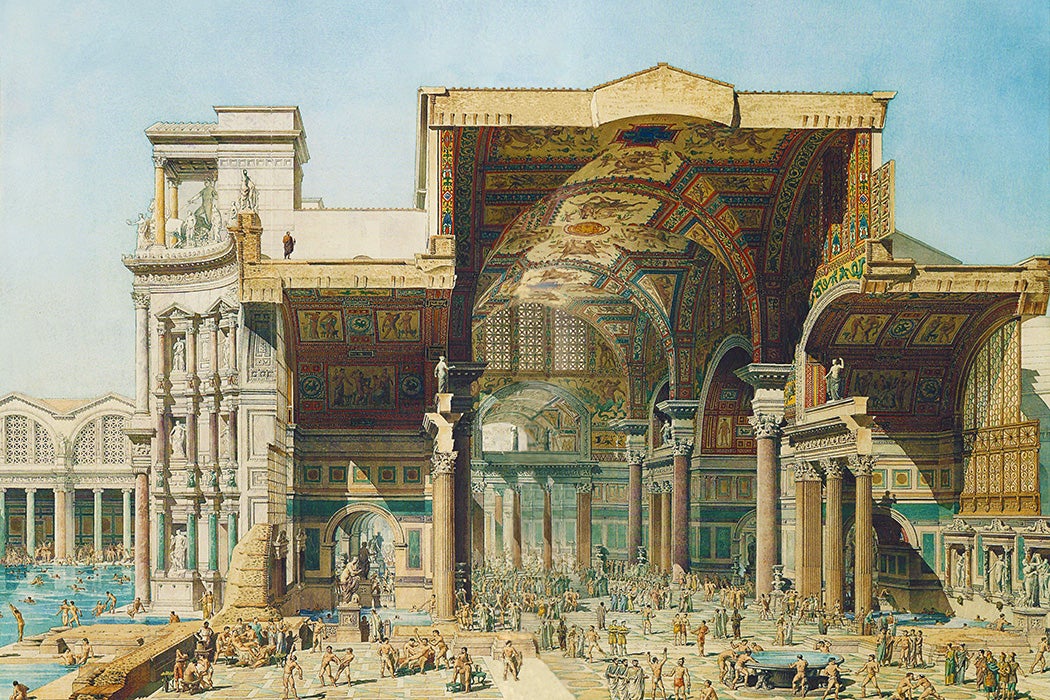
Public bathing today is frowned on, if not criminalized. But for the ancient Romans, public bathing was an essential part of everyday life for almost all members of society. The emperors were wise to have a lot of stone and water moved to keep Rome’s plebeians, the plebs urbana, in their hot and cold plunge baths.


“Baths provide more than simple hygiene; they were vital nodes of social and cultural interaction that crossed established boundaries of class or position,” writes scholar of Roman art and architecture Anne Hrychuk Kontokosta. Drawing on the words of archaeologist Janet DeLaine, she notes that
few other societies have put bathing at the center of social life. The ritual of public bathing helped shape the quotidian rhythms of the city, while the construction of bathing complexes played a significant role in the urban development of Rome.
By the fourth century CE, Rome had some 856 privately owned public baths. But it’s the eleven great bathing complexes built by the emperors that we remember today. They “were some of the largest and most expensive building projects undertaken” in their day, Kontokosta writes. Today, they are the some of the most excavated structures in the city.
The Baths of Caracalla, for instance, were completed around 212 CE. They would inspire such later architecture as New York City’s original Pennsylvania Station, Chicago’s Union Station, and the Senate of Canada. The largest of the imperial bath complexes were the Baths of Diocletian, which were also modeled on the earlier Baths of Caracalla. Diocletian’s complex was finished around 306 CE and in operation for the next two centuries. The facilities spread over thirty-two acres. This wasn’t just about having a quick wash.
“Imperial baths,” Kontokosta writes,
integrated a complex group of bathing and cultural spaces that combined recreation and cleanliness with leisure and intellectual pursuits, offering users facilities such as lecture halls, libraries, meeting rooms, auditoria, exedrae, athletic spaces, and religious shrines.
In addition, imperial baths had surrounding grounds, marking the “first large-scale and systematic introduction of civic gardens into the city.” These were typically sculpture gardens; many of the sculptures now tucked away as treasures in museums around the world were once on display in the Roman weather.
More to Explore
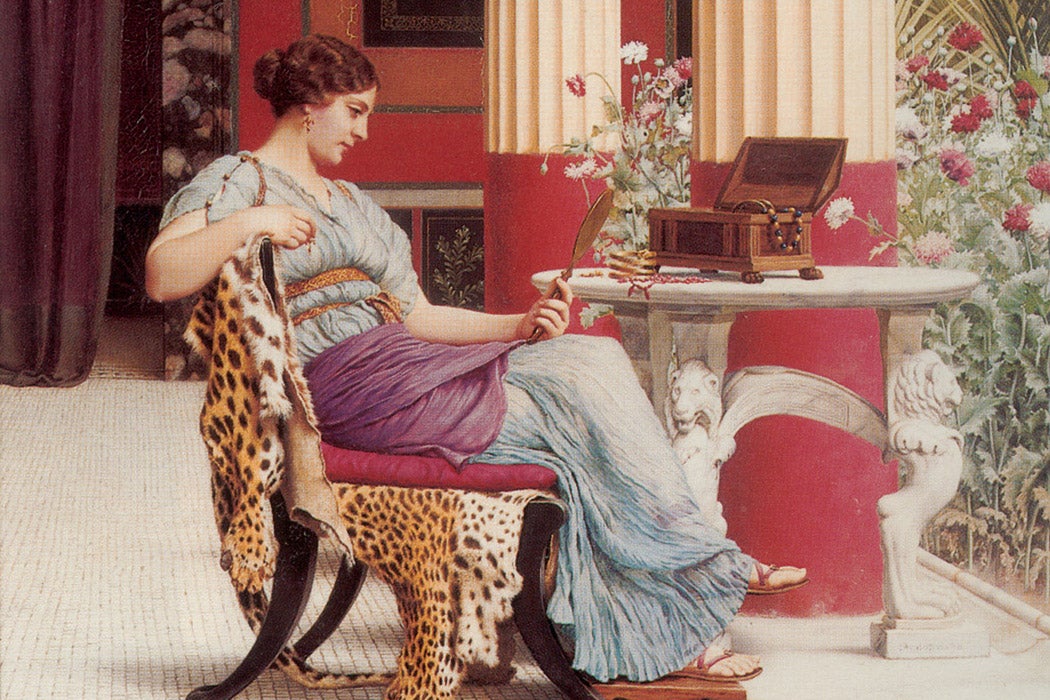
Recipe for an Ancient Roman Glow Up
Kontokosta goes back a few centuries to examine how the baths built by Marcus Vipsanius Agrippa (63 BCE–12 BCE) set the template for the imperial constructions to come. “Agrippa’s baths were so different in scale, facilities, and decoration” from existing urban baths, the small and dark balnea, that a whole new word began being used to describe the new palatial bathing complex: therma.
Weekly Newsletter
M. Agrippa was the quintessential Roman player, with a reputation as “a great military strategist and general, selfless politician, modest citizen, and trusted confidant and heir of Augustus.” Kontokosta warns that skillful Augustan “memory management” should trigger skepticism about Agrippa’s reputation. The Thermae Agrippae complex was the stately pleasure dome and garden of one of the elite of the elites. At least until his death in 12 BCE, when his will gifted the complex to the people of Rome. The state took over funding—the place was effectively nationalized. (Augustus, and future emperors, found selective de-privatization to be a good strategy for appeasing the masses, as well as the undercutting of competing elites.)
The Thermae Agrippae were surrounded by a vast garden “lavishly adorned with sculpture.” As Kontokosta explains, this was essentially Agrippa’s estate, one of the elite horti villa complexes of the city and its surroundings. The largest pool on the property, the Stagnum Agrippae, was big enough for boats. Decades after Agrippa’s death, Nero would make the stagnum infamous for his nocturnal floating orgies, while Tacitus wrote that the pool was lined with brothels. Tacitus’s observation, writes Kontokosta, “emphasizes its impressive size, bucolic setting, and an enduring connection between the new water feature […] and Roman conceptions of otium (leisure).”
Hanky-panky, as the Romans never called it, was not unheard of in the thermae.



![A Chelsea Pensioner, wearing a sprig of orange blossom [?] in his buttonhole, sipping a dish of tea. Engraving by J. Jenkins after M. W. Sharp, 1840](https://daily.jstor.org/wp-content/uploads/2026/02/consuming_the_empire_alt_1050x700-600x400.jpg)
