The mid-seventeenth century court of King Charles II introduced a radical innovation in fashion, eliminating voluminous layers of aristocratic male clothing in favor of an outfit consisting of narrow tapered breeches, a vest or waistcoat, and a coat. Over the next century, the three-piece suit spread across class lines and all over England. Some writers have viewed this simplification of male attire mainly as a dialing back of decorative flourishes and an emphasis on masculinity as a matter of disembodied rationality. But historian Karen Harvey points to something different about men’s fashion in this era: the tight pants.


Harvey writes that the increased visibility of male legs was partly a function of changes in textile technology. Particularly for men outside the aristocracy, the growing availability of cotton in the eighteenth century, and new ways of working with it, created new possibilities. Cotton breeches gradually replaced leather ones, and white cotton hose provided a streamlined silhouette previously only available to those who could afford knitted silk.
Tight, light-colored cotton breeches gave rise to new military-inspired fashion, with visible leg muscles serving as a sign of martial strength. They were also adopted by dandies who played with extremely eye-catching male styles.
More to Explore
Of Heights and Men
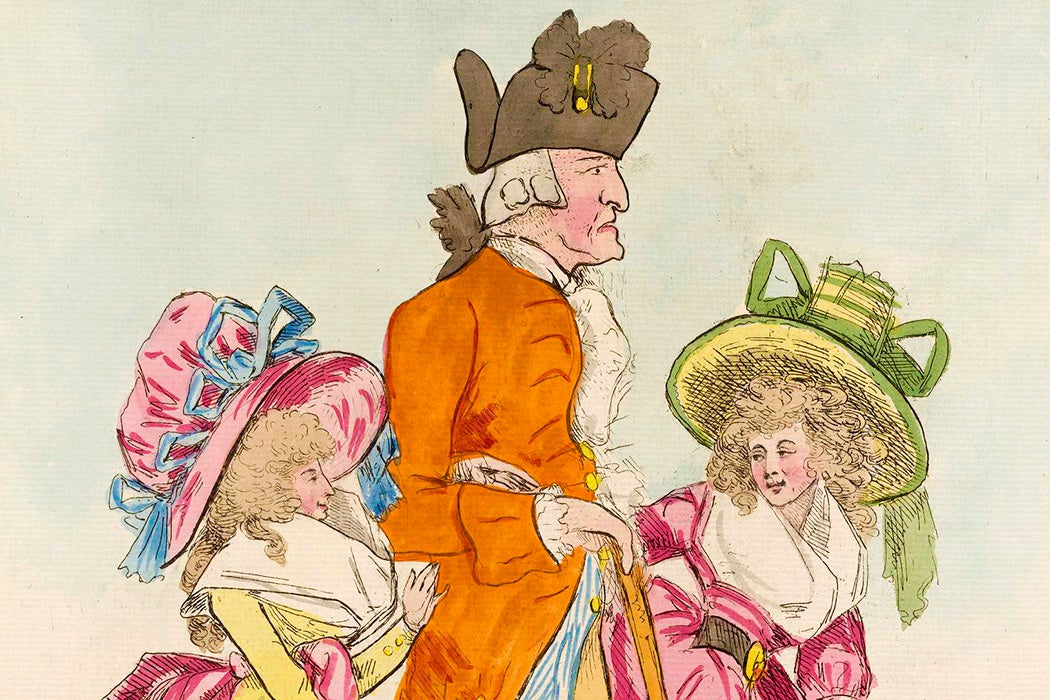
Harvey writes that the breeches imitated the look of bare skin while giving a neat, hairless, and white appearance. This both mimicked classical sculpture and distanced “civilized” men from their “savage” counterparts. In contrast, English depictions of Scottish men with bare legs below their kilts connoted military strength but also barbarity. And, from a different direction, weak men with “spindle legs” became pop-culture punchlines.
Advice written for young men suggested wearing shoes without thick heels to exercise the calf muscles. But vanity was also to be avoided. As writer Matthew Towle admonished his young gentlemen readers in 1770, “‘Tis not thy leg that God rejoices in, no, ‘tis thy Soul.”
Weekly Newsletter
Along with strength, Harvey writes, the musculature of men’s legs reflected grace in the socially important art of dancing. Eighteenth-century dances often featured the male dancer repeatedly making rapid, high jumps.
The Analysis of Beauty, written by artist William Hogarth in 1753, located beautiful curves in the female waist and the male leg. And legs also represented sexual and reproductive potency. In a scene from one smutty book in which women praise the virility of a male character, one exclaims “I warrant you there are twenty Boys in his Calves; he’s none of your Spindle-shanks.” Harvey notes that men who saw women judging their likelihood of siring sons by the shape of their thighs were envisioning themselves as something very different from disembodied minds. “The new, tight-fitting breeches would have given men an acute sense of the surface, shape, position, and feel of their own body, as well as its exposure,” she writes. “Yet in stark contrast to women’s embodiment, masculine embodiment empowered and liberated.”