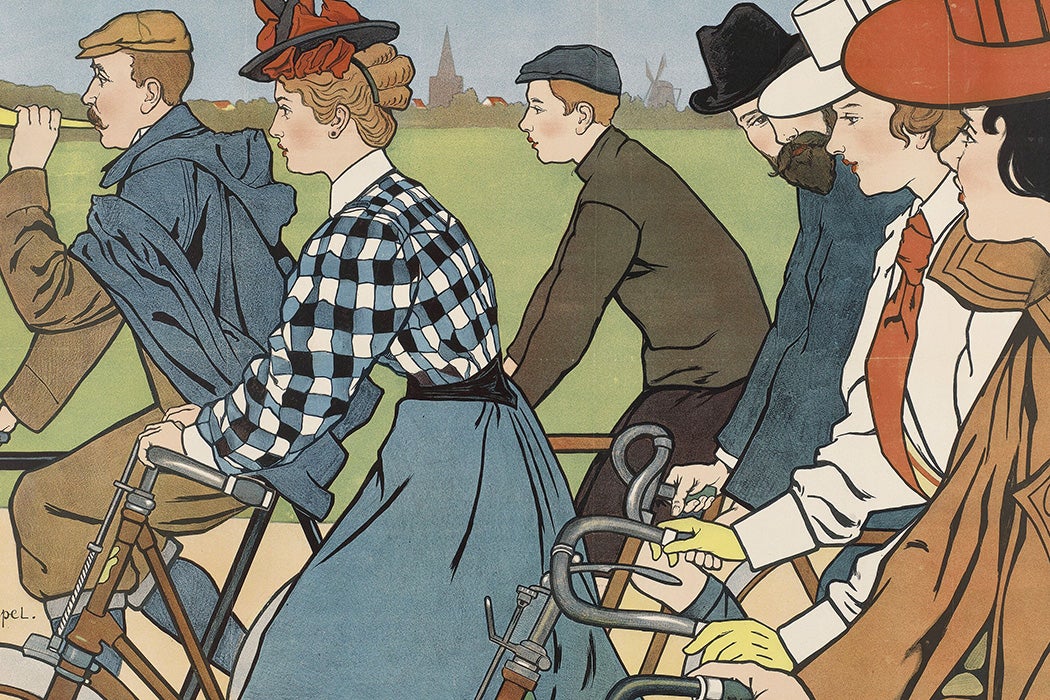
Since their invention, bicycles have been a symbol of the future. But as sociologist Cosmin Popan writes, the type of future it represents has changed dramatically over time.


As early as 1869, Popan writes, the first issue of French bicycling magazine Le Vélocipède Illustré featured an illustration of “Lady Progress” riding an early “boneshaker” bicycle. The modern “safety bicycle” invented in the 1880s extended mobility much more broadly and allowed for new social activities, including the ability of young women to move through the world independently. By the 1910s, futurist and cubist art adopted the bicycle as a representation of the fusion of humanity and machines in the modern era.
The rising bicycle industry also pioneered industrial production techniques such as the assembly line, as well as modern magazine and poster advertising, before the auto industry. And it literally paved the way for cars with cycling clubs campaigning for better roads in Europe and North America.
But, Popan writes, the car quickly became dominant as a mode of transportation and a symbol of fast-moving modern life. Transportation plans in the US and Europe centered cars and were almost always silent about any role for bicycles. By the second half of the twentieth century, media depictions of bicycles often showed them as something exclusively for children, or for odd, childish adults.
More to Explore

Who Killed the Recumbent Bicycle?
In this environment, some activists and intellectuals adopted bikes as part of a resistance to car-centric capitalist modernism. The White Bicycle Plan, created by the countercultural Provo movement in 1960s Amsterdam, proposed closing the city center to cars as part of an effort to curb pollution and improve people’s experience of public space. Participants provided free bicycles for people to use as they wished in the city, prefiguring today’s (often corporate-run) bike-sharing programs.
Popan writes that in the 1970s, philosopher Ivan Illich called the bicycle a “convivial tool” that could help riders escape car culture’s demands on both energy and time (the work needed to buy a vehicle). This harmonized with ideas about building local urban communities promoted in the 1960s and 1970s by figures such as Jane Jacobs.
A more recent development is Critical Mass, a movement that started in 1990s San Francisco and then spread around the world. Participants take over city streets for a carnivalesque monthly ride, contesting cars’ dominance.
Weekly Newsletter
Yet today, Popan writes, the most powerful strain in thinking about bicycles and the future comes from government agencies that tend to view them as an adjunct to cars, helping to make cities more efficient and better for business interests. For example, some cities have built “cycling superhighways” that are separated from auto traffic, providing a commuting option most accessible to younger and more athletic commuters.
In contrast, the most visible media depictions of a bicycle-centric future are postapocalyptic stories such as Ken Avidor’s graphic novel Bicyclopolis, in which the collapse of the fossil-fuel-powered industrial age forces a North American city into a different kind of technological track than the one it got on in the 1920s.