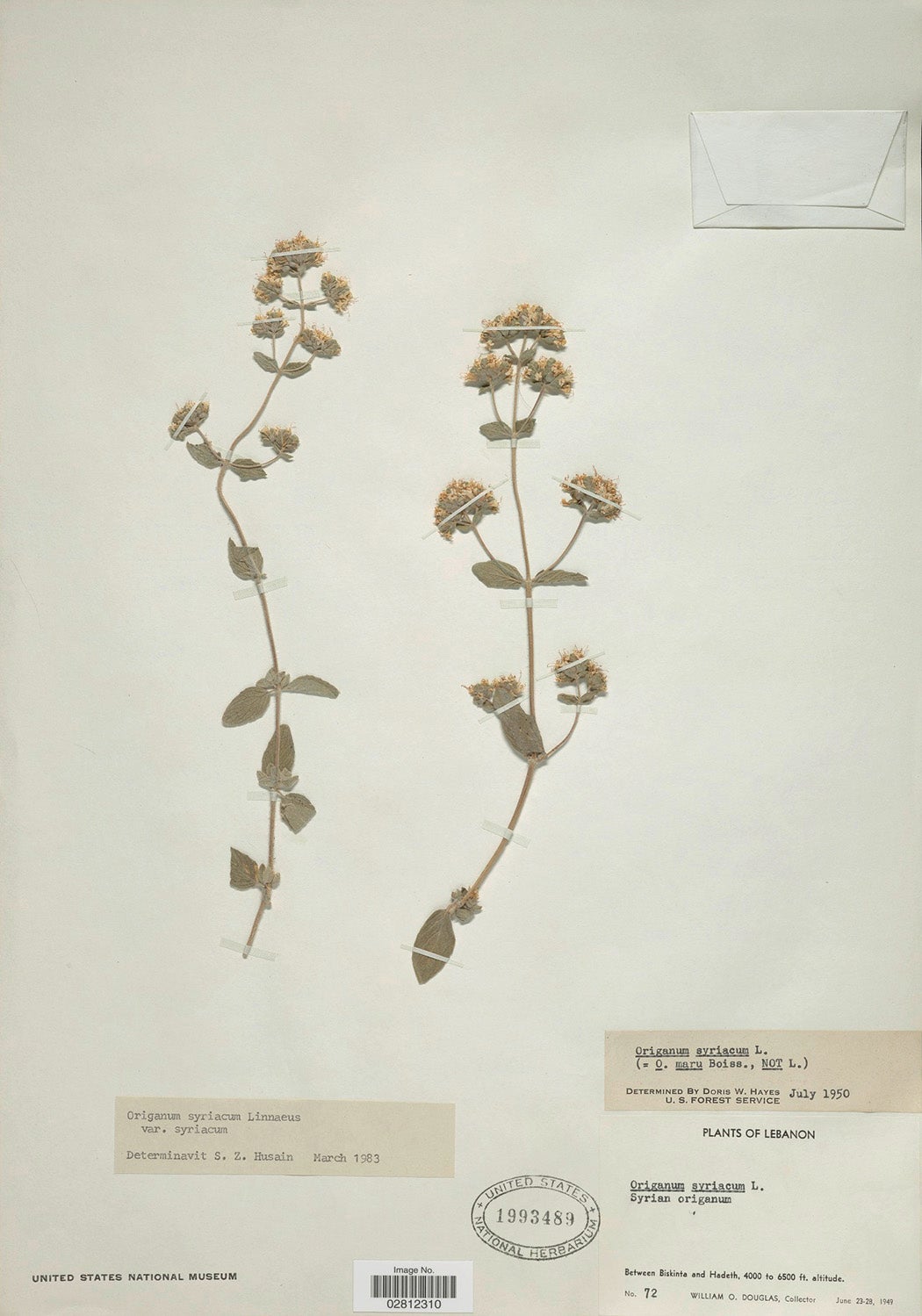
Some flavors whisper of home, speaking a language rooted in place and memory. For those living in the Levant, the slightly bitter and spicy notes of za’atar have been a symbol of heritage, culture, and resilience for centuries: an indispensable herb in tenth-century cookbooks, the heart of a rich communal harvesting, and the driver of poetic emotion. In these retellings, the plant’s name, transformed through time and languages, has acted as a passport allowing the herb to cross the boundaries of geography, culture, and identity, and with that acquire new meanings: Syrian oregano, Lebanese thyme, biblical hyssop, or, in Linnaean terms, Origanum syriacum.


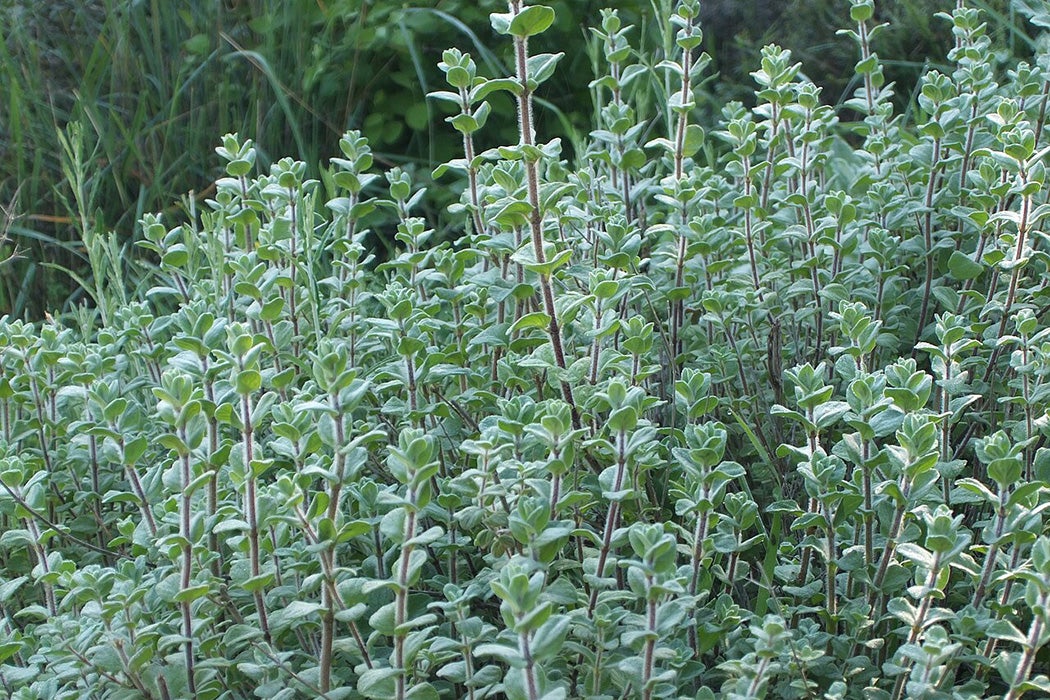
Today, in its dried and ground form, za’atar is best known as the central ingredient in the spice mix that has come to represent Palestinian cuisine worldwide. This herbaceous perennial grows abundantly in the rocky terrain of the Eastern Mediterranean and Sinai Peninsula, standing only about a meter tall, with fuzzy, spear-like leaves growing on hairy, square-shaped stems.
While naturally a free-growing shrub that carpets hillsides, za’atar has found itself at the bench in Israeli courtrooms as the first edible plant to be red-listed in the country’s law. This 1977 ban, based on environmental and overharvesting concerns, labelled za’atar as both a protected plant and a contraband commodity. In the same year, further Israeli laws encouraged the domestication of the plant and the expropriation of the land it grew on, consequently displacing centuries-long mutually beneficial relationships and threatening both the plant and the land’s ecological health.
The plant thus finds itself at the center of a controversy, with its rootedness in cultural heritage standing in opposition to its status as a politicized commodity, removed from its soil to assert control over land, people, and culture.
Za’atar has been a longstanding ingredient in West Asian food traditions. This pungent herb appears in the oldest surviving Arab cookbook, the tenth-century Baghdadi Kitāb al-Ṭabīkh (كتاب الطبيخ, The Book of Dishes), where it is recorded as saatar and translated as thyme. Written by Ibn Sayyār al-Warrāq, an Iraqi culinary author from Baghdad, the book compiles two centuries’ worth of recipes from the caliphs and councils, blending Persian, Greek, and Arabian culinary traditions. While many recipes feature uncommon regional ingredients, za’atar (الزعتر) is described as a typical garnish and essential herb for both daily and festive dishes in the book.
It was not until the thirteenth century that za’atar’s culinary identity would reach its full expressive potential through key cookbooks, such as Muhammad bin Hasan al-Baghdadi’s Kitāb al-Ṭabīkh, produced in Baghdad, and the Syrian Kitāb al-Wuslah ila l-habib (كتاب الوصلة إلى الحبيب, The Link to the Friend). Their authors were instructed to write detailed recipe instructions by mixing second-person instructions with third-person descriptions, which could be easily passed on and read aloud to illiterate cooks. Za’atar was mentioned in recipes for almost all of the 635 dishes in the books, accompanied by phrases such as “make sure to use plenty of thyme, since it’s the ingredient whose color and flavor should preponderate.”
These cookbooks, which form the basis of modern Levantine cuisine, elevated recipes to the status of written culinary memory. The most notable and variable recipe, preserved in both written and oral traditions, is the za’atar spice mix that bears the herb’s name. It is said that there are as many variations of za’atar as there are families in West Asia, but all start with the za’atar herb.
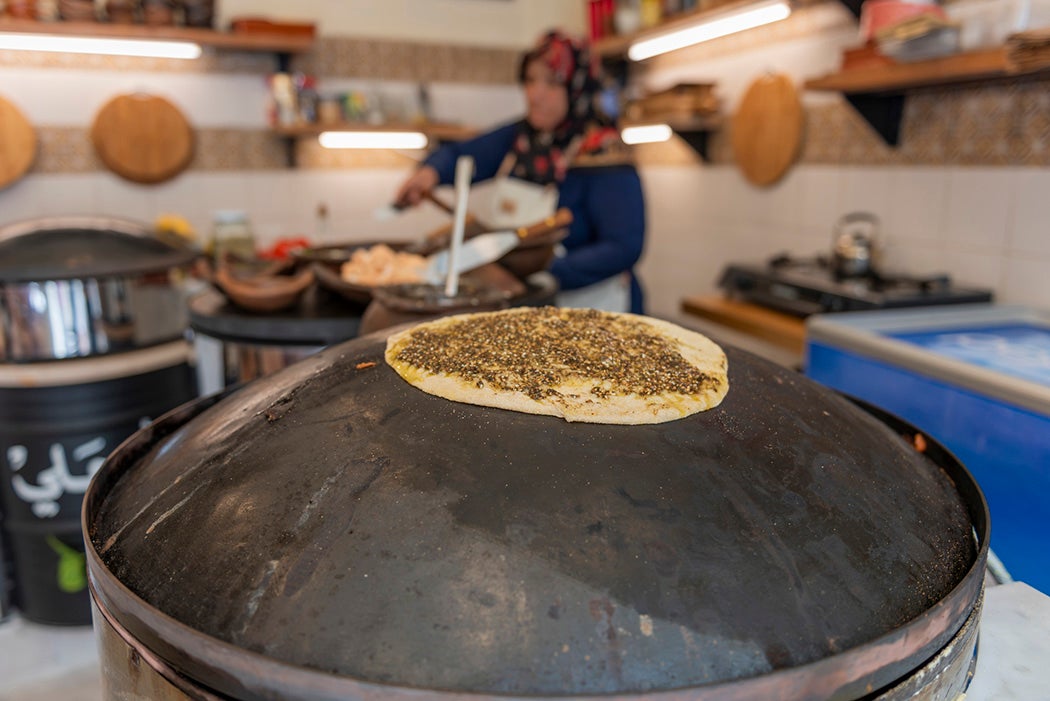
This herb was also a key component of various purification rituals. Mentioned in the Book of Exodus as biblical hyssop, or in the Hebrew bible as ezov, za’atar symbolizes the washing away of sins. The plant was also presented as a treatment for respiratory illnesses and bacterial infections in De Materia Medica by ancient Greek physician Dioscorides’ (40-90 CE). It was later cited in the Tibb-e-Nabawi (الطب النبوي, Prophetic Medicine) in 14th-century Damascus, which also notes za’atar’s use to fumigate the interior of homes.
More recently, za’atar’s cultural resonance extended to other, previously uncommon contexts. Palestinian poet Mahmoud Darwish writes of two hands “of za’atar and darkened stone,” making the herb the protagonist of his 1976 poem Ahmad al-Za’atar about the aftermath of the Tel al-Za’atar (Hill of Thyme) massacre, when a Palestinian refugee camp in Eastern Beirut was targeted during the Lebanese Civil War. Here, za’atar becomes a symbol of Palestinian identity and bond with the land: “To those hands of za’atar / and darkened stone, / I voice this cry: / To Ahmad / Forgotten and alone.” Through the motif of za’atar, the poem illustrates the violence and resistance experienced by the Palestinian people from the early-twentieth-century revolts to the Nakba of 1948, a mass displacement and dispossession of at least 700,000 to 750,000 Palestinians from their homes, and its enduring consequences today.
More to Explore
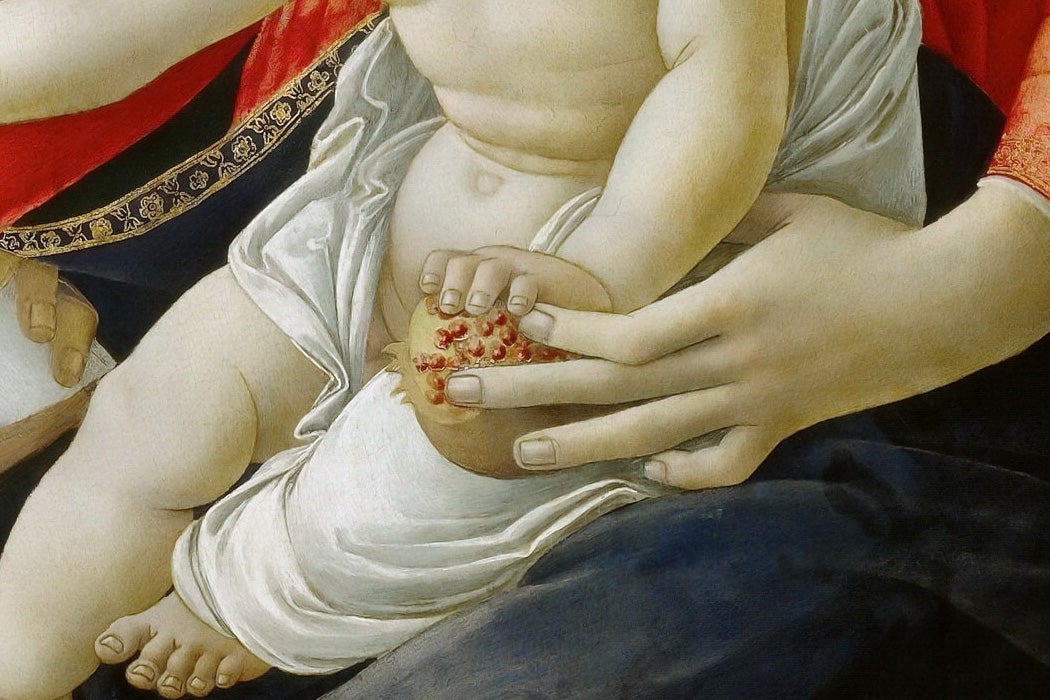
The Pomegranate in History and Myth
In response to ongoing dispossession, acts of cultural preservation emerged as a form of resistance, including the centuries-old Palestinian tatreez—a tradition of embroidering the thobe (a long, flowing linen or cotton dress) with “symbols of history, memory, and place.” It became central to Palestinian life to continue documenting and enshrining local agricultural traditions to assert the “inextricable bond[s] to the land” and to resist the growing settler ideology, popularized by early Zionist and Anglo-Jewish writer Israel Zangwill in 1901, that Palestine was “a land without people for a people without land.” One of these strategies is documenting the harvesting of za’atar. In their work, titled the “Forbidden Plants of Palestine,” mixed-media artist Shereen Quttaineh emphasizes the role of tatreez in archiving centuries-long plant-human narratives as a “testimony of endurance, belonging, and the fight to keep [Palestinian] heritage alive,” as well as a display against the Israeli attempt to erase local ecosystems and impose their own ecology through the courts.
Healthy ecosystems lie at the foundation of za’atar’s harvesting tradition, and yet the reasoning behind its ban makes this practice sound ecologically unsafe. For Israeli food scientist Uri Mayer-Chissick and botanist Efraim Lev, the heart of this environmental threat lies in the “excessive gathering combined with the growth of the [Arab] community,” referring to the increased use of refrigerators to store the alleged supply of overharvested za’atar during the off-season. In contrast, Professor Muzna Bishara, a noted linguist at Haifa University, outlines the intention of sustainability in za’atar’s harvesting tradition, explaining it as a communal project that begins in early winter and spring, when the risk of damaging the plant’s reproductive capacity is low. She describes it as a multi-step process that starts with surveying the land and then harvesting with “our backs bent, as if surrendering to the plants.” Lastly, harvesters take particular care in picking the aerial parts of the plants, protecting the roots for future seasons and stimulating growth that can double the plant’s size.
Weekly Newsletter
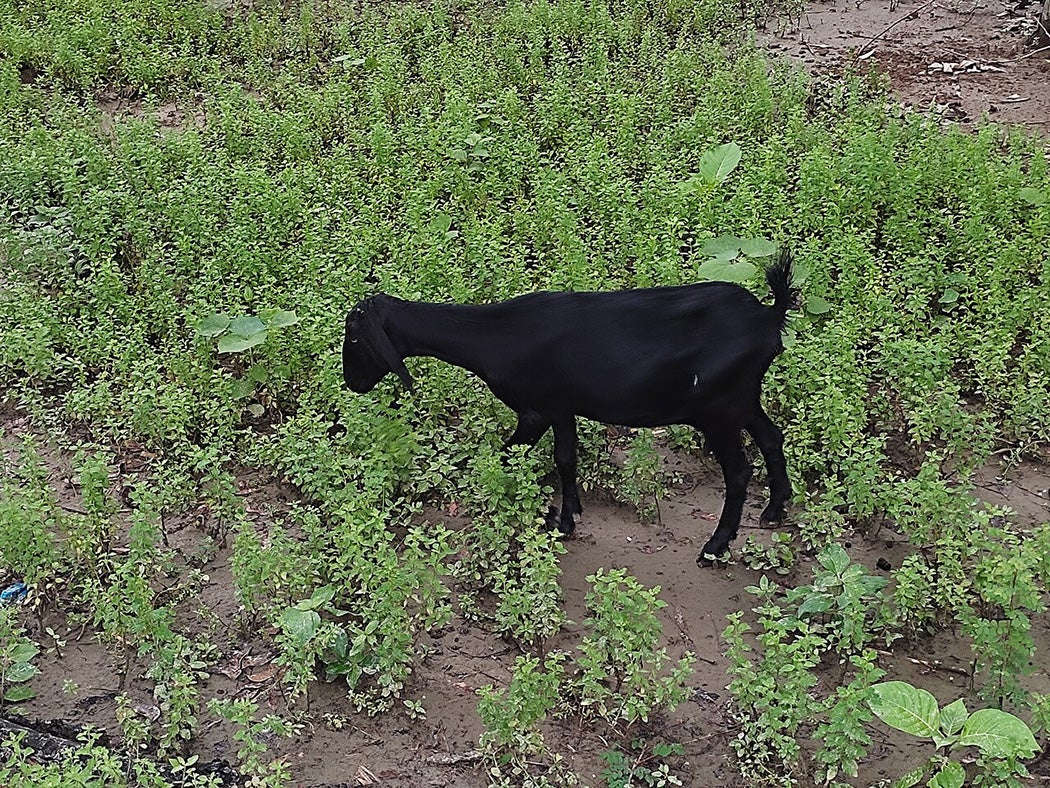
The yearly harvest of the bushy herb usually involves three actors: za’atar, Palestinians, and the black goat. The Israeli government sought to undermine this tradition of multispecies interaction. It targeted the native Palestinian black goats in 1950 by enacting the “Black Goat Laws,” which accused them of overgrazing the land and damaging the plantings of soil-acidifying pine, thereby criminalizing their herding by the Arab farmer, the fellah. In the same year, imports of non-native white goats and plants from Switzerland increased. Soon after the laws’ implementation, gatherers saw a decline in the quantity and quality of wild za’atar. This was due to a disruption in the “natural trimming by gatherers and goats,” as Muzna Bishara states, which “strengthened the plants and helped them grow fresh branches in the following year.” Moreover, the native black goats played a vital role in wildfire prevention practices, so that, with their removal, fire risks began to slowly increase. Concern about the goats’ environmental impact diminished by the 1970s; however, during the same decade, the Green Patrol of Israel increased its enforcement of the ban, with methods so brutal that the State Comptroller censured the unit in his 1980 report. As a result, the herded goat population fell from 220,000 to 80,000. By 2013, only 2,000 goats were left, and, although the ban was repealed in 2018, it had already left its mark: quietly removing “dunam after dunam, goat after goat”— a reference to an Ottoman unit of land measurement where the goal was to take Palestine piece by piece.
During the implementation of both the 1950 and 1977 bans, deadly assaults and the development of land by the Israeli government grazed over za’atar’s home hills. As a botanist and professor at Hebrew University of Jerusalem, Nativ Dudai asserts: “No one talks about the fact that we [Israel] destroy much more za’atar than the Arabs pick. Do you know how many great za’atar populations were uprooted by [our] bulldozers?” This tendency was further expressed in the domestication of za’atar. In 1977, Israeli officials encouraged the domestication of the plant on kibbutzim—settlements established on seized and redistributed Palestinian land in violation of international law. Echoing the earlier concerns over refrigeration, the domestication of za’atar highlights an attempt to take control over the land and its people, resulting in the land’s destruction, veiled as a way to counter an environmental threat.
In fact, the Minister of Agriculture of the West Bank at the time, Ze’ev Ben Herut, stated in a televised interview, “Za’atar is all good and beautiful … but the business has to bring back money.” The increased cultivation of O. syriacum funded by the Israeli government is an attempt to use za’atar to appropriate traditional local knowledge as a means to generate profit and to control the movements of the Palestinian population and the plant itself. This tendency is highlighted by the human rights organization and legal center, Adalah, in a document outlining the unlawful targeting of fellahin (farm-working) and Arab communities, where, in 2016–2018, twenty-six indictments and one hundred fifty-one fine notices were issued for offenses related to this plant, all of which were supposedly committed by Palestinians.
What once was a common herb that moved freely and was seen as a healer and community-maker is now perceived as both a threat and a mercenary to a broader development goal. And while the multiplicity of za’atar’s names carries a certain richness, it also generates fragmentation and constraint, as manifest in legislation that attempts to delimit its movement and disrupt the reciprocal relationship with land and local communities that it traditionally sustained. The Plant Humanities Initiative at Dumbarton Oaks seeks to explore plant-human relationships as illustrated by the case of za’atar, and to underscore the intricate connections between plants and human society.