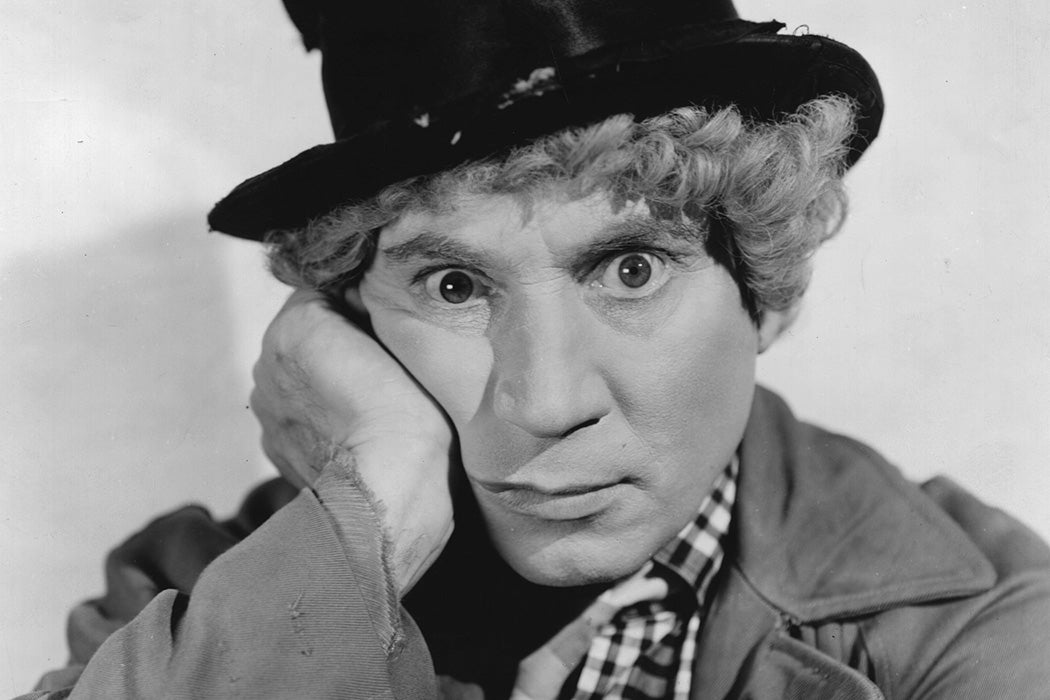
Among the five Marx Brothers—vaudeville legends turned Hollywood comedians whose films defined American screen comedy in the 1930s—Harpo stands out. Silent and seemingly childlike, he plays something between a pure fool and a savant. The French psychoanalyst Jacques Lacan, better known for his dense reinterpretations of Freud than for film criticism, was fascinated by him. In Seminar VII: The Ethics of Psychoanalysis (1959–60), Lacan described Harpo as having a “face with its smile which leaves us unclear as to whether it signifies the most extreme perversity or complete simplicity.” He adds that “this dumb man alone is sufficient to sustain the atmosphere of doubt and of radical annihilation which is the stuff of the Marx Brothers’ extraordinary farce and the uninterrupted play of ‘jokes’ that makes their activity so valuable.”


Why would one of the twentieth century’s most influential psychoanalytic thinkers devote such attention to a slapstick comedian? In an article in Cinema Studies, Paul Flaig examines how Lacan’s interest in the Marx Brothers reveals larger stakes about how we understand the pleasures of watching comedy. Tracing Lacan’s reading of Harpo through concepts such as das Ding, jouissance, and objet petit a, Flaig suggests that Lacan saw in their films alternative forms of spectatorial enjoyment—namely, “forms that emphasize the surreal possibilities of the comic ranging from slapstick violence to screwball wordplay.”
First, Lacan uses Harpo Marx as an exemplification and embodiment of das Ding (“the Thing”), or the original lost object of satisfaction that the psyche can never recover. For Paul Flaig, Harpo gives comic form to this abstract idea. “Yet the comedy embodied in Harpo’s face and in the overall ‘radical annihilation’ of the Marx Brothers’ farce is not one of some humanist-imagined mortal body but is instead profoundly inhuman—an excessive ‘passion’ that drives signification off its rails,” writes Flaig. “Harpo, far from acknowledging the deathly mystery of the Thing, reveals that such mystery is a ridiculous object, a bit of nothing that can only end in all sorts of perverse situations.” In Flaig’s reading, Harpo’s body seems indestructible and, ultimately, its perversion and simplicity are one and the same.
For Lacan, Harpo’s defining trait is his dumbness. Harpo’s character is mute, therefore simultaneously an idiot—someone who can’t write, speak, or listen. His face is described as “present,” “pressing,” “absorbing,” “disruptive,” “nauseating,” and “calculated to thrust everything that takes place before us into the abyss or void.” His comedy does not directly relate to the Symbolic (the realm of language, law, and social structure that structures the subject, dictating meaning and identity through the network of signifiers) but is laterally tied to it as “erupted excess, surprising stain, and bothersome byproduct,” writes Flaig.
Lacan’s concept of jouissance—the transgression of a subject’s regulation of pleasure—offers another lens for understanding Harpo. As Flaig writes, “Harpo is an automatic object-machine that converts both the world and himself into a polymorphously perverse source of jouissance.” For Lacan, jouissance begins with a tickle and ends in a blaze of petrol. That trajectory describes Harpo Marx and the effect he has on the events that unfold within the Marx Brothers’ films.
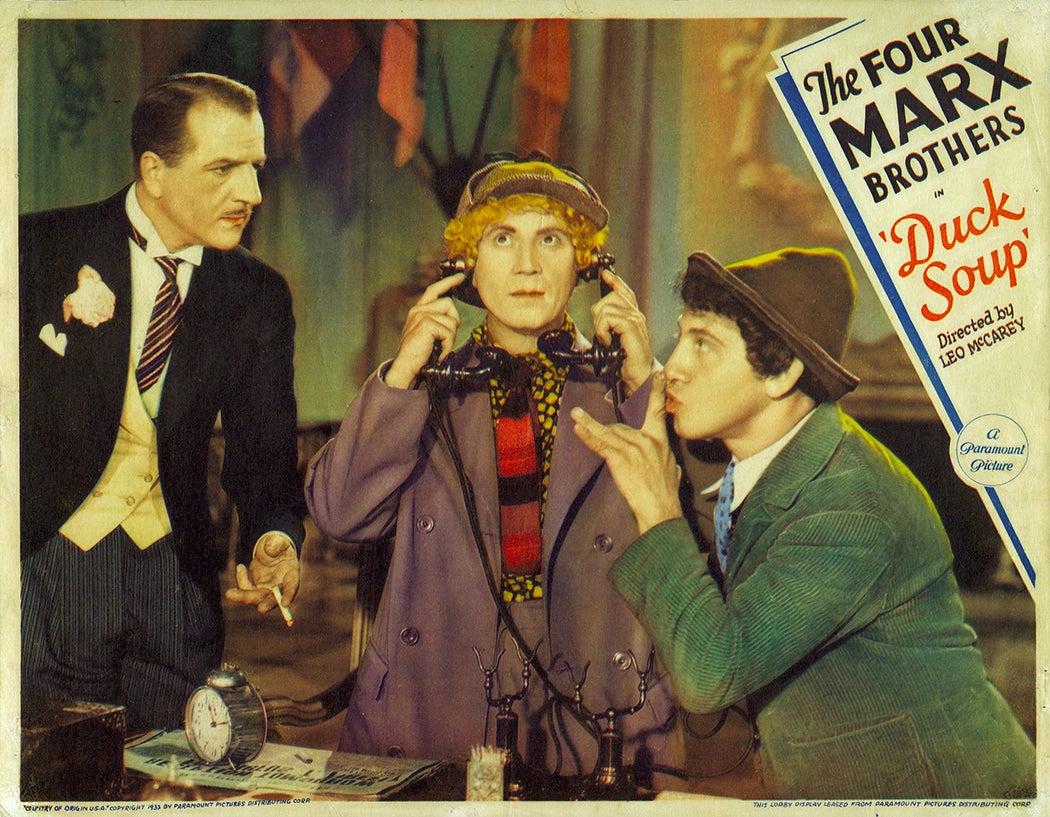
In Duck Soup (1933), for instance, Harpo follows Chico through the ornate room of an ambassador, grinning. When the ambassador passes him a note, he tears it up because, as Chico explains, he cannot read and thus gets mad. Offered a cigar, Harpo first tries to light it with a phone, then produces a blowtorch from his trench coat; moments later, he sneaks behind the ambassador and snips his freshly lit cigar in half with scissors, also drawn from his coat.
Asked for the records of a foreign prime minister, Harpo produces a phonograph record—again from his trench coat—frustrating the ambassador, which prompts Harpo to shoot it with a handgun. He cuts the tails off the ambassador’s jacket, glues a piece of newspaper in their place, and shakes hands with a mousetrap. This sequence perfectly captures comedy that “starts with a grin” and “ends in a blaze.”
Lacan sees Harpo’s structural function as objet a—the “object-cause” of desire, or the element that keeps desire in motion. In this context, the other brothers complement the system. Harpo’s function as the destructive agent of enjoyment suggests that the “atmosphere” sustained in these films is analogous to Lacan’s discourse of the analyst, where each term operates in new, unexpected, and funny ways.
If Groucho dominates the Marx Brothers’ films, initiating their plots and situations, he does so as the “master signifier,” or S1—the figure who lays down the law, as opposed to the objet a that Harpo embodies. As Flaig explains, “Both Groucho and Harpo rely on this difference in their comedy, but while Harpo repeats the mute no-Thingness at the heart of signification, Groucho repeats the joking difference left in the wake of that muteness.”
More to Explore
Sigmund Freud’s The Ego and the Id
Chico navigates between Harpo and Groucho. “If Groucho represents the ridiculous authority of the Symbolic Order, then Chico is one who has not yet learned how useless that authority truly is,” Flaig continues. In both films and radio shows, Groucho frequently tries to enlist Chico in some scheme, only to find that Chico cannot grasp what is being asked of him. In Duck Soup (1933), for example, Groucho asks Chico’s character whether he would like a job at the Mint. Chico replies, “I don’t like the mint. What other flavors you got?”
“Not as dumb as Harpo, Chico knows how to do things with words, but he does not have a handle on them like Groucho,” Flaig explains. “Most of Chico’s joking comes from mistaking the sound of one word for another—somewhere between Harpo’s literalisms and Groucho’s punning.”
Weekly Newsletter
These interactions culminate in the climactic scenes of the Marx Brothers’ films, where reality distorts into surreal farce. The end of each film provides a paradigmatic extension of this revolutionary movement of figures. In A Night at the Opera (1935), for example, Groucho begins selling peanuts at the opera, while Chico and Harpo replace the orchestra’s sheet music with “Take Me Out to the Ballgame,” begin to beat each other with violins, and change the set backdrop for La Traviata (1853) into a battleship, a modern city street, and a series of other ridiculous sets. In Duck Soup (1933), after Groucho’s character declares that the fictitious country of Freedonia has won the war, they pelt the main antagonist, Trentino, with fruit—but when the wealthy Freedonian benefactor Mrs. Tisdale sings the country’s national anthem, they proceed to throw fruit at her instead.
Overall, their comedy allows us to enjoy the perverse destruction and surreal recombination of reality. “Encountering that nothingness—the abyss of Harpo’s face—and the space for play opened by that encounter, we, like the analysand, confront the stupidity of being and find a means to enjoy ourselves as its meaningless symptom,” explains Flaig. “When we laugh at the Marx Brothers, we are not laughing because we know better than these idiots, nor are we taking pleasure in the suffering of their victims; rather, we are laughing at the nonsense of ourselves and of our world—the nonsense that infects the sense we have of who we are and what our world might mean.”