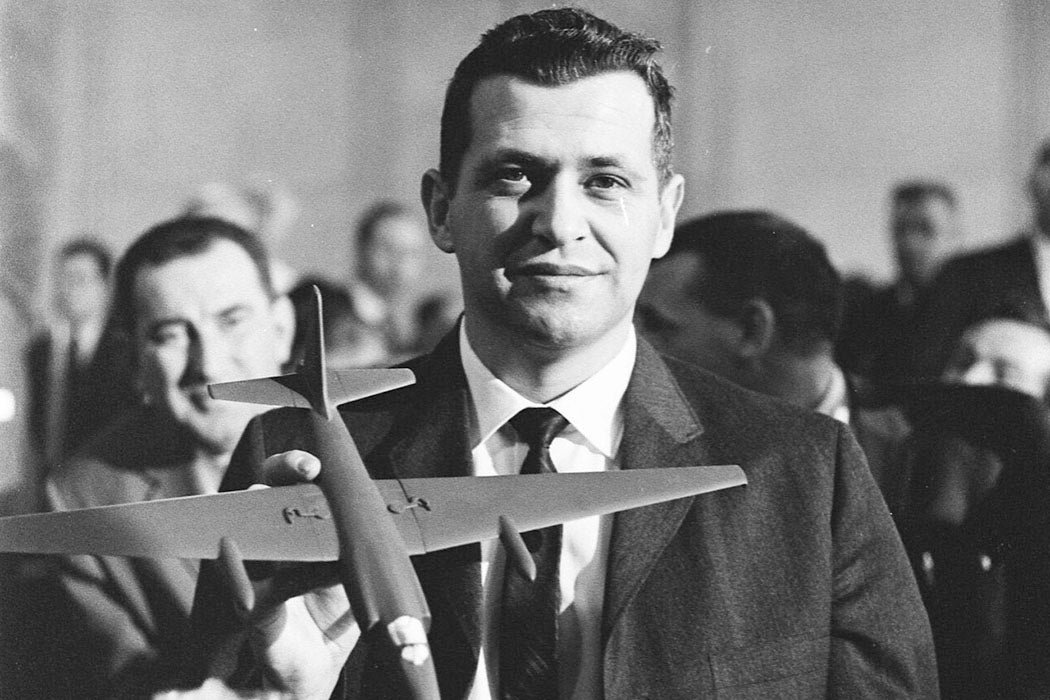
The May Day 1960 downing of a US U-2 spy plane over the Soviet Union was one of the most famous incidents of the Cold War—and an extraordinary pile-up of mis- and dis-information. John A. Schell tells the story with the help of Soviet archival material available in English for the first time.


Schell explains that U-2 overflights of the USSR were operated by the CIA because it was thought that a US Air Force (USAF) designation would be construed as more belligerent. The CIA’s cover was that the planes were doing high-altitude weather research for the National Advisory Committee for Aeronautics (NACA) and then the National Aeronautics and Space Administration (NASA). Shot-down U-2 pilot Frances Gary Powers was a retired USAF captain working as a civilian for the CIA; his mission ID read “USAF Air Weather Service GS-12 Francis G. Palmer.”
By the time of Powers’s flight, the CIA was aware that the Soviets could track U-2s almost from the moment they took off. Schell writes that they chose not to reveal this information to President Dwight Eisenhower. Because of the extreme sensitivity of overflights—they could be construed as acts of war—the president was the sole authorizer of the missions.
The first U-2 overflight of the USSR was in 1956. The mission then was to find out how many new M-4 Bison long-range nuclear-capable bombers the Soviets had. The Soviets (and a USAF eager for more funding) claimed they had a lot. It turned out they didn’t have many at all.
As the inevitability of losing a plane and causing an international incident increased, Eisenhower stopped authorization for flights in March 1958. In September of that year, a US C-130 reconnaissance plane flying along the Turkish–USSR border strayed into Soviet air-space and was shot down, with a loss of all seventeen aboard.
And then, the Soviets launched a propaganda campaign claiming they had a superior number of Intercontinental Ballistic Missiles (ICBMs). “We are making missiles like sausages,” boasted Soviet Premier Nikita Khrushchev in December 1958. It was pure bombast, but in the wake of Sputnik, the US Congress, the press, presidential candidate John F. Kennedy, and what Eisenhower would ultimately call the “military-industrial complex” all began to bemoan a nonexistent “missile gap.” U-2 overflights were resumed to track Soviet ICBM numbers, which were shown to be way overblown.
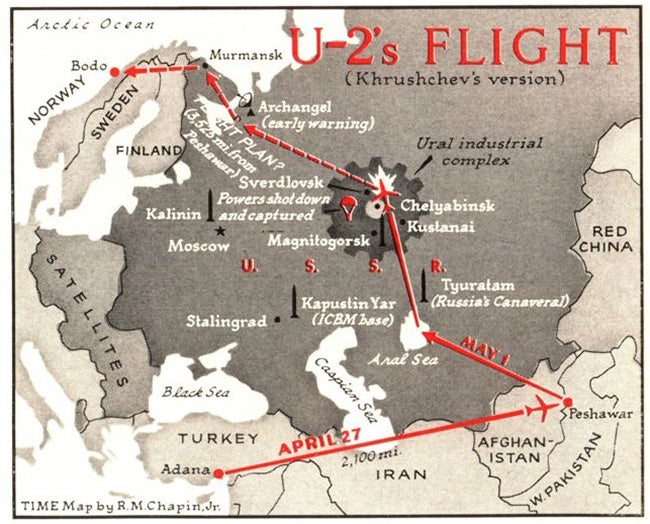
Powers’s mission, code-named Grand Slam, was a 3,800-mile route from Pakistan to Norway, with 2,900 of those miles across Soviet territory. It was supposed to take just under ten hours, at a crushing height of 70,500 feet. About four hours in, his plane was hit by a SA-2 surface-to-air missile. Schell notes that another SA-2 fired at the U-2 accidentally destroyed a Soviet jet scrambled to intercept the overflight. (An SA-2 also destroyed a U-2 over Cuba in October 1962, resulting in the only known US fatality from enemy action during the Cuban Missile Crisis.)
More to Explore
Convincing Peasants to Fly in the Soviet Union
After Powers’s plane went down, the US claimed it was an off-course weather research flight. Since the Soviets initially made no mention of the pilot, Powers was presumed by the US to be dead. In fact, he had managed to get out of the cockpit and parachute down.
Khrushchev let the US broadcast its tale until May 7, when he revealed that Powers was in custody. The American government was caught with its pants down and Cold War egg on its face. Khrushchev then dramatically walked out of a scheduled Paris summit that had been designed to continue the thaw ignited at Camp David with Eisenhower eight months before. The Cold War froze up all over again.
Weekly Newsletter
Powers was sentenced to ten years for espionage. He served twenty-one months before being exchanged for a Soviet spy—a deal initiated by his father. When Powers returned to the US, he faced criticism for failing to self-destruct the U-2 and/or himself via poison he carried on a pin inside a silver dollar. He was cleared of all allegations of misconduct. He died in 1977 at the age of forty-seven when the helicopter he flew for a Los Angeles television news station crashed. The CIA posthumously awarded him its highest medal.
The wreckage of Powers’s U-2 is on display in Moscow’s Central Armed Forces Museum. Amazingly, sixty-five years later, more than two dozen of the 104 U-2s built between 1955 and 1989 remain in active service. Although satellites and drones are now the primary forms of “eyes-in-the-sky” intelligence, the U-2 remains useful for its flexibility. Repeated plans to retire the planes have been put off. Earlier this year, it was reported they were being used to surveil the US/Mexican border.
Support JSTOR Daily! Join our membership program on Patreon today.