For the final episode in our series Perspectives on Public Space, Sara Ivry speaks with Nate Storring, Co-Executive Director at Project for Public Spaces, a nonprofit organization that unlocks the power of public space to strengthen the well-being of communities around the world. Links to some of the research mentioned in the conversation can be found at the bottom of the page.
Transcript
Sara Ivry: Hi, everybody. I’m Sara Ivry, the features editor at JSTOR Daily, where we’re exploring the idea of public space. Why is public space important? How is it used? What threats does it face? Today in our series on public space, we’re asking what role people play in placemaking and determining how public space is used. With us to do that is Nate Storring. Nate is the co-executive director of the Project for Public Spaces, a nonprofit organization which helps interested communities figure out how to enliven underused spaces and make them once again, or maybe even just for the first time, into thriving centers of activity. Nate, welcome.
Nate Storring: Thanks so much for having me, Sara.
Ivry: My description of the project for public spaces was fairly sparse, and I would love it if you could fill it out. Tell us, what is it that you all do?
Storring: Yeah, so we’re a national nonprofit organization. We’re actually celebrating our 50th anniversary this year, so we’re really excited about that. But Project for Public Spaces, as you said, we do help communities strengthen their public spaces so they can strengthen themselves so that we can be more connected, more resilient, and access all of the benefits that public space has to offer. And so we do that through on the ground projects, where we typically will work with, say, a municipality or a fellow nonprofit to improve a public space. But we also do it through education. So we provide training, webinars, and conferences to help professionals and advocates who are in this space learn more about their craft and also meet each other so that they can work together.
Ivry: And one of the key tools in your toolbox, as it were, is this concept of placemaking, which is sort of all over your website, and I wonder if you can tell us what that is, how does it work?
Storring: Yeah, so placemaking, I like to describe it as a community-based process of experimentation, visioning, and care to change the way people use and experience public space. And so, the end result is that, ideally, these public spaces can become better used and better loved by the community. But to do that, we actually have to invest in a process. And that process is never over. It’s actually something that we can kind of intervene in and try to make it work better. But it’s something that’s happening all the time. We’re constantly shaping the places where we live, the places that we go in our daily lives. So sometimes that process needs to be tweaked in order to get better results for all of us.
Ivry: So, let’s talk about this idea with a concrete example. Maybe you can choose one that you guys are working on or have worked on and take us from soup to nuts.
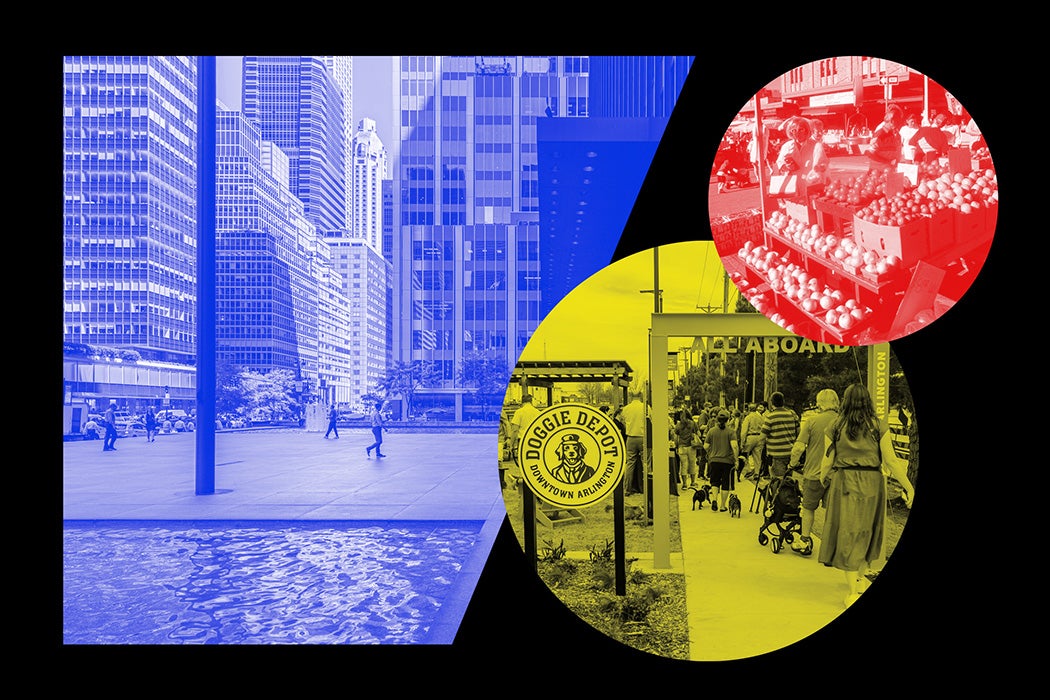
Storring: Yeah, absolutely. So, I’m going to talk about a project called Doggy Depot in Arlington, Texas. And this is a project we worked on through our community placemaking grants program. So, this is a program where we partner with funders to provide a combination of implementation funding and wrap around assistance to communities to help them improve a public space. So, in this case, the space was, you’d call it, I guess, buffer lands next to a railroad track. Which, you know, depending on who you ask, people might not even think of it as public space. It’s just leftover land, but it’s right downtown, and it has the opportunity to be something more.
So, we worked with Downtown Arlington, which is a fellow nonprofit, and what they were seeing was that a lot of people were moving downtown. Suddenly downtown was changing from primarily a commercial area where you would go to work to a place where more and more people were living. And a lot of those people were bringing pets. But there was nowhere to go with those pets. So actually, you know, people were complaining and also you might be seeing some dog waste on the sidewalk. And that’s not so great for anyone. So, they had this idea to build a dog park. So we worked with them to do the community engagement, to actually get all those folks who live downtown, as well as the businesses, to engage with the process and think through what they really wanted this space to be. We helped to solidify all of that input into a final vision and then worked with Downtown Arlington to actually implement it. So everything from selecting the furniture, gathering the materials, assisting with construction, all the way to the opening event. And now it’s actually open in downtown Arlington and has started to become this center of the community for dog owners and others alike.
One of the fascinating things about this project was just that when it kicked off, you know, we all thought that the city owned the land. And as it turns out, the city did not own the land. Instead, the railroad owned the land. So, we actually had to negotiate that through with everyone in order to unlock the potential of this space. And that’s not an uncommon story. Sometimes public space is not actually publicly owned. And that’s one of the complications of working in this field.
Ivry: It seems like a lot of your job is mediation.
Storring: That’s a great way to put it. Yeah. You know, and that involves actually bringing everyone to the table in the first place and making sure you have all the right folks at the table. And sometimes those, maybe people who have never even thought about that public space, but they have the opportunity to benefit from it. It could also be people who are maybe opponents of the project, and those people should be at the table too. And then it really is about mediation and trying to find a path forward that is satisfying to at least most people who are at the table. Consensus is very, very hard, but ideally you’re not going to do any harm by moving forward with a project either.
Weekly Newsletter
Ivry: Well, how do you negotiate that when there is a lack of consensus on a project, whether this dog park or a different project? Is there a specific anecdote you can share where a community reached an impasse about what use they wanted this space to go to or how it would be realized?
Storring: Yeah. So, you know, the way that public engagement is often run in cities is: you hold a public meeting. And what that looks like is, you know, some kind of spare space with fluorescent lights and stale coffee. And everyone is in their seats looking at a stage where some public officials kind of ask questions or present visions and that kind of thing. And what we found is that that often doesn’t lead to very great results. So, one of the things that we like to do in our community engagement process is to actually get people out in the space. And often what we do is we will teach them a guide for observing the public space themselves and evaluating what’s working and what’s not. And we find that that really shakes people out of the biases that they’ve come into the room with. Because suddenly you’re out actually observing things yourself with other people. And it breaks down some of the hierarchies as well. We often will have, you know, public officials in the room, and also residents in the room, who are not quote-unquote professionals in this space. But they actually are totally capable of observing the space themselves and coming to their own conclusions. And so then we invite everyone back, and they come together in small groups to actually discuss what they saw, and, again, it’s a surprisingly levelling experience, as opposed to the typical public meeting where people come in with their agenda, the same people, as always, are the people raising their hands and they’re leveling their agenda. So that’s a starting point for starting to break down some of the conflict is just getting people into that constructive mode of moving forward.
One project that comes to mind in particular is an Open Street project that we worked on. And this, I believe this was in Cleveland. And what was happening there was that we had an applicant that was the city planning department, and they wanted to open up the street to more pedestrian use, more public use, and away from just vehicle traffic. Now, this is often a very controversial sort of thing that happens in public space because, you know, business owners are worried about access. They want people to be able to come to their business. And that means parking to them, right? So, taking away parking spaces to them often reads as, you know, disrupting their business. And sometimes that’s true, and sometimes it’s not. There’s lots of data that would show maybe the opposite, that actually those parking spaces are used by the same one resident all day. It’s not actually their customers or whatever. But data is not always what it’s about. You can come with all the evidence you want, but people often have very firm views about the way their world works. So instead, we had to mediate, as you said. And what the sort of conclusion that we came to was, it was originally going to be two blocks, and we brought it down to one block. And the block that we chose is mostly cultural institutions that felt really strongly about the Open Street and felt that it could benefit from them.
So, that was a fairly simple example, but it can be much more complicated, and sometimes it does end up being a bit more of a campaign than simply everyone getting exactly what they want. Sometimes there are people whose proposal will win and others who may lose out, and that’s not ideal, but it does mean that you have to have a really good case and a really good argument for the majority of people to feel like, you know, they’re going to benefit from it. And that’s often the way democracy works.
Ivry: You mentioned that you invite people into a space and ask them to sort of experience the space and what they observe and you have a set of guidelines. Can you talk about what those guidelines are, what you’re asking them to try to pay attention to?
Storring: Yeah. So we actually started out as more of a research organization observing public spaces. And over the years, we’ve worked in, I think, 3,500 public spaces around the world. And what we found was across all of those, there were four basic characteristics that tend to indicate whether a space is going to be well used and well loved. So they are: uses and activities—in other words, is there stuff to do in the space? If you ask someone why they’re in a public space, they’re probably going to answer with a verb, right? They are going to tell you that they’re there to do something. So that’s a fundamental building block of a successful public spaces, lots of things to do. Comfort and image: Does the space feel welcoming, physically comfortable, mentally comfortable? Does it have a good reputation, right, as being a place that is safe, a place that’s clean, well taken care of? That’s another really important one. Access and linkages: How do you get there? And then once you’re there, how do you get around? And that’s everything from walking and biking to transit to driving, but also things like communications, right? Especially these days, you know, can you find the space on a map? Does it have a website? Does it tell you what’s going on in the space or not? Those are all important aspects of access and linkages. And then finally, sociability: Is it a space where you’re likely to run into someone you know? Is it a space where you like to bring your friends and family? Is it a space where you feel like you’re part of the community because you go to events and where you volunteer and those types of things? And this one in a lot of ways is the “So what?” of public space. We want public spaces that make us feel more connected and battle social isolation. But in order to get to that sociability, you often need to get those other three ingredients right in order for that to be a really great community space. So, we teach those characteristics to folks so that they can come into a public space looking for clues about whether there are enough uses and activities, or does this feel comfortable to me? And that’s the basis of the conversation.
Ivry: Yeah, it’s interesting ’cause when I was looking at the guidelines, or this set of questions on the site, one of them which stood out to me was: Is there roughly an equal number of women and men? Which, of course, yes, as a woman, if you go into a space and you’re the only woman, you might feel more threatened, more on guard. But it never occurred to me to think about that as a sort of metric of how welcoming a space is. It was just sort of, that’s sort of in the ether.
Storring: Yeah. Yeah. I mean, that’s the thing, is that a lot of this stuff, as just people who experience public space, we actually kind of know it intuitively, and you just need something to unlock that part of your brain to be like, “Oh yeah, totally. I’ve experienced that. I get it.” And then pay more close attention to it. And the other thing I think about that that I want to highlight is a lot of the stuff is super subjective, right, especially issues of comfort. And it can be a lens for talking about diversity in public space. When you open up a conversation about, “Oh, I didn’t feel comfortable because of this,” and someone else says something completely different that you maybe hadn’t thought of. It’s a way to start mediating those different experiences as we design public space.
Ivry: Yeah, I was thinking about that too, how Rashomonic this whole process is. You get ten different people going into a single space, you’re going to get ten different impressions of what the space feels like. And how do you make people open up their minds and imaginations to the idea that somebody else’s experience may be fundamentally different from yours and how they are existing in a certain park or thoroughfare?
Storring: Yeah. Well, I think that there’s a couple answers to that. One is that despite the fact that there is, of course, a diversity of experiences, there are also some things that are very universal, like seating, something as simple as, is there a place to sit? And I’ll tell you, a lot of public spaces don’t have adequate places to sit. Some don’t have any at all, some actively discourage you from sitting because they have hostile architecture, and then others just lack a diversity of seating, right? So there’s only one way that you’re allowed to sit. Just this bench, or just this ledge. And if you want to have a conversation with friends, for example, there isn’t really a place to do that. But that’s actually a very universal human experience. And of course, we have to think about things like accessibility and cultural differences around how people want to use those things. But broadly, seating is something that people want. Food. Again, your taste in food may vary, but food and drink is something that humans need to survive. Bathrooms, right? All of these basic things are these kind of fundamental building blocks again. And then you have to kind of build off of them from there. But in terms of accommodating different experiences, a lot of it is about creating some flexibility in the design, having space and amenities that can be used in a variety of different ways at different times or by different people. And that allows all of those, that sort of diversity. I love that Rashomonic experience of public space to coexist.
Ivry: Just yesterday I was waiting at the George Washington Bridge subway stop for my sister to come pick me up and there was nowhere to sit. My son and I were waiting, and it’s very dirty and it smells like cigarettes, and there’s an overpass and all this car traffic, and I was actually thinking to myself, “Why are there no benches here? Wouldn’t it be intuitive to have people be able to sit while they’re waiting?” It was really kind of interesting how this public space was not just ugly, but hostile.
Storring: Yeah. A lot of places are designed out of fear, and it might be fear of, quote-unquote, the wrong people spending time there, or it could also be something as simple as the fear that, “Oh, but then we’ll have to take care of it. Like, if we put amenities in and someone’s going to have to fix them and clean them. And if we just leave it, like, mean, then we can just let it rot.” Even in park design, often one of the things we hear is, “Well, but if you let people do that, then the lawn will, you know, be hurt.” And it’s like, yeah, but isn’t the point of the public space to be used? Right? We have to actually build in the care. If we don’t build in the care, it makes our public spaces meaner. But yeah, you know, the hostile architecture is a real problem. And I think the thing that you put your finger on is in the process of trying to actively exclude people experiencing homelessness or just people who spend a lot of time in public space, we actually make those spaces less comfortable and welcoming for everyone. And it starts to defeat the purpose of what public space managers are trying to do by excluding those people. They think they’re making the space more safe and welcoming, but actually it’s worse for everyone. So we need different solutions that don’t rely on that kind of hostile design and are actually addressing the root causes of things like homelessness, mental health challenges, addiction, in order to get past that impasse.
Ivry: Tell me, how did the Project for Public Spaces get its start? What was the genesis of its whole project?
Storring: Yeah. So, we were founded by a guy named Fred Kent. And then very quickly, Kathy Madden and Steve Davies came on as co-founders to the organization. And Fred Kent worked with a really famous researcher of public space, a guy named William H. Whyte. And he started this project called the Street Life Project, where they were analyzing, really for the first time, in great detail, the use of public space. Starting in New York City, what had happened was the new city plan had made this deal with developers, where developers could build taller buildings, more density, in exchange for building public plazas. Now, the issue is, how do you know if those plazas are actually benefiting the public? Because that’s why they made the deal, right? They felt like they needed more public space. But we didn’t really have the tools at the time to know whether they were serving their job and whether we were holding developers accountable. And so William H. Whyte took this fairly new technology at the time, video cameras, consumer-grade video cameras, and created a methodology for observing public space, how people are using it, and then coming to some conclusions about what’s working and what’s not. And in the process, he kind of invented this science of public space.
So, just for one example, he, you know, he studied the Seagram Plaza in New York City in great detail. And what he was looking for was, you know, how many people are moving through the space? How many people are sitting on the ledges? At what time of day? What seems to be the factors that are driving it? Is it the sun? People are seeking the sun? Is it the shade? Is it something else entirely? And our founder, Fred Kent, worked as an intern, basically, on that project. And Project for Public Spaces was started to continue that research, extend it, and then put it into application. So, actually taking some of the insights that emerged from that research and bringing it to public spaces to help improve them. And over the years, that really evolved from this very expert-driven approach of like, “We’ll come and observe your public space and tell you what you should do!” to one that’s more rooted in community engagement. And that process that I just told you about going out into a public space with the community is actually rooted all the way back in that research with William H. Whyte. It’s—instead of us doing the observation, we’re inviting the community to do the observation themselves and use that as the basis for community engagement.
Ivry: And what about you? What’s your professional background?
Storring: So I went to art school. And then I went to school for kind of managing cultural institutions and nonprofits. But all the way along, the thing that I was most curious about was getting people more involved in the design and planning and policy of cities. Because there are these places that we live, and they affect our lives so much. And yet, I think to most people, they just feel like a fact of life that just happens around you, and you’re born into it, and you just deal with it, and that’s it, right? You don’t have any control over it. But there are actually these levers where you can get involved. And helping people understand what those levers are and make more opportunities for people to be engage is what really excites me. And so that started out as just, you know, doing like an exhibition where you talk about a particular issue and get the general public involved in it. And more and more, I wanted to dig deeper and get more to the point of like, let’s not just raise awareness. Let’s actually get people directly involved. And that’s what we do at Project for Public Spaces.
Ivry: The Project for Public Spaces described itself as cross-disciplinary. What does that mean exactly, and what kinds of expertise do you need to create a widely functional public space?
Storring: Yeah, so I like to sometimes describe us as an island of misfit toys. There’s a lot of us who were trained in one discipline and felt maybe a little on the edge of it, a little out of place, and like the core of that discipline was not totally addressing the thing that we cared about the most. And coming to Project for Public Spaces was like, oh, these are my people. We share all these values. So we have folks on our team that are city planners, of course, landscape architects, but also people with more of like a sociology background. My co-executive director has a background in operating farmers markets. And so we really come from this wide diversity of different experiences around public space. And I think that that really lends itself well to our approach, which is all about inviting everyone’s expertise to the table. Because, again, even if you just walk through a public space every day, you know something about it, and it’s important to honor that knowledge.
Ivry: Placemaking isn’t the only initiative that you all undertake over there at the Project for Public Spaces. There’s also this thing called Market Cities, and I wondered if you could briefly tell us what that is.
Storring: Yeah, so our Market Cities program is something that’s been around in one form or another since 1987. And what it really grew out of was this recognition that markets, farmers markets, other types of public markets, even flea markets, all of those things are important public spaces in the broader ecosystem. And it’s interesting because sometimes when we talk to other organizations, they don’t even consider those public spaces because they’re a place of business as well. But the way we see it is they do contribute to our social life. They do contribute to our economies, our health, all of those things. And so you cannot ignore them as part of our broader public realm.
And so over the years, what that program has evolved into is really a mix of still on the ground projects, but more and more around convening market managers, managers of market systems from around the world, to improve the way that those market systems operate and also the way that they’re treated in public policy. Because again, like, we saw this during COVID, for example. When COVID happened, many, many markets were shut down because they just operate under event permits. They’re considered special events. Even if they’ve been happening for ten years, they may still be just considered special events. And that meant that healthy food got harder to access. And yet they were actually better positioned to adapt than like a grocery store because they’re outdoors. They have flexible setups. So, we see those types of issues arise all the time with markets because they’re treated as kind of informal, treated as special events and not as places that have this sort of enduring value to communities. So, what if we built markets into our resilience planning so that when something happens, they’re there ready to respond with healthy food, they have the ability, but they’re just not often planned for. So, that’s the Market Cities program. We have a network that operates through that, a conference, trainings, and those on-the-ground projects that all help to support stronger public markets.
Ivry: You mentioned COVID, and I did have a question related to that, which is: In the early months of COVID, when people, you know, were avoiding being inside together. I think we all saw the need for outdoor, usable public spaces that we could congregate in. Has that feeling of the importance of public spaces continued as the pandemic has kind of died out? I mean, is there still a sense of urgency of “We need to cultivate places where we can congregate that are outdoors”?
Storring: Yeah, I think the thing that has endured is this understanding of social isolation. People now feel it much more acutely than before the pandemic, and I think it was there before that, but now we’ve experienced what it’s like to be really deprived of that social contact. And, so, we get inquiries, for example, about the idea of third places all the time, which maybe this has come up on the series or not, but third places are, are these community gathering places where we access other people—usually acquaintances, not people we even know that well—could be a coffee shop, could be a bar, could be a barber shop. Could be, you know, any number of different types of places. Often they’re actually not public spaces, because they might be a local business. But we get inquiries about that all the time now. And I think it’s because people are like, what’s happened to our social fabric, right? And what do we do to fix it? How do we get people off their phones out of virtual worlds, less polarized, not getting sucked into rabbit holes of conspiracy theories, not getting radicalized? All of these things are interconnected, and they have a lot to do with public space.
Unfortunately, I think the flip side of that is that since the pandemic, I actually think policy-wise, we’ve backslided a little bit. Part of it is that a lot of the interventions that we did during the pandemic, like open streets, like dining, street dining, right? A lot of those just got pulled back in many places, and we lost them. And those were actually really good responses that many of them could have had a 2.0, a way where we made it a little bit more permanent, addressed some of the challenges that were emerging from that, but we let that go. The other thing that we’re seeing is a massive pulling back of funding for all different types of public space. And that starts at the federal level, but I think the thing that maybe not everyone appreciates is: The federal government funds states, it funds cities, so things that you would think of as being something that your state does or your city does, they’re going to start going away, too. So that’s really scary, when we think about public space and the investment that’s required to make our streets places where socializing happens, where community happens, and not just places where cars go through, to make sure that our parks and our national parks and our state parks are well maintained and continue to serve their important role. So, it’s a double-edged sword, I guess, in terms of how it’s affected. I think there’s more public understanding of the value, but public policy has really not gone in the right, in the direction that we would like to see.
More to Explore
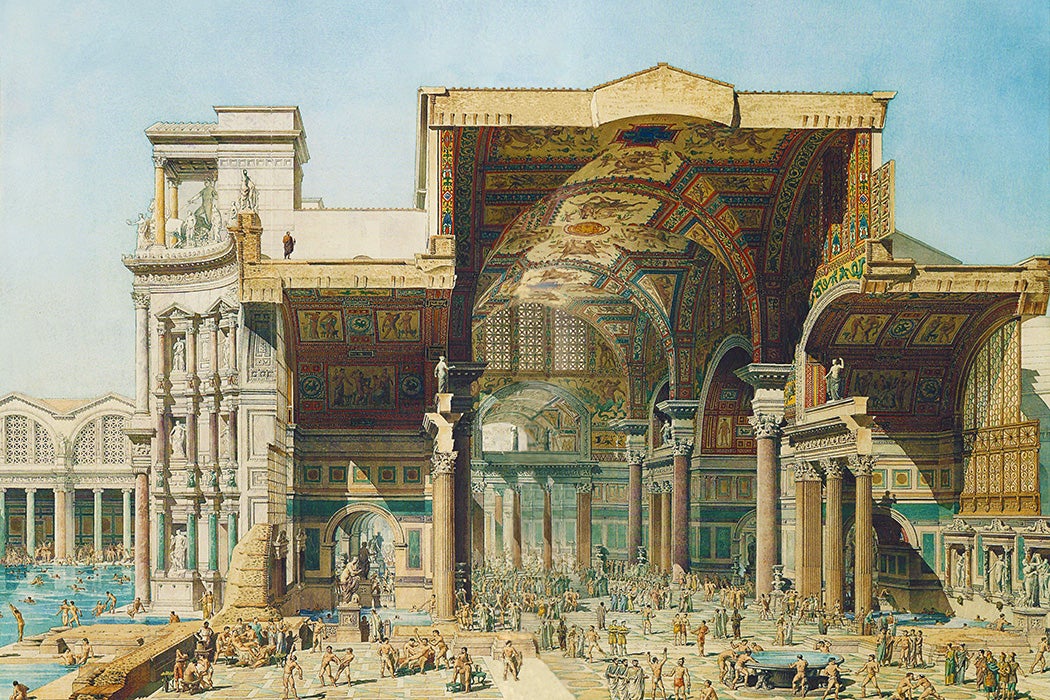
Bread, Circuses, Baths: Bathing in Rome, the Public Way
Ivry: What is the most surprising and delightful example of the reinvention of a, of an underused space into a public space that you have seen, whether in your work or just as a layperson?
Storring: Hmm. Oh, that’s a good question. So, I’ll tell a story about my parents’ street in the town that I grew up in. And it was during COVID, and they were starting to have this feeling of like, “Man, why do we live in this—where we live?” And they were really feeling the politics. They were really feeling just the sort of anger that was brewing at that time, feeling isolated. They had friends locally. But even them, they were, they were only seeing them every once in a while. They were seeing them one-on-one, and they were so used to being involved in, like, all of the arts activities locally, all of that stuff. Eventually, though, they started having some conversations with their neighbors, and they all have these porches. They were all out on their porches and would just say, “Oh, hey!” and then have these conversations. And one of the things that finally came out, probably in 2021 or 2022, was a block party. They all decided that they were going to organize a block party together. And they got off of NextDoor and onto their own chat, that was just a private chat for the folks on the street. And they started organizing it and talking more. And it became this amazing reinvention of their block and the relationship between neighbors in a way that I really think turned around my parents’ perspective on where they live entirely and made them feel reconnected, rejuvenated, and rooted in the place that they live. And the amazing thing is, you know, the block party still happens, only happens once a year, but that chat continues the energy of that block party all year long. And they’re constantly, you know, sharing different things saying, “Oh, I’m getting rid of this piece of furniture. Does anyone want it?” All of that kind of connection stays throughout the year. And so I think that that’s something that I find really inspiring, especially because sometimes it actually isn’t about that investment, as important as it is. There’s a lot that can be done just by connecting and getting organized with your neighbors.
Ivry: That makes me think of the city of New Orleans. I’ve spent a lot of time there, I have good friends who live there, and the second line parades that happen, you know, if somebody dies or if there’s some kind of celebration, that joins communities together and winds through the streets and people are on their porches waving and dancing and how fundamentally important things like dance and music are as unifying elements to bring community together in a public space.
Storring: Yeah, absolutely. I think, you know, certainly music and the arts and more broadly meaning making, right? Coming together to have a meaningful experience together is so important. The fundamental ingredients, I think, of creating great social spaces are about routines and about rituals. Routines are those things we do every day, and, you know, I go to the coffee shop every day because I work from home and I want to feel connected and see other people. That’s part of my routine. And I know so many people in that coffee shop now just because of that regular being in the same place. And then rituals are maybe not as frequent, but they can be incredibly meaningful in terms of feeling like you’re part of a broader community. So yeah, absolutely. The second line events are so important to the fabric of that community and feeling like you’re in New Orleans, like that sense of place.
Ivry: I just want to also add that, speaking of COVID and sort of the musical elements that bring us together, in the early months of COVID, people would open up their windows at a certain point, you know, and bang pans in appreciation of frontline workers. And that was sort of an accessing and utilizing of the public space. I mean, not necessarily a geographic space, but sort of the ambient space that brought everyone together. It’s such an interesting way to think about public space also. It’s not something with a defined border.
Storring: Yes, exactly. I think it’s a bit of a trap to think of public space as only publicly owned land. There are very important things that can happen on publicly owned land, like our right to free speech, for example, that only happen there and don’t happen in your local coffee shop. But if we forget about all the things that touch public space, vacant lots and markets and all of the ever—or the buffer lands next to the train, right, those are all opportunities that are very, very important to take advantage of in order to create this broader social fabric.
Ivry: Nate, thank you so much, this was a wonderful conversation.
Storring: Thank you so much for having me.
Ivry: Nate Storring is the co-executive director of the Project for Public Spaces. You can find out more about their work at their website pps.org. We’ve got six other fantastic conversations in this podcast series on public space. We talk about public lands, we talk about digital space, about the link between democracy and public space, and so much more. They are all available on our website, which is daily.jstor.org. JSTOR Daily is a project of JSTOR and the nonprofit organization, ITHAKA. This podcast series is produced by Julie Subrin and me, Sara Ivry, with help from JR Johnson-Roehr and Jonathan Aprea. Thank you so much for joining us.
Editor’s Note: When this conversation was recorded, Sara Ivry served as Features Editor at JSTOR Daily. She has since moved on from the publication. We’re grateful for her thoughtful work and the care she brought to this series.