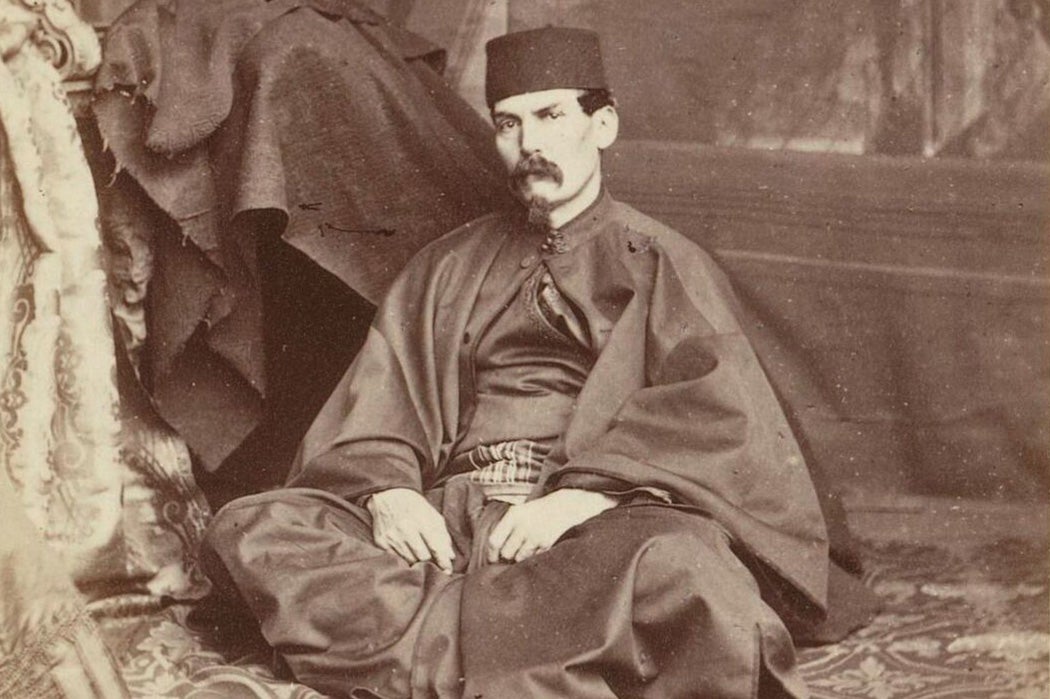
On April 4, 1853, a man named Mirza Abdullah embarked for Egypt from the British port of Southampton. Soon after his arrival, he adopted the title “Shaykh.” Hardly a Shaykh, the man was, in truth, English and named Richard Burton. Perhaps most recognized, and criticized, for his translations of Arabian Nights and the Kama Sutra, Burton also participated in the Hajj, the Islamic pilgrimage to Mecca in present-day Saudi Arabia. Yet non-Muslims are prohibited from Mecca. How, then, did Burton find himself in the center of Islam’s holiest city?


Burton tells us, after a fashion, in his Personal Narrative of a Pilgrimage to Al-Madinah & Meccah, which he began compiling shortly after completing the pilgrimage in 1853. Over the course of its two volumes, Burton detailed his five-month journey. He continued to tinker with the details in subsequent editions, the last of which—a “Memorial Edition” commissioned by his widow—appeared in 1893.
The essential prelude to that narrative began in 1821, the year Burton was born to an army officer and his wife, who raised their children in France and Italy, exposing them from early on to different languages and cultures. Burton quickly demonstrated linguistic flair; he became fluent in the languages of the countries he was reared in, in their regional dialects, and in Greek and Latin. But his linguistic aptitude wasn’t enough to keep him from trouble. He was ill-suited to abiding rules and as a university student was expelled in 1842 from Oxford’s Trinity College for taking part in a prohibited horse race. The banishment proved fruitful; rather than enroll elsewhere, Burton took the opportunity to enlist into the 18th Regiment, Bombay Native Infantry of the British East India Company (EIC). He was twenty-one.
The Sindh Province and the Birth of Mirza Abdullah
Burton soon built a reputation as a devotee of Asian cultures and languages. After a year in the military, he passed the “interpreter” examination for Hindustani, a lingua franca of what we now recognize as Northern India and Pakistan. Burton then passed similar exams for Persian, Gujarati, and Punjabi, and by 1849, he was fluent in five Asian languages, which gave him an advantage in gaining assignments that involved dealing with local populations. This was how Burton found himself enlisted to gather information about brothels trafficking in adolescent boys in the city of Karachi in the Sindh province, which—according to scholar Jonathan Bishop—the British military saw as potentially corrupting of their battalions.
Literature scholar Parama Roy contextualizes Burton’s information collecting methods; where it was common anthropologic practice to procure information from locals, Burton opted to become a local himself. He immersed himself in Sindh culture, recording painstaking details on local custom, mannerisms, and language and, in the course of this education, became familiar with Islam.
Weekly Newsletter
Burton remained in the Sindh province for four years, from 1844 to 1849, during which he developed the persona of Mirza Abdullah, whom Roy describes as a “‘half-Arab, half-Iranian’ merchant from Bushire in the Persian Gulf.” Mirza Abdullah was Burton’s default character when traveling to Mecca, though the disguise was less readily accepted in the Persian Gulf. Burton’s time with the East India Company was cut short after he contracted rheumatic ophthalmia, an eye infection, which kicked off a nearly three-year sick leave that had to be carried out on European soil.
Burton spent his leave between France and England; medical records show that he also suffered from conjunctivitis, digestive issues, and possibly venereal disease. Yet by 1852, his health must have improved. Biographer Jon R. Godsall references a letter Burton wrote on November 6 of that year requesting funding from the Royal Geographical Society’s (RGS) Committee on Expeditions to “[penetrate] into the interior of that part of Arabia which extends from Muskat to Aden, including the provinces of Shayr and Shakr, Hazramaut the Region of frankincense and the Himyaritic land of ancient fame.” By March 1853, Burton had been granted an additional extension of leave from his infantry duties and, backed by the RGS, was ready to apply his immersive study of Islamic culture to the region of Arabia. This was the beginning of Burton’s Hajj.
Why Mecca?
The Hajj to Mecca has traditionally been a sacred pilgrimage reserved solely for Muslims. The holiest city in Islam, Mecca is the birthplace of the Prophet Muhammad and where he received his first revelations. One of the most important religious duties of Muslims able to visit the city is to enter the Masjid al-Haram mosque and perform the tawaf, circling the central stone structure of the Kaaba seven times.
The first known photograph of the Kaaba, toward which Muslims the world over face when they pray, was taken by Egyptian photographer and engineer Muhammad Sadiq Bey in 1861. Before that, much about the Muslim world, its customs, and people seemed to many Europeans to be shrouded in mystery and intrigue. Edward Said famously identified this perspective as paradigmatic of Orientalism, a Eurocentric romanticization of Asian cultures, particularly those within what’s referred to as the “Near East.” Arguably representing the apex of this romance, Mecca was opaque, hidden by a veil Europeans could see but could not touch, only its outline visible. For an adventure-seeker like Burton, entering this space was the pinnacle of masquerade.
“There it lay at last…”
Burton went to painstaking lengths to disguise himself as a non-European Muslim. Roy explains that he feared others in Mecca would consider a European Muslim as inauthentic. He worried that he would be unwelcome and excluded, perhaps even a target for attack. For his journey to be legitimate, he needed to abandon his Englishness and his identity as Richard Burton altogether. As Mirza Abdullah, he wore long robes and a beard, and darkened his skin with henna. One biographer of Burton, Edward Rice, in his 1990 biography Captain Sir Richard Francis Burton, even alleges that Burton underwent a circumcision, though Burton himself does not mention it.
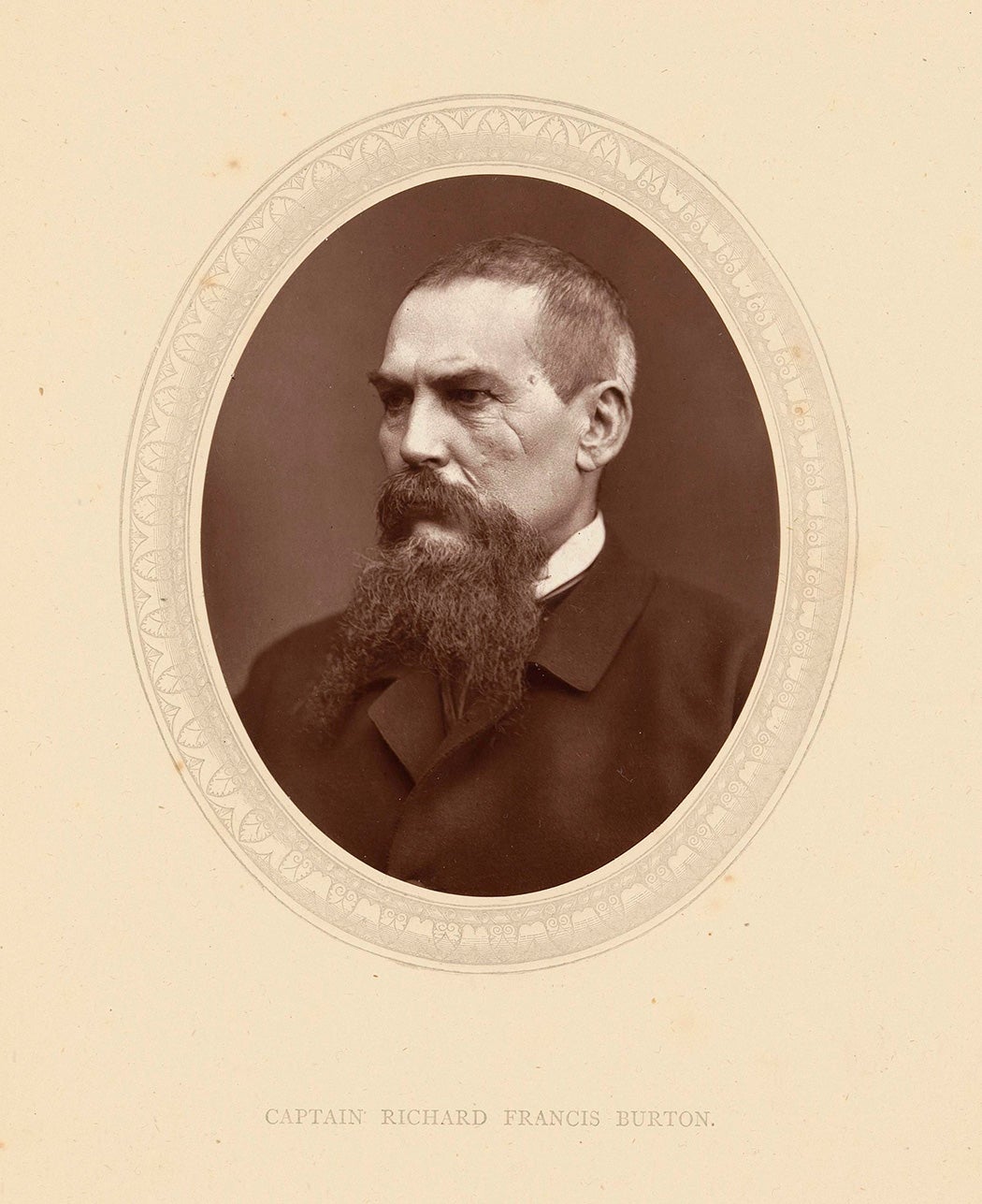
Mirza Abdullah was undoubtedly Muslim. However, whether Burton himself fully converted is unknown. Biographers uncritical of Burton’s mimetic adventures, such as Rice, interpret his practice of Islam as an unabashed embrace of the religion. Through this lens, his participation in the Hajj is perceived as his right as a Muslim. Roy on the other hand posits that instead of focusing on the sincerity of Burton’s conversion, we might instead view his conversion in measurements of opportunity. By such a metric, Burton’s devotion as a Muslim lasted only as long as it benefited him.
Burton left London for Southampton on April 3, 1853, and was Egypt-bound the next day on a journey lasting two weeks. When the steamer finally landed in Alexandria, west of where the Nile River delta pours into the Mediterranean, Burton realized that for all his knowledge about Arab and Islamic customs, he had “found out [a] mistake” in his plan, according to Godsall.
Burton had assumed the guise of a Shiite Muslim yet was suddenly surrounded by members of the Sunni sect who were hostile to the newcomer. The two sects were united in their animosity toward one another, and Burton had to rethink his ruse. He dreaded suspicions not that he was an Englishman disguised as an Arab, but that he was a Shiite pretending to pass as a rival Sunni. Roy notes that in his memoir, Burton recalls drawing his “knife every time an offensive hint [of his actually being Persian] was thrown out, the ill-fame clung to me like the shirt of Nessus.”
In short order, Burton transformed into “Abdullah the Darwaysh.” A darwaysh, or dervish, is someone from the Sufi sect renowned for their asceticism and meditative whirling dances. The nomadic and peculiar lifestyle of a dervish was perfect for his masquerade, “like a notably eccentric character in the West” he wrote in his Personal Narrative “allowed to say or do whatever the spirit directs.”
Burton’s dervish wasn’t to last; it was soon replaced by his final incarnation, Shaykh Abdullah, a Sunni Pathan, an “Afghan from India,” educated in Rangoon, the present-day city of Yangon in Myanmar (formerly Burma). The unique origins of this persona perfectly accounted for the strangeness of Burton’s mannerisms and idiosyncrasies of his speech. A Pathan background also accounted for his knowledge of Pashto and other regional languages. He gave this persona the profile of a healer; in Cairo, he allegedly saw patients and kept a small amount of medical supplies on his person. In his Personal Narrative, Burton explains that this included “phials and pill boxes” of tonics and “cathartics,” chloroform and Prussic acid, and “bottles of tincture of cantharides,” which he kept in a “pea green box with red and yellow flowers… capable of standing falls from a camel twice a day.”
After “a month pleasantly spent” in Alexandria, he wrote, he continued onward to Cairo, where he stayed for the month of Ramadan, which that year fell in June. From there he traveled to Port Suez and then south to Yanbu in present-day Saudi Arabia. In late July, he arrived in Medina, Islam’s second-holiest city, and joined a caravan carrying pilgrims from Damascus to Mecca, becoming the first European to travel there via the Nejd Desert. Throughout the trip, Roy writes, Burton sought to both blend into his environment and to stand out. He was constantly finding ways to show up the Muslims he encountered, correcting their recitations of Qur’anic law, flirting with the wives of his patients, and exhibiting exceptional courage, as during a Bedouin attack.
More to Explore
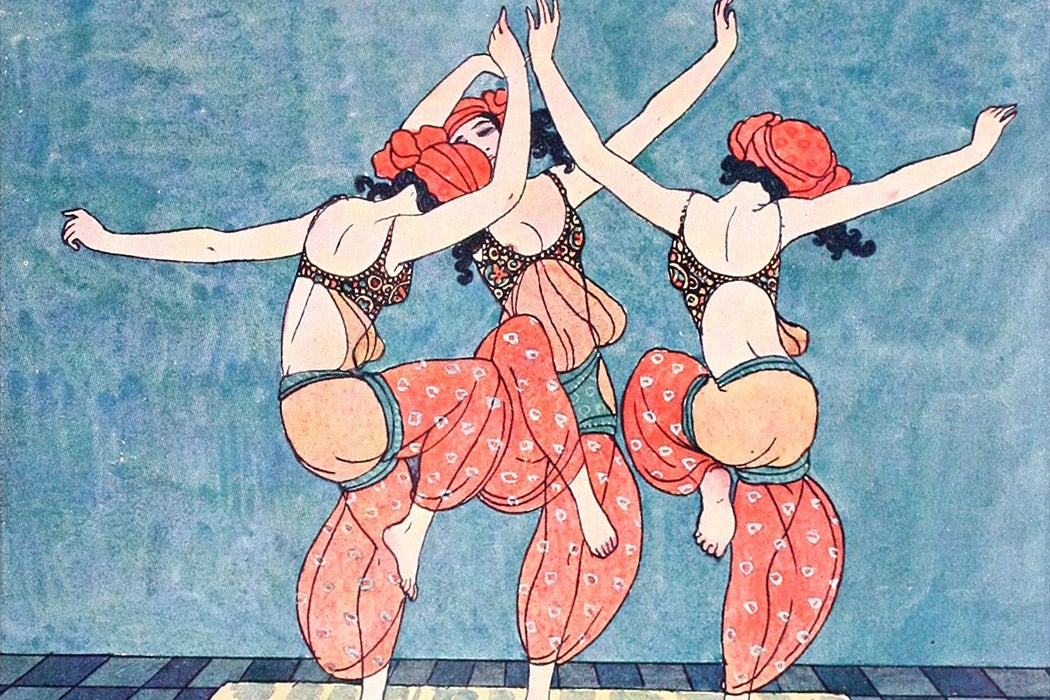
The Exotic “Pornography” of the Arabian Nights
Once Burton reached the Kaaba in Mecca, he wrote of “worshippers who clung weeping to the curtain,” and “that the waving wings of angels, not the sweet breeze of morning, were agitating and swelling the black covering of the shrine.” Although these lines suggest genuine religious sentiment, Burton quickly explains his feelings were from “the ecstasy of gratified pride,” perhaps referring to the success of his ruse. He laid his hands on the Black Stone after a hair-raising encounter with another man he feared would catch him out, whereupon “[his] bones would’ve whitened the desert sand.” He also encountered a “real” Pathan, who took Burton as an authentic fellow traveler. It was a moment of high achievement nearly as important to Burton as entering Mecca itself.
The Pilgrimage Legacy
Burton’s participation in the Hajj left a complicated legacy. His journey, Roy argues, is informed by the mentality of “imperial conquest” that permeated nineteenth-century European perceptions towards other regions and people. He points out Burton’s use of the word “penetrate” regarding Mecca with its implication of forced entry. Did Burton desecrate this holy site by entering it under disguise? Bishop and other scholars argue his use of disguise wasn’t for blending in but rather to fuel his own ego. He’s known for his adventures, but also for his fabrications about them.
Godsall also pokes holes in Burton’s narrative, suggesting that he intended not to go to Mecca but to the Hadhramaut, a region in the southern Arabian Peninsula infamous for its danger at the time. Inconsistencies in Burton’s storytelling are found in other works, even those referring to personal details of his life. In The Life of Captain Sir Richard F. Burton, Burton identifies his birthplace as Barham House in Elstree, a village in the lush countryside outside of London. But biographer Thomas Wright, in The Life of Sir Richard Burton, contends it’s Torquay, a beach town nestled into the armpit of southwest England. Although he did eventually grow up on his father’s estate in Elstree, he wasn’t born there. For Burton, storytelling took precedence over fact.
However unreliable he was as a storyteller, Burton displayed a great deal of tenderness towards Islam and its adherents. To him, Sufism was a “religion of beauty […] its rites wine, music and dancing […] its place[s] of worship meadow[s] and gardens.” Said writes in Orientalism that Burton’s Personal Narrative was “truly trying to see Oriental life from the viewpoint of a person immersed in it.” He even attempted to normalize aspects of Islam by comparing it with Christianity. He likened the animosity between Shiites and Sunnis to that between “a Catholic of Cork and a Protestant from the Black North,” and, in reference to Islamic rites of passage, defended them by stating “what nation, either in the West or in the East, has been able to cast out from its ceremonies every suspicion of its old idolatry?” All these factors likely surprised nineteenth-century English readers of his story, challenging their assumptions about Islam and its followers.
Although his choice to disguise himself and the nature of that costume were arguably unethical, if not sacrilegious, his Personal Narrative was peppered with examples of what appears to be a genuine appreciation of the Islamic world. Simultaneously, it’s a work of literature representative of imperial thinking and superiority over non-European regions. Said argues that although Burton saw himself as a “rebel against… Victorian moral authority,” he still perceived himself as an “agent” of authority while in Asia. His Personal Narrative oftentimes takes on an air of superiority, especially when describing the various people and environments he encountered. The legacy of Burton’s journey to Mecca remains as fluid as Burton himself, ever subject to change.


,_RP-F-2001-7-235A-7.jpg)