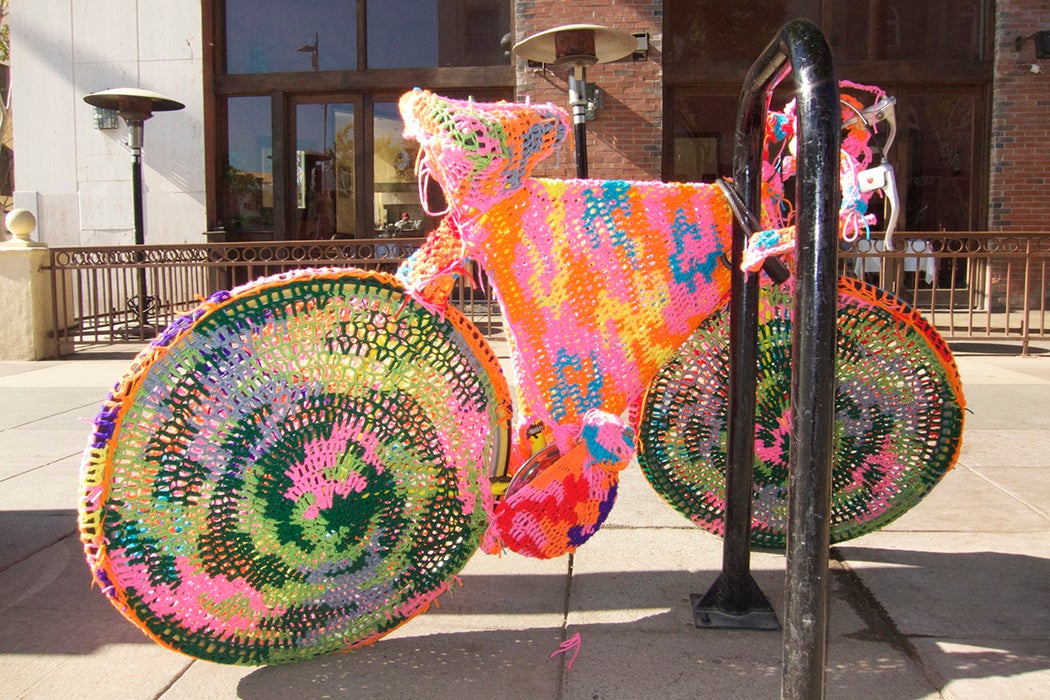
“Yarn bombing.” The term sounds like an oxymoron, but comes out of the street-wise school of graffiti. Geographer Joanna Mann defines this form of street art: “Also known as ‘yarn storming,’ ‘knit graffiti,’ and ‘guerrilla knitting,’ yarn bombing involves stealthily attaching handmade fibre items to street fixtures or parts of the urban landscape.”


Criminologist Andrew Millie reminds us that like other forms of graffiti and street art, yarn bombing is, well, usually illegal:
Yarn bombing happens when knitted or crocheted items are displayed in public space, often without permission and thereby having the potential to come into conflict with civil and criminal law through issues of trespass and property ownership, criminal damage, littering or other legislation on nuisance, incivility or antisocial behavior.
As an antisocial behavior, though, it’s fairly innocuous. Or is it?
Both Mann and Millie cite Magda Sayeg as the Ur-bomber. In 2005, Sayeg put a knitted piece around the door handle of her clothing boutique in Houston, Texas. It was well-received. Millie quotes Sayeg: “Could I do something, like, in the public domain that would get the same reaction? So, I wrapped the stop sign pole near my house. The reaction was wild.” With a friend known publicly as AKrylik, Sayeg formed a group calling itself Knitta to re-humanize the urban environment by putting fiber arts in public spaces.
Since then, utility poles, trees, fences, a whole Mexican bus, a Danish tank, Philadelphia’s statues of Rocky Balboa (a fictional character) and former Mayor Frank Rizzo (a nonfictional character), and the Wall Street Bull, among other things, have been covered in knitting or crochet. The idea and practice spread rapidly around the world, knitted together through the wiry fabric of social media. There’s even an International Yarn Bombing Day every June 11.
More to Explore
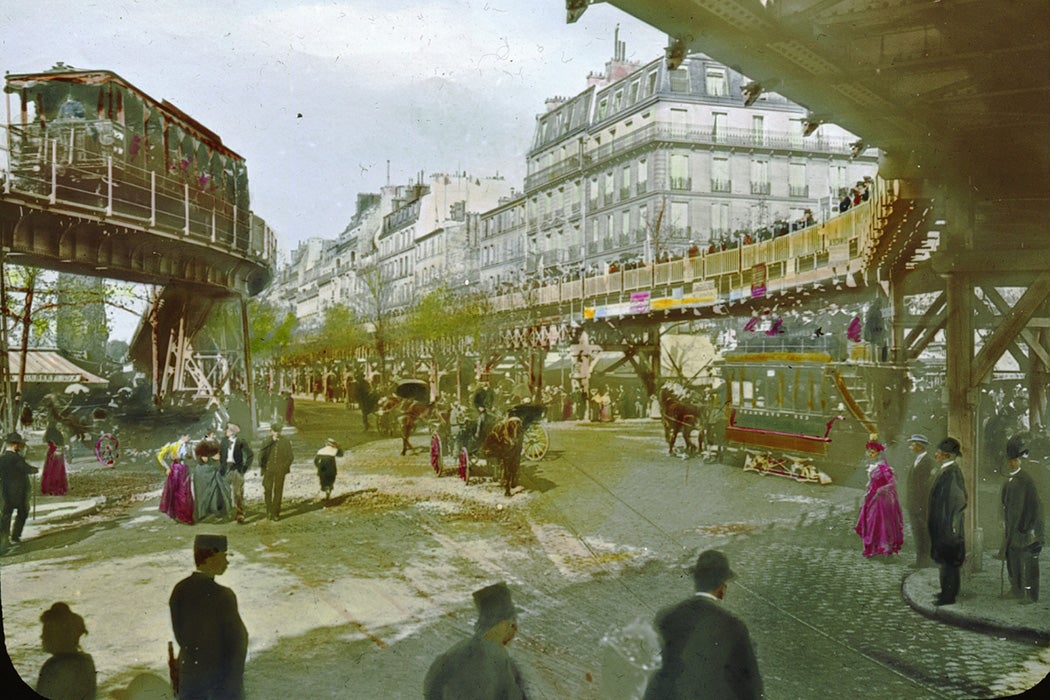
Graffiti: Jaytalking in 19th Century Paris
Some guerrilla knitters call themselves “craftivists,” notes Mann, merging “their craft and activist interests to fight for a better world, often by knitting or crocheting political statements as a form of protest.” The majority, however, “indulge in yarn bombing without these motives, and create installations just for a fun way to use their craft skills, because they can.” It’s in the latter apolitical work that Mann finds that “a different form of politics is unintentionally being enacted through the presence of whimsy” to offer “a significant ground for micro-political change.”
Mann argues that the “curiously unexpected and joyful force of whimsy”—with its “capricious irrationality”—can act to disrupt the “police order” of society. In “reclaiming and reconfiguring urban space,” whimsy can “restimulate the senses and instill a mood of possibility by inviting inhabitants to think differently.” Mann also notes that attempts to harness whimsy’s politics inevitably fail, or “unravel”—it just doesn’t work when it’s intentional or linked to a cause, even she argues, a good cause like breast cancer awareness.
Weekly Newsletter
Yarn bombing, elaborates Millie, is a “seemingly spontaneous, ephemeral and fundamental change to the textural form of the street” that challenges “what is normally legally permitted in public space.”
About this “challenge to the aesthetic order of the city,” Millie’s interviewed yarn-bombers, all women in the north of England, think it unlikely they would be arrested for what they do, even without “permission.”
“Like graffiti, the yarn bomb may not be to everyone’s taste,” notes Millie, but unlike spray paint, yarn is fairly temporary and easy to remove. While loopy graffiti tags are cliché today, colorful pieces of knitting can still surprise.