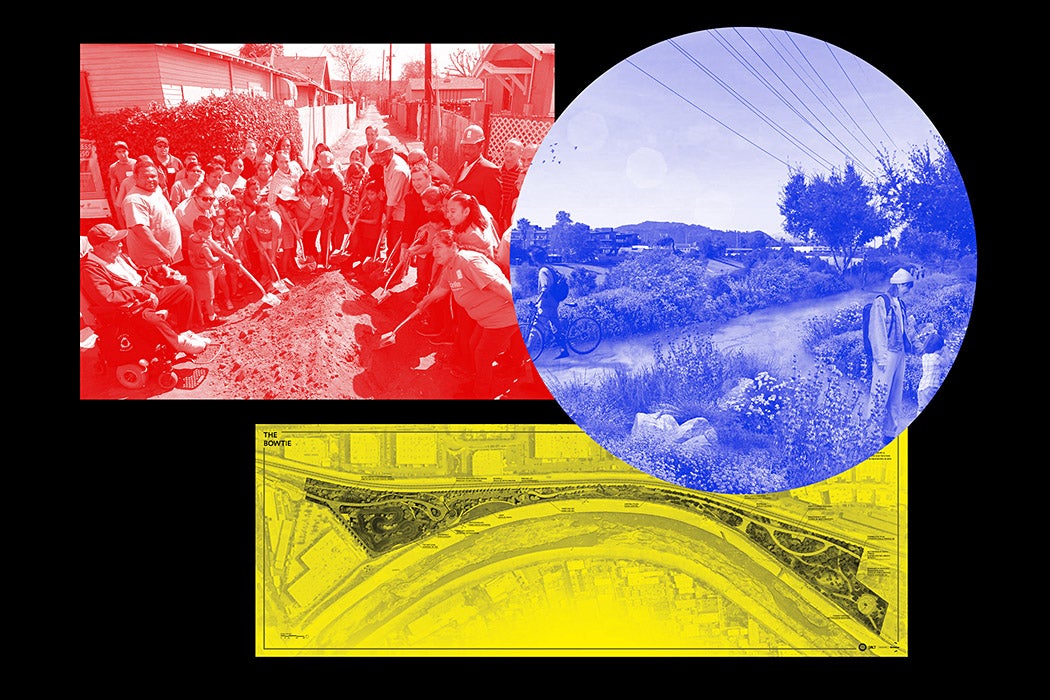
As part of our Perspectives on Public Space podcast, Sara Ivry speaks with Robin Mark, director of partnerships at SALT, a Los Angeles-based design studio that prioritizes community, social justice, and the environment when working in public spaces. Links to some of the research mentioned in the conversation can be found at the bottom of the page.
Transcript
Sara Ivry: Hi, everybody. I’m Sara Ivry, the features editor at JSTOR Daily. Los Angeles is known for a lot of things: Hollywood, wildfires, and traffic. Lots and lots of traffic. There are roughly 6,500 miles of roads that crisscross the city and many thousands more of cars that drive on them every day, coughing out tremendous amounts of pollution. The impact of all of this on public space and community life is profound and challenging. That’s where SALT comes in. SALT is a firm of landscape architects that tries, in its own words, to humanize the city. What does that mean exactly? Robin Mark is here to help us answer that. Robin is SALT’s director of partnerships, and before that, she worked at the Trust for Public Land in Los Angeles, where she focused on turning underutilized locations into green community space. Robin Mark, welcome.
Robin Mark: Thank you. Thanks for having me.
Ivry: Now we’ve talked to many people who study the history and theory of public space, but one reason we wanted to SALT is because you guys make very deliberate interventions in public spaces. When you all think about public space, what is that you’re thinking about? What do you mean, how do you define it?
Mark: Well, we think about public space, and I’ll take this from a SALT Landscape Architect’s perspective, we think about public space as places to create a sense of place, places where communities can gather to cultivate social capital, to build connectivity to really support residents to thrive. We need human interaction. We need a sense of community. We need a sense of place in order to feel comfortable in our society. And so, by doing work in public spaces, that’s what we’re trying to help spark.
Ivry: Has SALT always been invested in working with public spaces specifically? Or if not, how did that involvement and engagement develop?
Mark: That’s a great question. So, since SALT was founded, we have always been sort of on the trajectory to be working in public space. We are now at a place where we do that almost exclusively. We are a little unique in the fact that we are a mission- and vision-driven firm. So, we have a mission that we have laid out, that was sort of collectively designed by the staff here, and we use that as sort of our North Star. And so public space has always been a factor of that mission. And we just feel fortunate that we’re able to do it.
Ivry: Do you have a favorite project from SALT that deals with public space? And if so, why do you find that particular project so compelling?
Mark: Yeah, I do have a favorite project. And this is also a project that SALT is currently working on a redesign for. The project itself has such a long history. So, it’s a project called Maywood Riverfront Park. It’s located in southeast Los Angeles County along the LA River. And for folks who are familiar with the LA River, you know it is a channelized body of water that runs through Los Angeles. It’s 51 miles. It wasn’t always channelized. It was actually a real river at one point. It still is a real river; it just has some constraints. And the history, I mean, there are many books and scholars who have talked about what we as humans have done to our rivers over many generations. And in Los Angeles, I think we’ve done a really good job of treating our rivers very poorly, channelizing them being one thing that we’ve done but also just placing industry on the banks of rivers and letting a lot of waste and toxic substances like flow through those rivers, right?
And so, along the banks of the LA River, particularly in southeast Los Angeles, there is sort of this legacy of environmental contamination. And the site of Maywood Riverfront Park had been what’s called a brownfield. The soil was dirty from legacy uses. There was even one area of the site that was qualified as a Superfund site, which meant that it had a federal designation for environmental contamination. So, the idea of turning this sort of wasteland, if you will, into a public park in the late ’90s was pretty inspired. And I don’t know that a lot of people thought it would be successful. But, you know, there were many people, myself not included, many people before me who worked really, really hard to not only be able to acquire the park and designate it as open space for community but then transition it into a public park and begin the long cleanup that was necessary. There’s actually still remediation that’s happening in the area that is designated as Superfund. And so, just the idea of kind of reclaiming space in a historically contaminated community. Maywood, the city that it sits in, is a really, really small community, one of the densest communities west of the Mississippi, actually, that’s a fact. And, you know, high immigrant population, low-income community. There’s been governmental corruption over and over again, right? So, this is a community that has not had a chance. And then here is this 5-acre site that was the idea that was turned on its head and reclaimed really for community benefit.
So, I love the story of Maywood Riverfront Park. And I love that we now, in partnership with the Los Angeles Neighborhood Land Trust and Sacred Places Institute, are having an opportunity to work on a redesign that really listens to elements that community members want. The park had really been, over the years since it was turned into a park initially, it had really fallen into disrepair. And so, the Land Trust was able to secure money and a partnership with the City and are really bringing more—a vibrancy back into the park.
Ivry: Robin, I wonder if you can tell us, what was your professional journey that got you so invested in creating and improving public spaces?
Mark: So, I started off really interested in social movements, social justice movements, and was really interested in that subject matter through the lens of documentary film. And so, had started, when I graduated from undergrad, looking to work in that world and was fortunate enough to get a job on a PBS documentary. It wasn’t necessarily about social movements, but it was about environmentalism, and it was about sustainable cities. And this was back in the early aughts. You know, so sustainability has come a long way, I think, in the last twenty years. And the way that we’re thinking about climate change has certainly changed dramatically in the last twenty years. But, you know, here were folks that were, relatively early on, thinking about resiliency and thinking about how they could support, with their expertise, how they could support residents and communities to deal with environmental sustainability and climate change. And they were all landscape architects. And they were doing all this incredible work in the public sector supporting communities of all different sorts. And it just felt very inspiring to me.
So, working on this documentary, I had the opportunity to travel around the country and meet different landscape architects and see all the incredible work they were doing. And I really, I just felt like I could be more productive as a human doing the work rather than sort of videoing people doing the work. And so, you know, sort of without looking, I kind of dropped it all and went back to school. I was very intimidated. I’m not an artist per se. I don’t have great hand-drawing skills, but I certainly had a passion to really be thinking about these large issues, and so I was very excited to do it, and I’m happy I did.
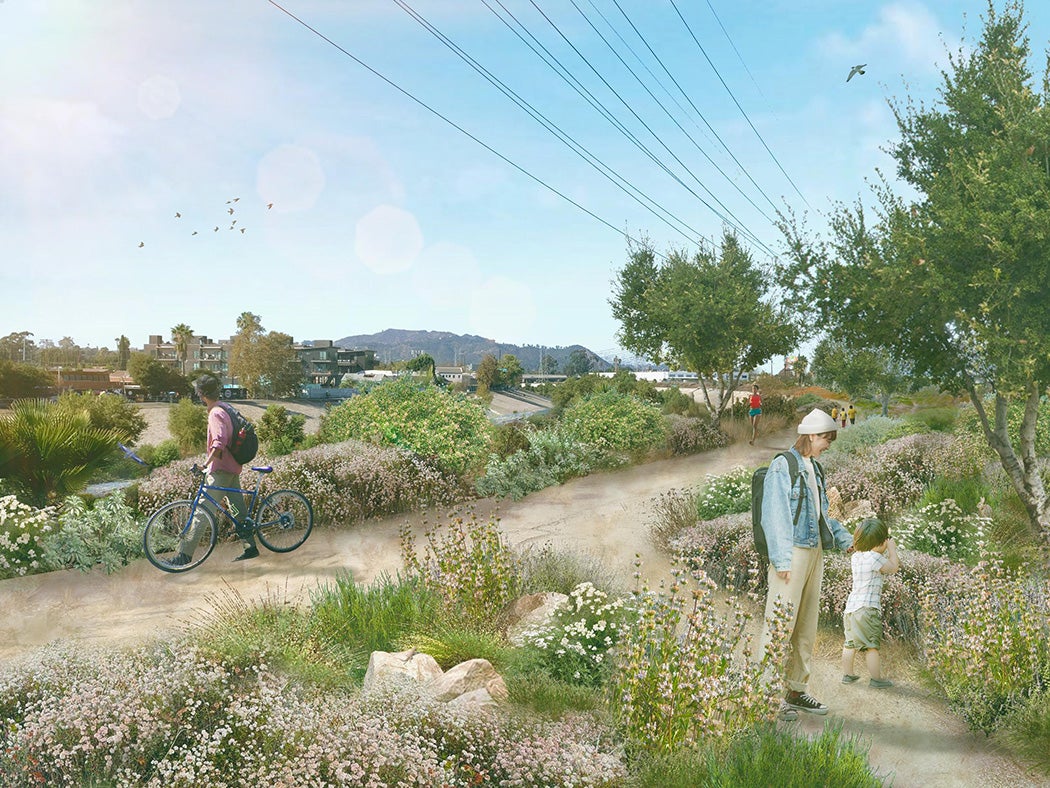
Ivry: Let’s talk for a moment about The Bowtie project. I wonder first if you can describe it for us.
Mark: So, The Bowtie is a really interesting and dynamic space that’s located sort of at the middle of the 51 miles of the LA River. It’s formerly Southern Pacific Railroad property in the late 1800s. And then about twenty years ago, it was purchased by state parks for a public park. And very little has actually happened. Well, I won’t say that. A lot has happened on the property since the purchase, but a public park has not been built. And, you know, this is a really interesting part of the LA River. There are only a few places along the river, where, when they were laying concrete to channelize it, they were not able to lay concrete on the bottom of the river because the water table was too high. And they couldn’t put the concrete there because it was wet. And so, in those spaces is really where the river has kind of revealed itself to Angelenos, right? There are trees growing, there are plants growing, there are fish and there’s a lot of habitat in those areas. And one of the soft-bottom portions of the LA River, there’s only three in total, is right adjacent to The Bowtie.
So, it’s already sort of this exciting and dynamic space. And The Bowtie parcel, it’s named that because it literally looks like a bow tie with like sort of a pinch point at the middle. And SALT had the opportunity to get involved several years ago, we created a concept plan for The Bowtie that was based on lots of really hard-won community input. The project kicked off just as COVID kicked off. And so our partners at Clockshop—Clockshop is a locally based arts organization, really, but they have honored local artists and worked with local artists to have art installations on The Bowtie in all the years that it hasn’t been turned into a public park—and so they were a partner on this, as was RADAR, a landscape architect—or I’m sorry, an architecture firm. But they, you know, Hugo Garcia is one of their key organizers there. And he was—put a mask on and was door knocking in the middle, like early days of COVID, when there was a lot of fear. But we also knew that, you know, you can’t do something at this really important site if you don’t have community input. COVID be damned, right? Like, we still needed the input. So, Hugo went out, and he did all of that work and really helped frame what the park would become. What residents wanted was a passive space for walking, for environmental restoration. There’s an existing park just down the river from The Bowtie, which is Parque [del Río] de Los Angeles, which is an active recreation park. And there’s soccer fields, and there’s a lot of opportunities for folks to have active recreation. And so, the community didn’t want another one of those.
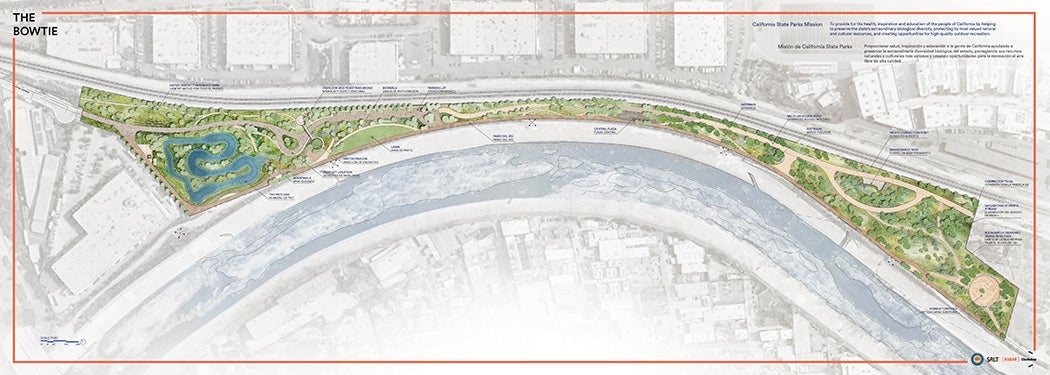
So, that was sort of the beginnings of the redesign of The Bowtie. But what I think is particularly exciting about that park is that it sits at this place along the LA River where nature is kind of not really backing down. You know, again, you’ve got the trees and the habitat that is growing through places that couldn’t be concretized during the channelization of the river. But it’s right on this, the edge of a very dense urban environment. And so, you have nature and the urban kind of smashed together. And the site itself really shows that. And we talk about that in studio in sort of layers of this site’s history. And it was important to us and in our conversations with the State, really convincing them to understand that, once again, this couldn’t be a site where you come and you scrape everything off and you build something fancy and new, right? This really had to be a telling of the story of this site through history, right? It historically was flood plain. There was a wetland, right? And then it transitioned, and it became railroad property. And then it ceased to be railroad property and sort of became this place with fences around it. But people were accessing it. You know, they were cutting through the fences. There’s tagging on parts of it, on remaining infrastructure that’s there. People were using the site as a park. And so, it felt important to us to recognize that like, okay, it was gated, and it wasn’t technically a public park, but it’s still acting as a public park. And so, we need to, in this redesign, respect that legacy. And then how can we again augment it? And so, this does really feel a part of the community that exists there and continues to tell this very long story of this property.
More to Explore
Building Community and Urban Tree Canopy
Ivry: It’s interesting because the idea of the density of the city of urban Los Angeles, budding up against sort of nature that refuses to be suppressed. That’s sort of a metaphor for the city writ large, isn’t it? I mean, you’ve got this like megalopolis and then surrounded by these beautiful mountains. And even within the city, you’ve got canyons and hiking trails and a lot of beautiful, really natural environments, wild environments.
Mark: Yeah, I mean, you know, seeing coyotes running down the middle of the street is not unusual in parts of Los Angeles for sure, and hawks and all kinds of wildlife that I don’t think people necessarily understand are here, but they are. So yeah, you were correct. It is a perfect kind of example of greater Los Angeles, this, all of these different needs coming together on this one bow tie-shaped parcel.
Ivry: The other thing that it makes me think of when you say that people were using it as a park functionally, even before it was formerly a park, is of these playgrounds that you see, there’s one in Berkeley that I’ve been to, there’s one in New York City on Governor’s Island, these junkyard parks. I mean, that’s not what they’re called, but that’s sort of like reused materials like tires and piping that are constructed into jungle gyms and all sorts of climbing structures for kids. And so, in some ways, it’s sort of like taking the manufactured environment and turning it into something usable.
Mark: Yeah, those projects are so interesting to me. I have yet to have the chance to work on one. We try to kind of surreptitiously get it into some of our more traditional playgrounds, moving pieces, that sort of thing, things that aren’t bolted to the ground so that children can really play. That idea of… everybody talks about, you know, you buy your kid a toy, and then they spend more time playing with the box then they do the actual thing, right? So, I think giving children the opportunity to just be creative, giving everybody the opportunity just be creative when they’re outdoors, and it doesn’t have to be a formal bench to be something to sit on.
Ivry: What happens in a project like Bowtie if there are competing demands? I mean, you said that, you know, your colleague went out to talk to the community about what they wanted. Were there any cases in which desires were in conflict with one another?
Mark: You know, we try and do things as democratically as possible. There’s always going to be disagreements on any open space project, and so what we try to do is once we hear from residents about the things that they’re looking for, is then at the subsequent meeting, we reflect all that information back. So, for example, for Bowtie, you know, we heard from folks, you know, there was like 80 percent of the people that we spoke to really wanted restoration, enhancement of the natural habitat. And so, we created a graphic that showed that 80 percent of the people agreed with that statement and that—I’m sorry, strongly agreed. And then an additional 16 percent just agreed. And then you have a small sliver of the overall people that we spoke to that didn’t really care about that. And so, when you lay everything out, the information that’s being gathered is also then being shared democratically. The folks who might disagree, generally—not always, but generally—they will take a step back. Because they realize that they are one of many, and no one individual is going to be the person to decide, and this really is a collective exercise.
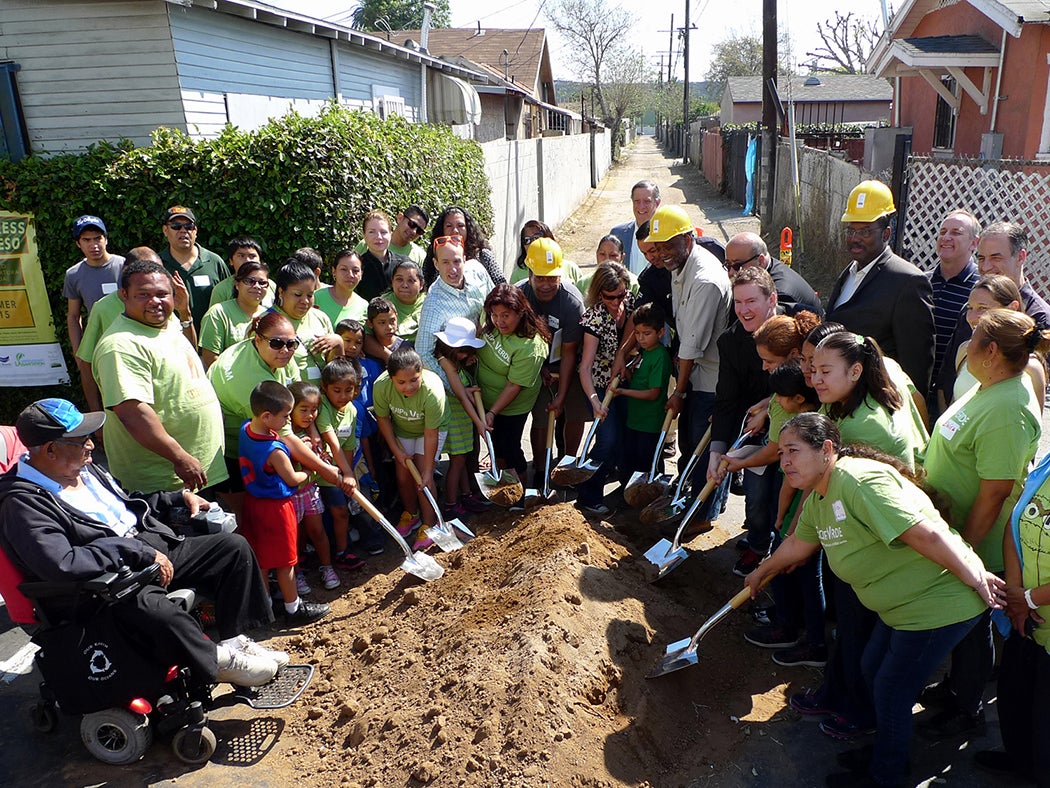
Ivry: Another project I wanted to talk about a little bit is the Green Alleys project. Tell us about that. I found it so compelling when I was looking on the website and reading about it.
Mark: So, the interesting part about the Green Alleys, that work started in 2011. The folks of the Trust for Public Land had been doing research into the disproportionate number of alleys in South Central Los Angeles, and that 90 percent of all of the alleys within the city of LA are actually located in South Central Los Angeles, right? And so, when you think about alleys, everybody, there’s always a negative connotation, right? You’re not going to send your kid out to play in the alley. You know, people associate them with being dark, being scary, being filled with trash, you know, all sorts of things that aren’t necessarily places that you want to be. The alleys in South Central Los Angeles, I think the existing condition of them is maybe even worse than what you might imagine because there’s no agency that is specifically tasked with the long-term operations and maintenance of those alleys. And so, as the asphalt that they were once laid with starts to crumble, there’s nobody there to then patch it and fix it. When the lights go out because they break, there’s no one there that’s going to fix it. And so, you end up with this completely forgotten infrastructure that is immediately adjacent to people’s homes. And so, the alleys really started as a way to, again, reclaim this forgotten infrastructure and turn it into a benefit for these community members, with these community members.
And so, it started really with a lot of work to engage residents on what they wanted. And I’ll be honest, Trust for Public Land did the work, the engagement early in the early days, and they had a very difficult time getting people to participate. Because just the idea of fixing an alley, first of all, they were like, that’s never going to work. And then second of all, they were like, of all of the things that I need to worry about in my daily life, the alley is not the one where I want you to put a bunch of money. You know, they’re like, you need to address crime. You need to address why my kid can’t walk to school; you need to address all these other social issues. And so, it became this very challenging, I mean, all they are, you know, sort of linear roads, but they became these very dynamic and complicated projects. From an engagement perspective, and then also from a design perspective. What can you do to make these places safer? We’re hearing from community that they don’t really want to talk about the alleys because they’re fearful in their community. Well, how do we use these as opportunities to address those concerns? And so, it was years of engagement, really, again, led by Trust for Public Land, and then also a community group called the Equipo Verde, which really organized themselves around the retrofit of these alleys.
We added on to, or Trust for Public Land, added on to the idea of reclaiming these spaces, this idea of stormwater management. And the idea around focusing the alleys around stormwater management was in large part, I think, due to a necessity to find funding. If we can manage stormwater in these alleys, because we know that because they’re so, the asphalt’s so degraded, they flood when it rains—there’s puddles, people can’t get out of their driveways because of that—there is money in California for stormwater management. So, it was really this opportunistic thing of, like, there’s money for stormwater management. We know that the soils in south central Los Angeles are actually quite conducive to infiltration and tapping the aquifer to replenish that water. And we also have this abundance of alleys. So, sort of this confluence of all these conditions that really made the alleys right for multi-benefit green infrastructure to support residents.
We are not going to solve all the world’s problems because we retrofit an alley. But this was really a way to kind of, once again, use these projects as a kind of a call to action to say this lack of investment in communities like South Central Los Angeles is not acceptable. And we really need to be doing something about it. And we’re going to do that by working directly with residents. And so over time, residents came to the table. They were really excited. We had the opportunity to work with many residents. We actually had the opportunity to work on two different alley networks. So, SALT designed the first Green Alley network called the Avalon Green Alley Network. That was a pilot project to really demonstrate that these alleys could be these multi-benefit projects, managing stormwater and also creating spaces for people to walk safely from their home to school, to the local park.
And so, that was the pilot that was completed in 2017, and then in 2022–23 we worked on the Central-Jefferson and Quincy Jones Green Alleys that are located in the historic jazz district in South Central, again working very closely with our client, the Public Trust for Land, the Equipo Verde, which is the community group, and then other folks in the community at the surrounding high schools and businesses.
Ivry: So, what does retrofit of a green alley include? What elements are there to make it safer and to make it more pleasant to be in, in general?
Mark: So, the alleys include, you know, the key feature, again, being stormwater management. To the layperson walking through, except for the signage that’s around, they wouldn’t necessarily know. It looks like an alley. But underneath the ground are these huge infiltration trenches that allow water that hits the alley—stormwater—that hits the alley and then stormwater from the surrounding streets to all be funneled into the alley and then underground, where it is cleaned through a series of gravel trenches and then replenishes the aquifer.
So that’s one. The last two alleys that we worked on, the Central-Jefferson and Quincy Jones Alley Networks, I think the total number of stormwater being managed per year is 2 million gallons, which for Los Angeles is a lot of water. And that’s water that again is being cleaned, would otherwise run off into the ocean. It is being cleaned, and it is being, the aquifer’s being replenished. The other elements include—and probably my favorite part of the alleys—are the murals that are designed by community members that are placed throughout the alleys. And we had the opportunity to work with different groups for the first pilot project, Avalon, and then the second two alleys, different community groups that are supporting local artists to translate their vision into public murals.
There’s also lighting. And then for the most recent alleys, we worked with a local Tongva artist named River Garza. Tongva is the Indigenous community that originally inhabited this land. There are still many Tongva living in South Central Los Angeles. And so, River worked with us to design a basket weaving texture and a motif that was painted into the alley. So, it’s going to just represent the Tongva and to just demonstrate the awareness that, you know, the Indigenous community is here, alive and well and a part of these public investments.
Ivry: You’ve talked a little bit about the role that landscape architecture can play in making our environment more sustainable or making Los Angeles more climate resilient in the face of the various challenges that the climate is presenting increasingly. What, if anything, can landscape architecture do beyond what you are doing? Is there more to be done that you all can take on? And could you speak to that a little bit?
Mark: Sure. I think the work is endless for us. I think it’s endless for everybody, whether you’re a landscape architect or not. We all have a lot of work to do to get to a place of resiliency. The field in and of itself is really thinking about carbon sequestration, carbon neutral projects, how can we specify materials that don’t have to fly from another country to get here, how can we work with concrete that has a smaller carbon footprint, those things. I think it is our obligation to continue to investigate and explore how each project in and of itself can be more sustainable.
That said, I think what we are doing in large part in this office is really thinking about how we can address the specific issues that face Los Angeles. Most of our work, not all of it, but most of our work is in LA County. And, you know, it’s really important that when we have an opportunity to design a site, we’re also thinking about how that site’s going to change over time simply because our climate is changing. And so, an example of that is the work that we’re doing right now on schoolyards. We have been hired by LAUSD directly and through nonprofit partners who are all trying to create greener campuses for students. And that really begins by removing the asphalt—because these schools are just fields of asphalt with no shade coverage whatsoever—removing as much asphalt as we can, so there’s more permeability and it’s cooler. And then thinking really about shade canopy.
And there are many trees that we love, and everybody’s got their favorite trees. But some trees provide constant shade. Once they’re established and they’re really, their canopy has grown in, they provide deep shade. And those are the trees, whether they’re our favorites or not, those are the ones that we really need to be thinking about to place on these campuses, because that’s the only way we’re going to cool down these yards. There’s not a lot of funding for maintenance. There’s not a lot of, you know, opportunity to make these investments on school campuses, so when we do them, we’re not there to put in beautiful pops of color. We’re really there to create some shade. And, you know, we’ve sort of put that onus on ourselves. You know, yes, the district has some requirements for percentage of shade canopy, but it’s that small thing of, like, what’s the species that you’re going to select that’s really going to create that consistent shade? So those are things that we’re thinking about.
Ivry: I’m curious, what is the tree that provides the most shade canopy?
Mark: We love oaks. Quercus agrifolio, is California, coast live oak. There’s lots of different oaks, blue oak. There’s different oaks that we’re selecting. We can’t only use oaks, but it’s a native evergreen. Once, you know, they reach maturity, which takes time, I mean, you just want to sit in the shade of an oak tree, right? And so, we try to put those in where we can.
We also are looking at climate adaptive tree species, right? Trees that are starting to do well in this environment, like a mesquite, which is—you typically see that in Arizona, but it’s starting to be a tree that really works in Southern California as well. So, we’re constantly trying to just increase our knowledge, working with our growers, right? Folks who really are growing these trees, what’s starting to look better than others, and what will last over time as we get hotter.
Ivry: And what are you using instead of asphalt? What will be the surface of the schoolyard?
Mark: We are trying to do whatever we can that becomes a permeable surface. Right now, the surfaces that the district will accept are—we also have to think about accessibility, so they have to be surfaces that any person, despite their physical abilities, is able to move across. So right now, decomposed granite, compacted decomposed granite, is a surface that we are looking at and that we use. In areas that are not necessarily for access, we are looking at mulch as a surface. Or in areas for playgrounds, we have not yet been approved by the district, but even the County of Los Angeles uses an engineered wood fiber instead of that resilient surfacing, which is that spongy rubber that you’ll often see under play structures. That surfacing actually, because it’s all rubber, can be up to 60 degrees hotter than, like, the average temperature of the ground, even asphalt. It gets extremely hot. So, we’re just trying to remove those materials as much as we can.
Ivry: When I think of landscape architecture, I definitely think of a field that’s somewhat siloed, with all due respect. But your work seems much more community oriented and interactive with different communities. I wonder if that is intentional or default. How much of that is part of your brief?
Mark: Yeah, it’s really intentional for us to be community facing and community aligned. I actually came to SALT to really help formalize some of the advocacy that the firm was already doing before I got here, but really formalize it. And, you know, it stems from my previous work at Trust for Public Land and the relationships that I made there working with community-based organizations that we’re doing, again, the fight for social environmental justice every single day, knowing that the SALT always had this perspective, right? But how do we formalize it? And really, that comes through, it comes through the work. And it can be a fine line that we walk sometimes, right? If we’re advocating with the Los Angeles Unified School District to remove more pavement and add more shade canopy and make certain choices that they might be uncomfortable with, you know, they’re still our client, you know, so we have to walk that tightrope. But at the same time, it’s important for us to be moving the needle on some of the social, racial, and environmental justice issues. We are a part of the Living Schoolyards Coalition, which is, I think, has had a huge impact on the advocacy for green space with LA Unified. LA Unified is the second largest school district in the country. Most of the campuses are, again, fields of asphalt. And the coalition has had a really big impact on getting certain standards passed within the Board of Education, and SALT is a member of that organization. We bring our expertise on what it takes to design something at LAUSD and help funnel that into the advocacy so that the requests and the things that we are advocating for actually can be implemented on the ground.
Ivry: Robin, thank you so much for speaking with us.
Mark: Thank you for having me. This was a pleasure.
Ivry: Robin Mark is the Director of Partnerships at SALT Landscape Architects in Los Angeles, California. You can find out more about SALT’s very innovative approach to urban landscapes on their website, SALT-la.com. To read a transcript of this conversation, head to our website, daily.jstor.org. This podcast is part of a much larger series we’re doing on public space. All of the episodes in this series are on our website. Again, that site is daily.jstor.org. I encourage you to check out the series, as well as the many other great offerings we have there, whether that’s an article on the poet Frank O’Hara or the felling of a legendary sycamore tree in England. JSTOR Daily is a project of JSTOR and ITHAKA, the nonprofit. Our podcast is produced by Julie Subrin and me, Sara Ivry. We’ve got help from JR Johnson-Roehr and Jonathan Aprea. Thank you so much for listening.
Editor’s Note: When this conversation was recorded, Sara Ivry served as Features Editor at JSTOR Daily. She has since moved on from the publication. We’re grateful for her thoughtful work and the care she brought to this series.