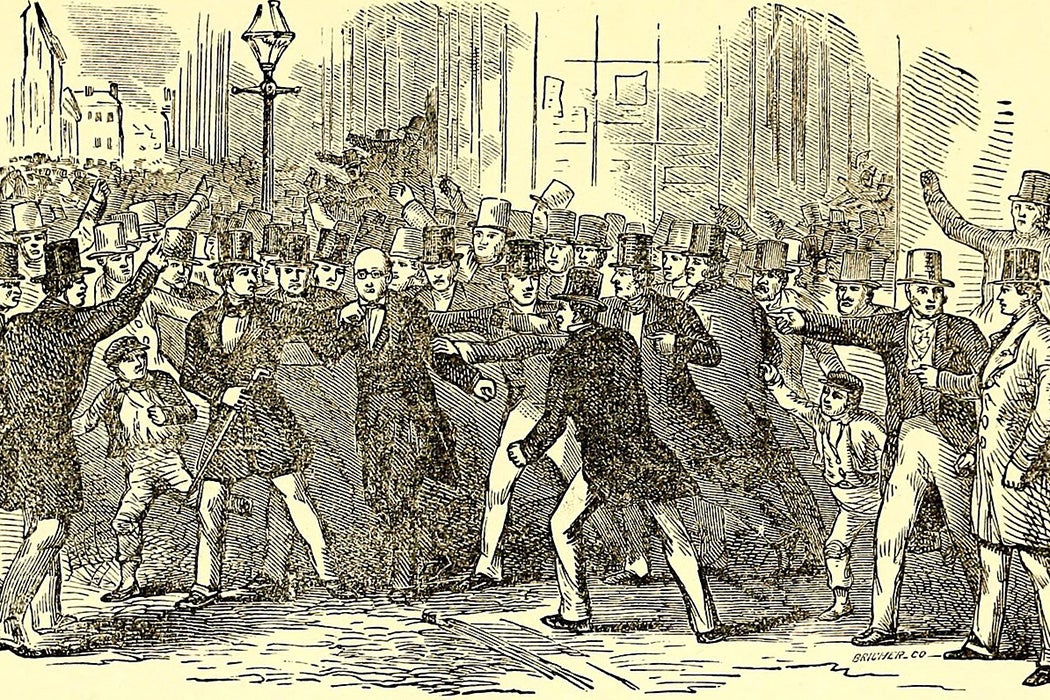
Anti-abolitionist violence was a serious threat in the 1830s, and not just in the Southern states. To take one notorious example: noted abolitionist William Lloyd Garrison was almost lynched in October 1835 by pro-slavery supporters. This happened in Boston, Massachusetts—a city whose newspapers were almost unanimous in supporting mob action against Garrison.


With their “deep ties to slaveholding interests,” writes legal historian Lyndsay Campbell, Boston’s ruling business elites characterized “its own mob actions as rational and constitutionally legitimate.” But collective action by Black abolitionists and their allies was, of course, an outrage.
Boston’s “abolition riot” of August 1, 1836 was thus unusual. It was a pro-abolitionist action, perhaps the first of its kind. The city’s “self-appointed respectable class” were shocked to see anyone other than themselves using extrajudicial action to achieve their ends.
What happened, as Campbell explains, was that the mostly Black women spectators in the courtroom defiantly put a stop to the judicial wrangling over the legal status of Eliza Small and Polly Ann Bates. Moments before, two white lawyers had been arguing over the fate of these two Black women, who may or may not have been on the run from slavery in Baltimore—their identities were never definitively proven. The white judge had just ruled in Small’s and Bates’s favor, declaring their detention illegal in response to a writ of habeas corpus. However, the judge had not yet discharged the women from the court, and the enslaver’s lawyer was in the middle of asking that the women be arrested again. This was a known strategy of slave hunters, bringing up a new charge, like theft, to keep their targets enmeshed in the legal system.
In the words of one reporter present, it was then that someone suddenly “cried ‘now go’; ‘go—go’ was the cry, and men and women rushed from the opening allotted to spectators, over the benches, and crowded through the private passages where the girls had just passed, within a foot of the judge’s desk.”
More to Explore
The Undercover Abolitionists of the 18th Century
“An old colored woman, of great size,” grabbed the Deputy Sheriff by the neck as Small and Bates were hustled out of the courtroom, down the stairs, and into a waiting carriage. The carriage raced away. At least one report noted that someone in the carriage did not neglect to pay the toll road’s fee, flinging the coins out as the carriage sped by. The Deputy Sheriff pursued for several days, but the escape route was full of rumors and intentionally false leads. Small and Bates ultimately made it to freedom in Halifax, Nova Scotia.
Campbell writes that earlier retellings of this incident have focused on the white male actors and concentrated on the legal arguments. The famed abolitionist lawyer Samuel E. Sewell represented Small and Bates before Justice Lemuel Shaw, who would eventually become the state’s Chief Justice (and Herman Melville’s father-in-law). Meanwhile, Sheriff C. P. Summer, notably absent from the courtroom that day, was the father of the future abolitionist U.S. senator Charles Sumner.
Campbell highlights the roles of Samuel H. Adams, the Black Bostonian who filed the writ of habeas corpus; Black minister Samuel Snowden, who advised in the crowd; and a small group of white abolitionist women who were widely condemned in the press afterwards. One of the latter said to the enslaver’s agent, “They prey hath escaped thee.”
Weekly Newsletter
The Black women who dominated the “riot” have, however, remained anonymous. Some were undoubtedly identifiable at the time, but none faced legal repercussions. How was it, fumed one local paper, that “the fat, burley wench—the dusky amazon—who took such an active part in the rescue” got away with it in broad daylight before so many witnesses? (Campbell notes that Sewell’s biographer identified the woman as the person who scrubbed Sewell’s office floors.)
Ironically, another paper—whose very editors had participated in the attempted lynching of Garrison—argued that a “respectable white mob” should have been mobilized to “sustain the supremacy of the laws” under threat by the abolitionists. Garrison’s own paper, The Liberator, sarcastically noted these other papers’ “newfound zeal in [sic] behalf of the dignity and sacredness of law”—law that, the anarchist-inclined Garrison never failed to stress, codified some human beings as chattel property.



_(14782541933).jpg)