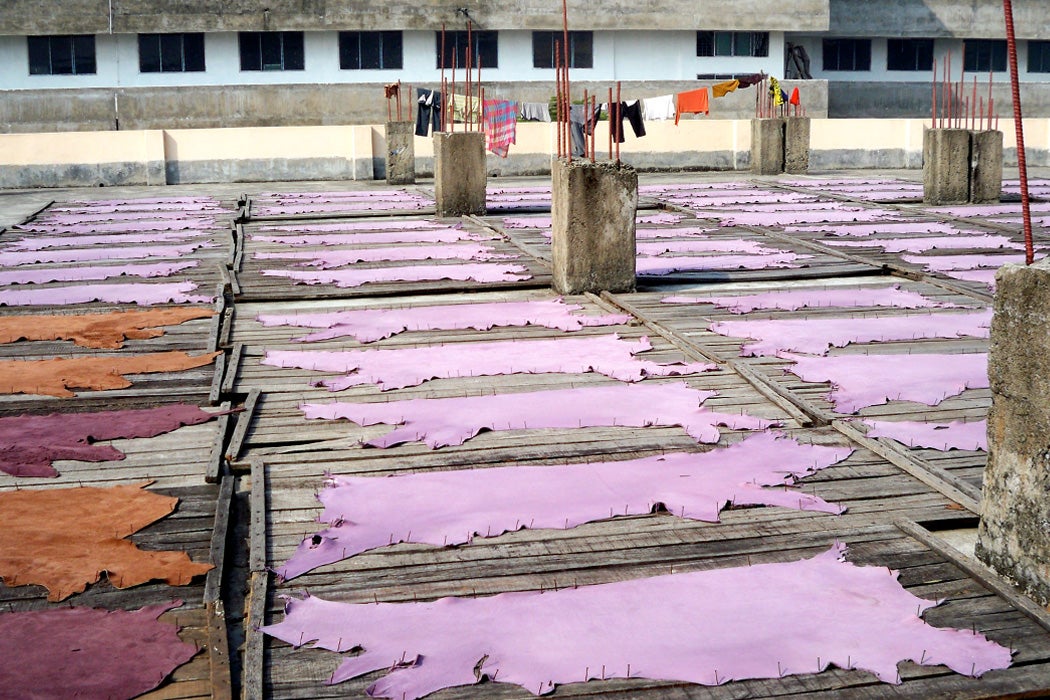
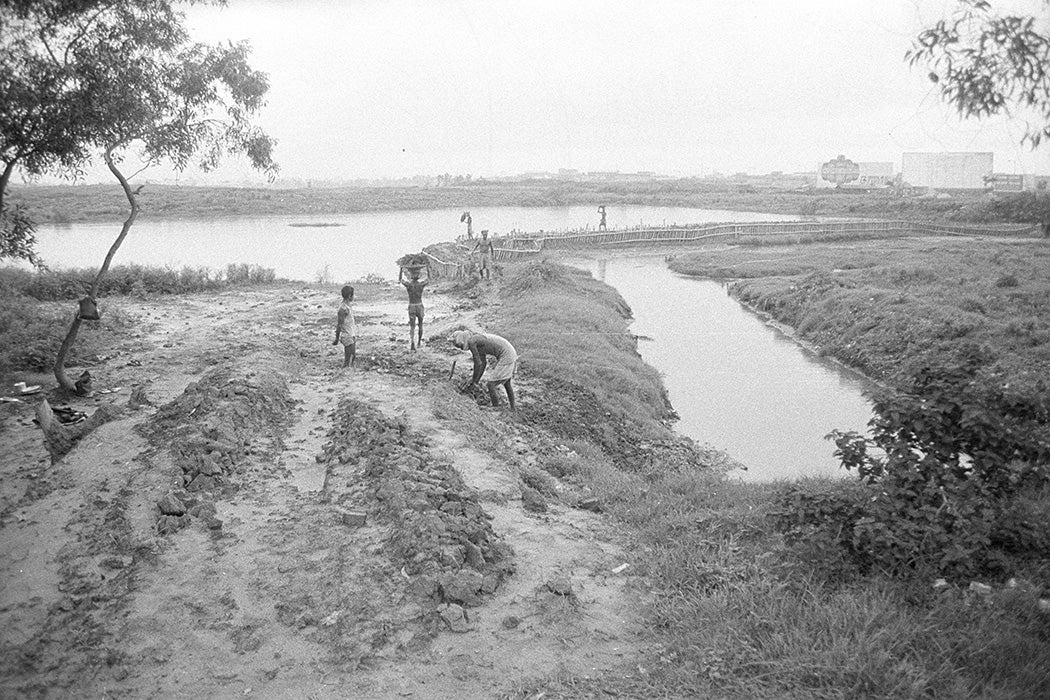
Cultural taboos around purity have made leather work a controversial industry in India, with occupations such as tanning largely limited to members of marginalized groups. In fact, the trade in Calcutta (now known as Kolkata) is dominated by an unlikely set of outsiders—Hakka Chinese, who make up the bulk of the Chinese community there. Since arriving in the city in the 1910s, they have “found a profitable niche in Calcutta’s leather industry,” observes anthropologist Ellen Oxfeld, who studied this group in the 1980s. They live and work on the eastern outskirts of Kolkata, in a swampy district called Dhapa where she observed “open sewers through which the byproducts of the tanning process flow.”


This environment has led Oxfeld to investigate how the Hakka community’s role in Indian society parallels the inferior status of lower castes and so-called “untouchables.” “[I]n many Indian villages the untouchable outcasts are found in distinct quarters outside the village proper,” she remarks. “The peripheral geographical position of the Chinese within Calcutta’s urban space is in many ways analogous to that of an untouchable community within an Indian village.” Indeed, even the Indians living near Dhapa are from the untouchable Chamar caste, and many are employed by the Hakka either as factory laborers or as domestic servants.
Unlike other non-Hindu minorities in India—such as Christians, Muslims, Parsis, and Jews—the Hakka have not adopted elements of the caste system in their community. As one Hakka informant starkly put it to Oxfeld, “We don’t have castes. Your blood doesn’t matter. We have classes. What matters is how much money you make.”
“[F]rom the point of view of the Calcutta Hakka, any job is worthwhile if it is a profitable source of income,” Oxfeld explains. “While tanning is viewed within caste ideology as a polluting occupation, one performed only by a particular untouchable caste, Dhapa Chinese consider tanning a good business because it is so lucrative.”
Besides leather-tanning, smaller numbers of Hakka entrepreneurs are also engaged in hairdressing, shoemaking, or running restaurants in Kolkata. At the same time, the Hakka hold themselves apart from the other local Chinese—namely, the Cantonese, who mainly work as carpenters, and the Hubeinese, who are dentists. “They usually refer to themselves as ‘people of Meixian,’ thereby distinguishing themselves not only from other Chinese, but even from Hakka who do not come from Meixian, Guangdong, from which all Calcutta Hakka originate,” says Oxfeld.
“But the Calcutta Hakka use the word lao, translatable as ‘fellow’—a word connoting a vulgar person, a hillbilly or hick—when referring to the Cantonese or Hubeinese.” Besides refusing to refer to them as ren or “person,” the Hakka also view other Chinese as morally and culturally suspect. One informant told Oxfeld that “those Cantonese… mix Hindi and English in with their Chinese,” while another disapprovingly contrasted the stereotypical lifestyles led by Cantonese counterparts with how “Hakka keep working hard.”
More to Explore
Waste Pickers Unite!
Yet the cultural distinctions among the Chinese of Kolkata often go unnoticed by others. Most Indians in Kolkata “are not aware of language differences,” such as the cultural gap between the Cantonese and the Hakka, and “usually refer to the Chinese as one group.”
“In fact, for most Calcuttans, the tanning area is a place to avoid—a slightly mysterious, even dangerous location,” says Oxfeld. She cites a local youth’s impression that “people are rather intrigued by the Chinese because they have, you know, they have their ‘walled city.’”
Given their association with a foreign origin and their involvement in what is seen as “a particularly degraded occupation,” Oxfeld argues that the Chinese community occupies “an outsider status greater in degree to that of other immigrants.”
Weekly Newsletter
But the role that Kolkata’s Hakkas have had for nearly a century may be vanishing. Amid tensions between India and China, many Hakka left Kolkata from the 1970s onward, with Toronto as a top destination. There, they took up “a variety of occupations,” including factory jobs, “rather than in a specialized ethnic niche associated with a degraded occupation.”
“[H]ow will the Calcutta Hakka identify themselves and be identified?” Oxfeld asks. “Will the next generation still refer to themselves as ‘people of Meixian?’ Or will they instead see themselves as descendants of Chinese Indians or as members of a more vague and amorphous category of Chinese Canadians? Will they speak Hakka at all?”