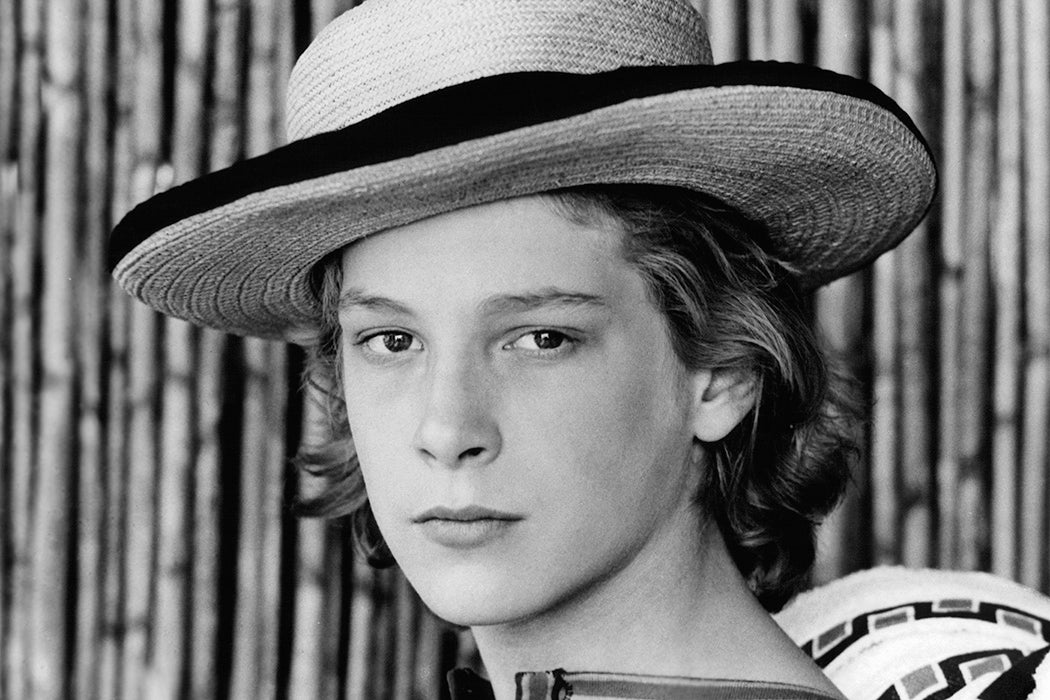
In Thomas Mann’s 1912 novella Death in Venice, the writer and scholar Gustav von Aschenbach decides to take a vacation in Venice and, while there, becomes infatuated with the youth Tadzio. He gradually unravels and loses his sense of decorum, only to succumb to cholera. The novella notably lacks dialogue, so an omniscient narrator does much of the heavy lifting in propelling both the narration and the reader forward.


When it came to transposing the novella into a film, Luchino Visconti used music to fill the role of the omniscient narrator. “Visconti was not only a film director but also a highly regarded director of opera,” writes James Larner in College Music Symposium. “His knowledge of music was extensive and it always played a prominent role in his films—and none so prominent as his use of music in Death in Venice (1971).”
The most widely featured piece is Mahler’s Adagietto from his Symphony No. 5, which Visconti uses to accompany, amplify, and reflect the actions unfolding onscreen. It occurs in four sequences throughout the film. In the opening scene, which follows von Aschenbach, played by Dirk Bogarde, on his voyage to Venice, his fidgeting is juxtaposed with the Adagietto‘s growing agitation; his wistful glances to the horizon coincide with more wistful musical passages. While we are not privy to the details of his malaise, Bogarde’s acting and Mahler’s melody fill us in. Mahler is not just an aesthetic choice; the connection extends to the main character. “Visconti was aware that Mann had intentionally given Gustav von Aschenbach Mahler’s first name and physical description,” writes Larner. “Given that, Visconti creates a hybrid character […] and transforms Mann’s writer into a musician, imbuing Aschenbach with biographical details of Mahler.”
Vocal music provides commentary on the film’s action, but “the twist is that the lyrics are in a foreign language or the selection is performed instrumentally,” writes Larner. For example, Visconti uses the fourth movement of Mahler’s Symphony No. 3, which adapts the text of the poem “Zarathustra’s Night Song,” taken, in turn, from Nietzsche’s Also sprach Zarathustra. The text describes waking up from a deep dream and is juxtaposed with Aschenbach awakening in Venice as the sun rises and he takes in the view. Larner interprets this scene as an homage to the Nietzschean balance between Apollo and Dionysus.
In the novella, Mann writes that Aschenbach wanted “foreign air and infusion of new blood,” which meant “travel it would be then […] not too far, though, not quite all the way to the tigers.” As Larner observes, “The intention is clear. Aschenbach wants a bit of foreign influence to loosen the Apollonian death grip that has created his writer’s block, but he thinks he can control the depth of his descent into his emotions.”
More to Explore
Terry Southern’s Lucid Absurdities
In the hotel lobby, we hear diegetic music—specifically, a selection from Franz Lehár’s The Merry Widow, which, upon its premiere, enjoyed mainstream success and would thus fit naturally in the lobby of a cosmopolitan Venetian hotel. While the rendition in the film is instrumental, the original operetta includes lyrics about forbidden love and spirits that enthrall mortals, causing them to forsake all reason in the name of attraction. In another scene in the hotel lobby, Aschenbach hears someone plunking out the opening bars of Beethoven’s Für Elise, and it turns out to be Tadzio. This leads to a flashback of Aschenbach in a brothel, where he also happened to hear a few bars of a distorted version of Für Elise. “I believe he is communicating that Aschenbach has moved beyond the intellectual, Apollonian appreciation of Tadzio as the embodiment of pure beauty to the sensual, Dionysian obsession with Tadzio,” Larner writes. “Beethoven’s Für Elise provides the commentary that might have been provided by the narrator.”
Another example of diegetic music is Mussorgsky’s “Lullaby” (Kolïbel’naya), which Visconti presents as an onscreen performance. An elderly woman sings it (in the original Russian) as she sits on the beach. The fact that she performs it without instrumental accompaniment adds to the sense of foreboding. Just as Aschenbach reflects in the novella that his forebears would never have found themselves in his predicament, the lyrics of the lullaby include the line “Our forefathers never saw such a misfortune.” Eventually, on that same beach, Aschenbach slumps in his recliner, wearing a white suit, a visual echo of the lyric of the lullaby, “Your small white body lies there in the cradle // Your soul flies in the heavens.”
Weekly Newsletter
After that, Tadzio walks out into the surf, and the deathly debilitated Aschenbach, as usual, watches him. “When Tadzio points to the horizon and Aschenbach breathes his last, we are given the impression that Tadzio is leading Aschenbach into eternity—and that is certainly what happens in the novella, where Tadzio is described as ‘the pale and charming psychagogue,’” writes Larner. Visconti returns to the use of the Adagietto: Tadzio walks into the surf to the opening of the piece. The crescendo coincides with Tadzio pointing to the horizon and Aschenbach trying to rise to follow—only to die in his chair. Then, as the music builds to a new crescendo, people on the beach realize that Aschenbach has died, and they rush to carry him away.
Beyond his use of Mussorgsky, Visconti fashioned Death in Venice as an homage to German and Mitteleuropean culture. As Larner concludes, “Visconti was able to combine his love of German literature and music and also exercise his creativity.”