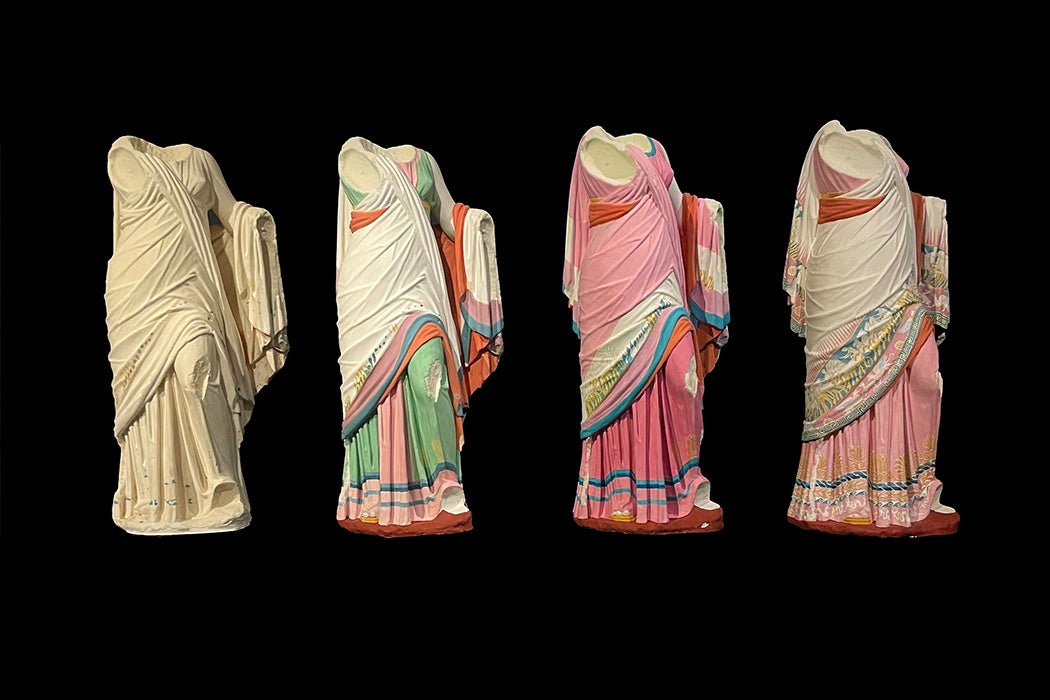
For hundreds of years, almost all representations of ancient Greek and Roman marble statues have shown them to be clean, white marble. Today it’s clear that many of the statues were originally colorfully painted. But, as sociologist Fiona Rose-Greenland explores, many of us don’t want to see them presented that way.


Rose-Greenland examines the Gods in Color exhibition, which toured Europe and North America from 2003 to 2015. It displayed plaster recreations of ancient Greek and Roman statues designed to look as close as possible to the way those statues appeared when they were first made. This meant their clothes, hair, and features were painted in bright colors.
When archaeologists began uncovering ancient statues many centuries after their creation, there was often little sign that they had ever been painted. And, in the late eighteenth century, German art historian JJ Winckelmann popularized the idea that they were always intended to be white, which he and others of his time viewed as a color of purity and beauty.
However, soon archaeologists discovered many ancient sculptures and temples with clear remnants of brightly colored pigments. Gradually, they came to a consensus that many ancient sculptures were designed from the start to be painted, something apparent in the way the rock was shaped and finished.
“The unpainted version that we know today is an accident of entropy legitimated by Western civic values,” Rose-Greenland writes. “With their brightly painted surfaces, the Gods in Color statues challenged this accomplishment.”
More to Explore
Latin Literature’s Problem with Invisibility
Among the statues reproduced for the show was a famous image of Emperor Augustus discovered in a ruined villa in 1863. For more than a century, academics identified this statue as conveying a calm, neat, and virtuous masculinity. Rose-Greenland writes that “pigment free, the emperor is the model of omnipotence, severity, and divine detachment.” But, she adds, the reproduction, which includes red lips, brightly colored clothes, and long eyelashes, is very different, “simultaneously human and alien, awesome and vulnerable.”
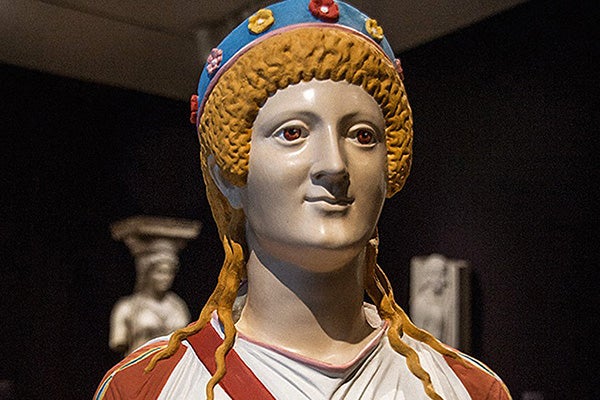
Rose-Greenland writes that when she first learned of the Gods in Color show, she and her fellow scholars felt that sharing the research-backed understanding of the statues’ original appearance with the public was important. But, she writes, “there was also considerable grumbling. Few people actually liked the statues (or were willing to admit as much).”
Weekly Newsletter
Many non-academics also viscerally disliked the statues. In 2007, one reviewer of the showing at the Sackler Museum in Massachusetts wrote that, while the reproductions were fascinating, “All this color feels wrong, wrong, wrong.”
Rose-Greenland suggests that the exhibition was authentic from a material point of view, using appropriate techniques like spectroscopy to identify pigments used on the original statues and then recreating them as precisely as possible. But, through a cultural lens, they appeared inauthentic to many viewers.
“Authenticity, in sum, is an outcome of our own experiences and socially cultivated understandings,” she writes. “It is not interchangeable with accuracy.”