In the 1880s, dry plate photographs of the Pleiades star cluster revealed a previously undiscovered nebula. It was an important moment for astronomers, who were hopeful that this photography would usher in a new type of mechanized observation. And while it was transformative, historian Alex Soojung-Kim Pang finds that early astrophotography did not always live up to astronomers’ hopes.


Astronomers like John Flamsteed (1646-1719) had long been using technology to remove human judgement from their practice. By the middle of the nineteenth century, many were intensely pursuing this type of “mechanical objectivity.” Drawing had once been an important astronomical skill, but in the era of objectivity, Pang writes, “its dependence on training, skill and judgment…were now seen as fatal liabilities that could never be overcome.”
Astronomers quickly found they couldn’t escape from aesthetic judgement. The issue was getting a photograph outside the observatory—to publish and distribute pictures, astronomers relied on photoengraving. In letters between Lick Observatory astronomers and their printers, Pang finds “a world in which pictures were surprisingly plastic, images were born and died in baths of acid or under a retoucher’s tool, and the real and unreal were sometimes hard to tell apart.”
In halftone printing, screens in the camera created a negative with a fine grid of “pixels” that varied in exposure over the image. A printer then placed this negative onto photosensitive enamel covering a copper plate. Passing light through the negative hardened the enamel where the light came through. This allowed “pixels” to survive acid baths, leaving a plate usable for printing. The other common photoengraving process, photogravure, was more difficult and could create smoother images.
More to Explore
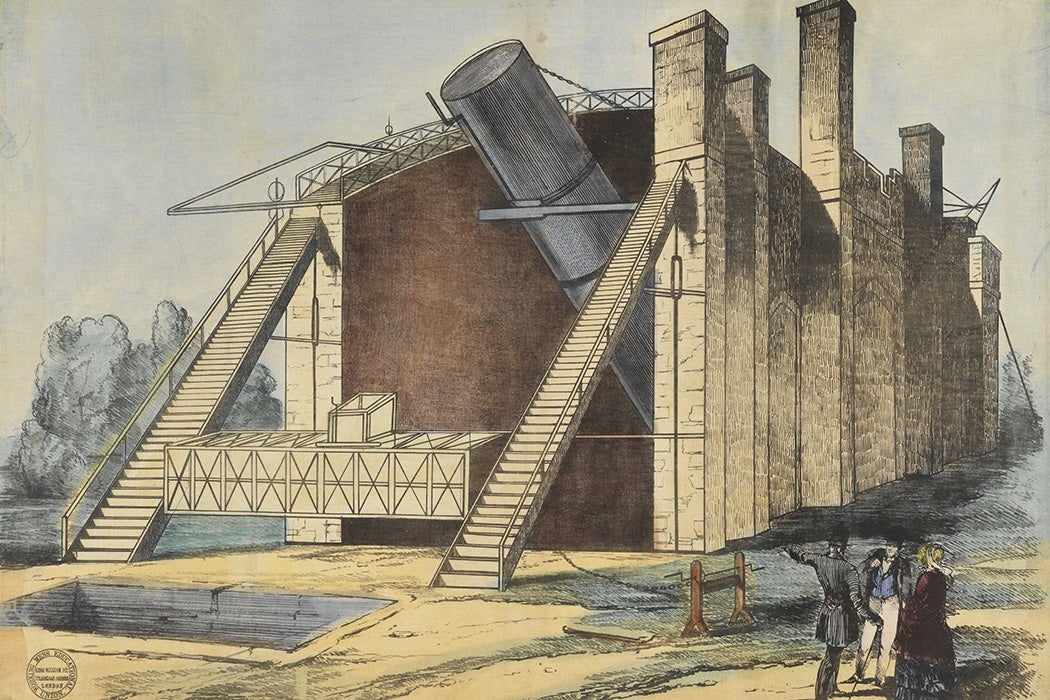
Leviathan Resurrected: Illustration and Astronomy
But as engraver Carl Nemethy wrote, “the machines do not work alone.” Human intervention and judgement returned, as choices in each stage of the engraving process impacted the final plate. Engravers had to balance contrast over the image, while trying to bring out details in objects. They also had to preserve the dark background of space. Pang explains that “printers found uniform backgrounds as hard to make as singers find sustaining a single note over several measures.”
Weekly Newsletter
It was customary for engravers to touch up pictures for customers. Astronomers had more strict requirements, however. “The principal subject of the plate–the comet, nebula, or corona–was always forbidden to engravers’ tools,” Pang explains. In one case, an engraver etched circles around stars in a 1908 image of the Orion Nebula to highlight them. Lick Observatory director Wallace Campbell wrote an angry letter to the engraver to make sure it didn’t happen again.
Engravers and astronomers developed what Pang calls “a practical aesthetics of image-processing.” It was a delicate balancing act between “improvement” and “alteration.” The line between these had to be negotiated, and inevitably involved aesthetic choices. But in the age of objectivity, the goal was to create faithful, trustworthy images. These choices were meant to be unobtrusive. “The irony was,” Pang writes, “that astronomers and engravers worked together on pictures so skilfully crafted that they betrayed no evidence of human intervention.”