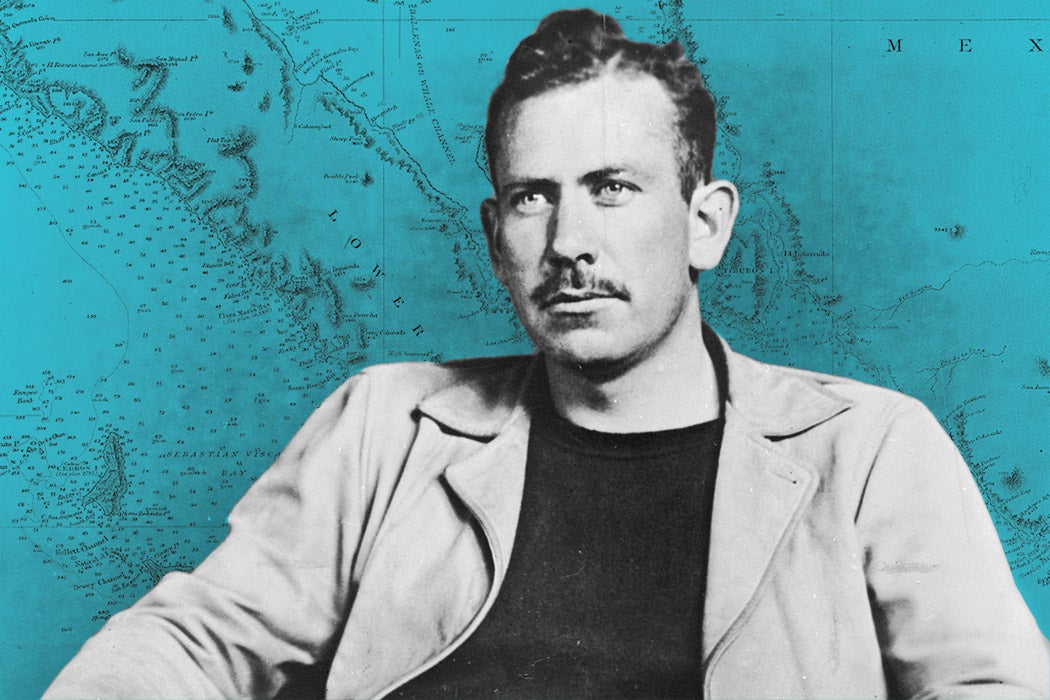
In 1940, author John Steinbeck and marine biologist Ed Ricketts chartered a fishing boat named the Western Flyer to explore the Gulf of California, also known as the Sea of Cortez. The book they co-authored, Sea of Cortez: A Leisurely Journal of Travel and Research (1941), included a catalog of the more than 550 species found.


Flash forward sixty-four years. Sea of Cortez was used as a “non-traditional dataset” by Raphael D. Sagarin, William F. Gilly, Charles H. Baxter, Nancy Burnett, and Jon Christensen as part of the Sea of Cortez Expedition and Education Project (SOCEEP) in 2004 to document contemporary conditions in the area. About the Steinbeck and Ricketts book, Sagarin and company write:
Their account has helped us to understand ecological disruptions that had already affected the Gulf by 1940, and it established a baseline for understanding the accelerating human impacts that have occurred in the Gulf since their voyage.
Following the course of the Western Flyer during the same time of year, the modern SOCEEP expedition members wanted to see what had changed at the intertidal and pelagic sites visited more than six decades earlier. Sagarin et al. write that examination of this historical baseline “leaves little doubt that major ecological changes have occurred in the Sea of Cortez.” The changes have been “dramatic.” They summarize:
Diversity and abundance of large gastropod snails and echinoderms have declined at many intertidal sites and large pelagic species of tuna, shark, billfish, and turtles also appear to be much less abundant.
Tube snails appear to be more abundant and widespread, and jumbo squid, not documented at all by Steinbeck and Ricketts, are currently very common in the Sea of Cortez and constitute a major fishery.
Cabo San Lucas, at the southern tip of the Baja California peninsula, “provides a good example of the dramatic changes that have taken place at intertidal sites in the Gulf.” When Steinbeck, Ricketts, and the crew of Western Flyer visited, they saw not a light at night from the town. Today, the city is a major resort, lit up most of the night. The local tide pools described as “ferocious with life” in Sea of Cortez are now far from that: “even the common and conspicuous species they noted were absent.” Further north, Puerto Escondido, “a textbook exhibit for ecologists” according to Steinbeck and Ricketts, is now a crowded anchorage. The construction of marinas and breakwaters, the increase in pollutants, much heavier usage, etc., all those factors associated with more people and more development, have resulted in declines in diversity and abundance.
On the plus side, the most remote sites sampled by Steinbeck and Ricketts still “appear to have retained relatively high species diversity.”
Sagarin and company conclude that “even those who have documented declines in Sea of Cortez populations acknowledge that it remains an ecologically remarkable place, where marine megafauna still congregate, human population density remains relatively low, and marine diversity high.”
More to Explore
Edgar Allan Poe (Sort of) Wrote a Book About Seashells
After Ed Ricketts died in 1948, Steinbeck translated his appreciation of him as friend, mentor, and inspiration for the character of “Doc” in the novel Cannery Row (1945) into an introduction to a new edition of the narrative part of the original book. The Log From the Sea of Cortez, issued under Steinbeck’s sole authorship in 1951, is the version of the book most likely encountered today. Steinbeck’s fame, popularity, and 1962 Nobel Prize in Literature keeps it in print.
Weekly Newsletter
Readers of The Log may be interested in Steinbeck scholar Gregory MacDonald’s report on recollections of two other members of the 1940 expedition, crewman Sparky Enea and Captain Tony Berry, made many years after the fact. It’s an interesting comparing and contrasting of events, and a good reminder that even nonfiction authors craft their stories in specific ways.
Most notably, Macdonald details how the narrative barely mentions, and never names, the seventh member of a crew otherwise colorfully described by a masterful writer. This was John Steinbeck’s first wife Carol. The pair were on the outs before the expedition and formally divorced after it in 1943. Like everyone else on the boat, Carol Steinbeck helped with collecting the specimens that served as a scientific baseline for measuring ecological change.