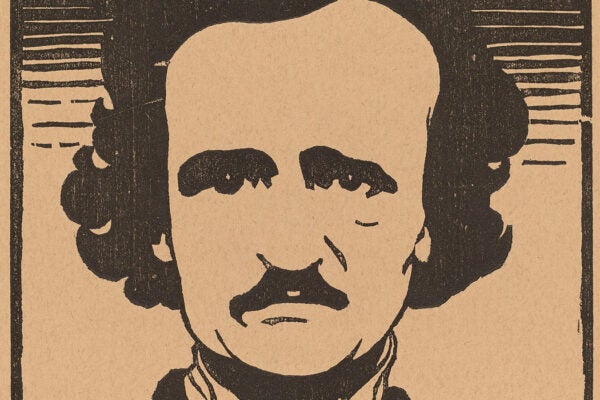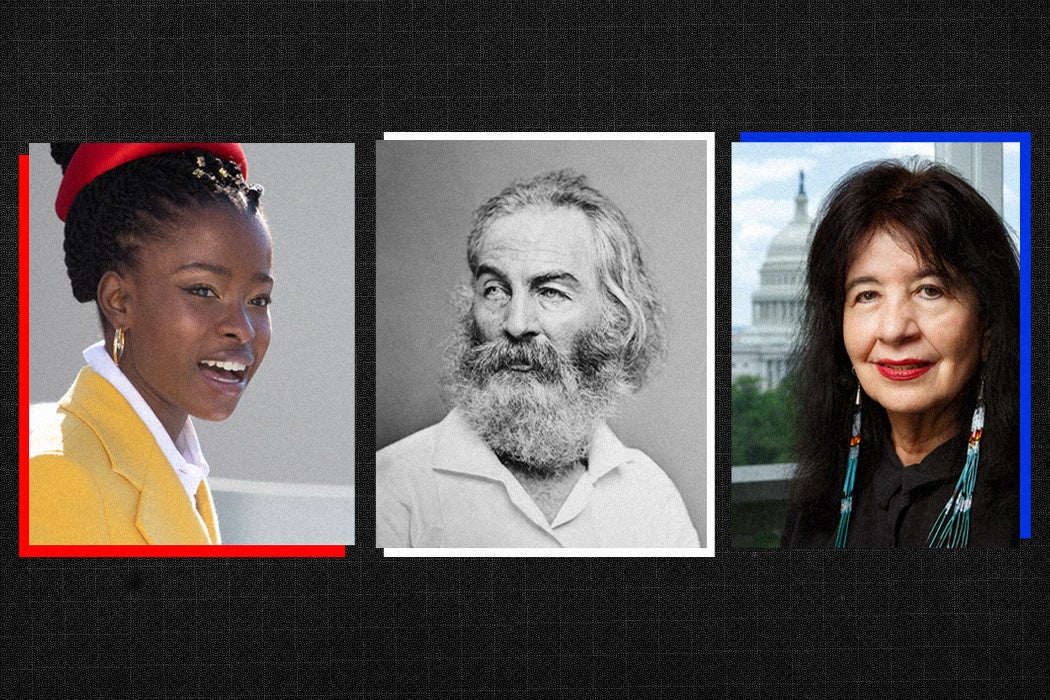
“Of all nations the United States with veins full of poetical stuff most need poets and will doubtless have the greatest and use them the greatest. Their Presidents shall not be their common referee so much as their poets shall,” wrote Walt Whitman (1819-1892) in the preface to Leaves of Grass (1855), the poetry collection that he revised and expanded over nine editions in response to the country’s unfolding history and politics. Whitman is widely recognized as “the poet of democracy.” But he also regarded himself as the United States’ Poet Laureate nearly 100 years before the role was established and revived the concept of “the poet” as a political player and poetry as an alternative check and balance to the traditional branches of government.


“[The poet] is the arbiter of the diverse and he is the key. He is the equalizer of his age and land,” he explained. “He supplies what wants supplying and checks what wants checking.”
Whitman, a newspaperman before he wrote verse, embraced the concepts of a democratic and United States but recognized both were unrealized. He came to believe poetry, not politics or journalism, was the most powerful tool for their promotion. Towards the end of his career, in the essay “The Poetry of the Future,” he proposed that “democracy waits the coming of its bards…in the twilight of the dawn.”
Now, the Sun has risen with Joy Harjo, the first Native American (Muscogee Creek Nation) Poet Laureate, whose three terms in the office coincided with the first Trump Administration, and Amanda Gorman, the first National Youth Poet Laureate and youngest poet to read at a presidential inauguration. Like Whitman, Harjo and Gorman have reimagined both the concept of “the poet” and the possibilities of poetry. Their historically grounded, unifying poetics serve as an antidote to superficial political bickering; shouty, repetitive, journalism cycles; and the digital rabbit holes in which so many get trapped. In this second Trump administration we need their poetry, and poetry broadly, more than ever.
Many Americans don’t think of poets as powerful or poetry as a political tool even though, as Colin Wells demonstrates in Poetry Wars: Verse and Politics in the American Revolution and Early Republic (2018), it played a central role in the nation’s origin story. Verse was used to challenge British authority and garner popular support during the American Revolution. Later, early political parties used poetry to define themselves and debate the policies that would shape the young country.
Weekly Newsletter
“Waging war using pens and printing presses was no less important to the founding of a new American nation than warfare fought with bullets, bayonets, and cannonballs” observes literature professor Paul Gutjahr in an appraisal of Wells’ “focus on the role of poetry in forming, framing, and fracturing the politics and identity of a young United States.”
Whitman’s radical free verse form evolved in response to the next major existential and military crisis of the country, the Civil War. James M. Cox explains that with the poem “Song of Myself,” from Leaves of Grass, “Whitman had, at a time of growing political division and paralysis, managed to create a poetic personality which would recognize the diversity of the national self, include all its aspects, and finally contain that self.” As Whitman wrote, “I am… One of the great nation, the nation of many nations—the smallest the same and the largest the same,” and “Of every hue and trade and rank, of every caste and religion,/ Not merely of the New World but of Africa Europe or Asia.”
Natasha Trethewey, United States Poet Laureate during the Obama Administration, recognizes Whitman’s legacy but points out his limitations, especially regarding African Americans during and after the Civil War. “Because of his open-armed enthusiasm, his inclusiveness and celebration of everyone, even the lowliest prostitute or degraded slave, Whitman’s work has come to represent a poetics of democracy, a humane tradition of antiracism,” Trethewey writes. “Even now, there is much more to be learned from him, and from his conflicted relationship to his subject matter—especially as Americans near and far are still fighting, ideologically, the Civil War.”
In Walt Whitman’s Native Representations (1997), scholar Ed Folsom presents Whitman as similarly contradictory regarding Native Americans. While Whitman respected and admired Indigenous peoples, languages, and cultures, his poetry repeatedly depicts the prevalent literary and popular trope of “the vanishing Indian.” Harjo’s project as poet laureate, Living Nations, Living Words (2021), an anthology that maps the breadth of contemporary Indigenous poets and poetry, directly counters this trope. In tandem, her own collection as laureate, An American Sunrise (2019), engages Whitman along with a diverse array of American poets including Emily Dickinson, Langston Hughes, and Adrienne Rich, whom she identifies as “poetry ancestor[s].” Harjo invokes these poets to present American poetry as a powerful, cumulative, and collective tradition.
More to Explore
12 Poems by Frank O’Hara
“There is one heart, said the poetry maker, one body and all poems make one poem,” Harjo writes in “Bless This Land” while reminding us that the whole of American history and culture are preceded by and rooted in Indigenous American history and cultures. She employs this perspective and the accrued power of poetry to “check” President Trump’s political policies and cultural ideologies while “supply[ing] what needs supplying”—some rays of light and hope during a bleak and divisive period for many Americans. The collection became even more relevant in his second term, opening as it does with the dedication:
For the children, so they may find their way through the dark
They are all our children.
This is a broad democratic response to Trump’s dark rhetoric of racial division and American decline that underlines the power of poetry to serve as moral and cultural beacon. “They are all our children” specifically refers to immigration policies that divide families and demonize southern border migrants whose journey northward Harjo ties to the Trail of Tears, which forced her own ancestors from their traditional homelands.
Harjo emphasizes the transformative and participatory power of poetry by closing the collection with the call and response, “Bless This Land,” which identifies the caller as a “poetry maker” and a “rememberer.” She rewrites the chorus to Woody Guthrie’s popular American anthem “This Land is Your Land” from an Indigenous perspective, rejecting the Biblical interpretation that informs the song’s message of ownership and first justified colonization then manifest destiny: man has inherited the earth from God, and his mission is to improve it. “In this economic and cultural framework,” explains historian Ronald Takaki, “the Indians were demonized,” and racial othering “contributed to the making of a national identity.” The atrocities and genocide that followed Puritan settlement were effectively justified by a religious mandate. Racial othering continued to inform the development of the nation, and, Takaki writes, “over the centuries, the significance of this cultural construction of race grew even broader, more dynamic, and more inclusive” informing contemporary racial and cultural ideologies. Harjo reverses Guthrie and the Biblical interpretation, such that the “lands” hold spiritual authority to “bless” and transform the people:
Bless us, these lands, said the rememberer. These lands aren’t our lands.
These lands aren’t your lands. We are this land.
And the blessing began a graceful moving through the grasses of time, from the beginning, to the circling around place of time, always moving, always
The poem and collection end with no punctuation: the blessing extends beyond the pages to circulate perpetually through the world. Emphasizing gratitude and her Mvskoke (Muscogee) perspective, the final page holds only four words: “Mvto, mvto, mvto, mvto,” thankfulness four times in the language of her Native nation.
I teach this poem in my college classes, and it’s always followed by a moment of stunned silence after we read it aloud. And then, students begin to marvel at the poet’s generosity and the work’s capacity for transformation and unity. It makes the terrible history of colonization and genocide into a blessing that brings people together through its participatory form and unifying pronouns. It asks readers to recognize their existential ties to the land on which they stand and to each other.
The poem and collection allow the reader to reimagine themselves and the nation. However, Harjo didn’t associate poetry with American or American Indian experience until she met poet Simon Ortiz. As she explains, “I’d always imagined poets as pale men (and the rare spinster) declaiming in long aristocratic coats, hailing from wet, cold lands. I had never met an Indian person before who introduced himself as ‘a poet.’” She quickly recognized the power of poetry and was amazed “how a kernel of meaning and sound condensed to one page could stagger the world with meaning.”
The inability of many American readers to recognize the gift of poetry is a byproduct of twentieth-century literary history and the influence of those poets, namely Ezra Pound and T. S. Eliot, reacting to Whitman. They enshrined poetry as academic, difficult, and populated with European landscapes and cultural references rather than the American “poetical stuff” celebrated by Whitman. After poetry lost its popular audience, explains poet Janet McAdams, it fell victim to the “canon wars” within the academy, during which
much talk [was] focused on the inclusion of formerly excluded literatures, especially those written by non-white and/or female authors. One genre, however, [became] so marginalized that its increasing exclusion from curricula and its virtual invisibility in the canon wars have gone unnoticed. Poetry, especially that written by contemporary poets, remains the most excluded, the least read and taught, the most marginalized genre of our time.
Given the history of twentieth-century poetry, it’s no wonder that Joy Harjo, and many others, found poetry unrelatable.
However, Amanda Gorman has completely reinvented the concept of “the poet” and the possibilities of the form. In a world where people gorge on digital, short-form content, poetry has a much better chance at capturing a piece of our time and profoundly and positively impacting us than other literary or media forms. No more evident is the power of a young person wielding a poem than Gorman. Her impact on writing, reading, and sharing poetry in K–12 education has been widely observed by teachers, writes educator Tiffany Rehbein. For many, the Biden inauguration and “The Hill We Climb”—the poem she recited during it—was their first encounter with this literary form. Completed on the evening of the January 6 attack on the Capitol, it offered a new pathway forward and a message of unity:
When day comes, we ask ourselves, where can we find light in this never-ending shade?…
We’ve learned that quiet isn’t always peace, and the norms and notions of what “just” is isn’t always justice…
Somehow we weathered and witnessed a nation that isn’t broken, but simply unfinished.
Gorman’s appearance answered her own question about where we might “find light in this never-ending shade.” Like a beacon in her yellow Prada suit, she embodied the power of poetry or a ray of full noonday sunlight following Harjo’s American Sunrise. She was understandable, elegant, and engaging.
For many of my students, watching her live was a transformative, shared cultural and historic moment akin to witnessing Kennedy’s assassination or the attacks of September 11, even though those events began and ended in tragedy, while her performance signaled democratic and cultural triumph over the divisive events that preceded it. Gorman not only broke through the pandemic bubble to civically and poetically engage young people, she started a poetry trend. She went on to read at the Super Bowl, become a brand representative for Prada and Estée Lauder, made the cover of Time, and has continued to chart a new path for poetry. A frequent guest on mainstream news programs and a savvy social media user, Gorman employed both to share the poem “Smoldering Dawn” and raise more than $100,000 for charity during the January 25 Los Angeles wildfires. Her bestselling collection, Call Us What We Carry (2021), addresses the pandemic, police violence, and climate change. Her work might be dismissed as topical or political by some because it responds, often in almost real time, to history as it is happening. Who does that recall? Raising Whitman’s bar considerably, this poet plans to be president, with a run for office in 2036.