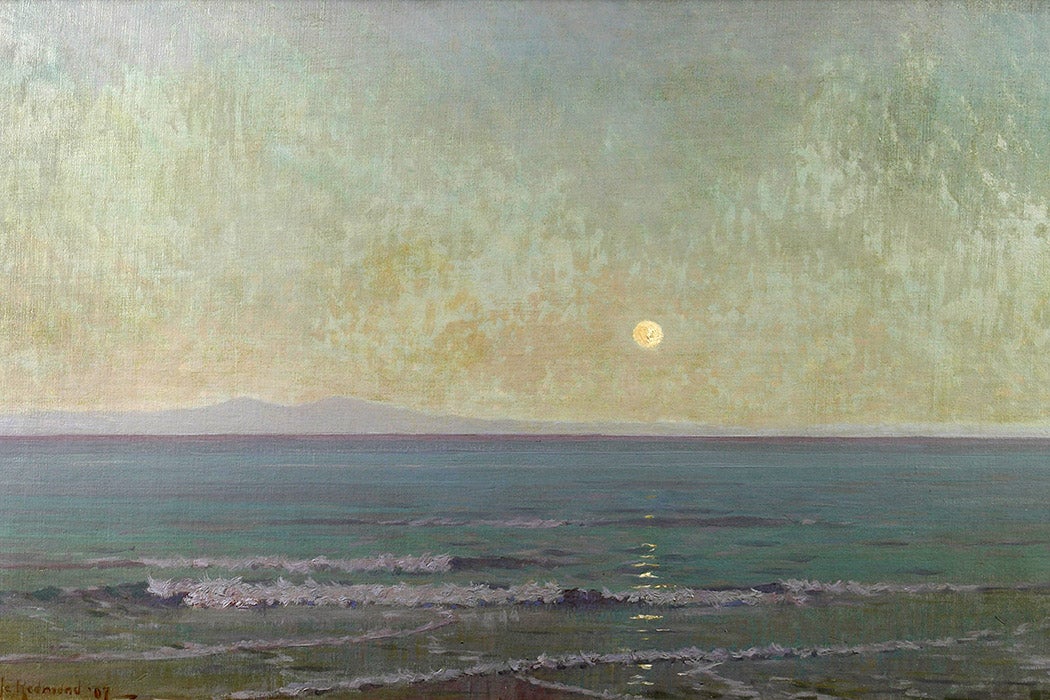
If you live in a coastal area and want to know the timing and intensity of the tides, you can easily consult a tide chart. For much of history, however, tides were frustratingly difficult to predict. In the seventeenth century, Isaac Newton used gravitational forces from the Moon and the Sun to explain the tides. He had arrived at part of the correct answer, but historians Federico Bonelli and Lucio Russo believe that Newton’s insight had roots in older work.


Renaissance thinking was “one of the elements which allowed Newton to achieve his synthesis,” Bonelli and Russo write. They trace Renaissance explanations back to antiquity, when thinkers like Strabo and Pliny speculated that the Sun and the Moon influenced tides. Their full explanations varied, and by the Middle Ages, scholars had picked up elements of these theories and added their own.
Medieval tidal theories fell into a few categories. Some were “mythical or vitalistic,” Bonelli and Russo write, explaining tides as “analogous to breathing in an animal.” Others invoked natural phenomena like rivers or wind. And finally, there were astronomical theories, which primarily focused on the Sun and Moon. Some scholars believed the Moon’s “affinity to moistness” shifted the tides. Others believed the Sun’s heat caused water on Earth to expand. By the thirteenth century, writers like Guillelme d’Auvergne and Pietro d’Abano theorized that a force like magnetism created tides. But these theories lacked predictive power.
In the fifteenth century, Italian teacher Frederico Chrisogono presented “an effective explanation” using the Sun and the Moon, Bonelli and Russo write. In his theory, high tide occurred when the Sun and Moon were at zenith, and low tide when they were at the horizon. Their combined influence created “four pointed protuberances, the peaks directed at each of the luminaries and away from them.”
More to Explore
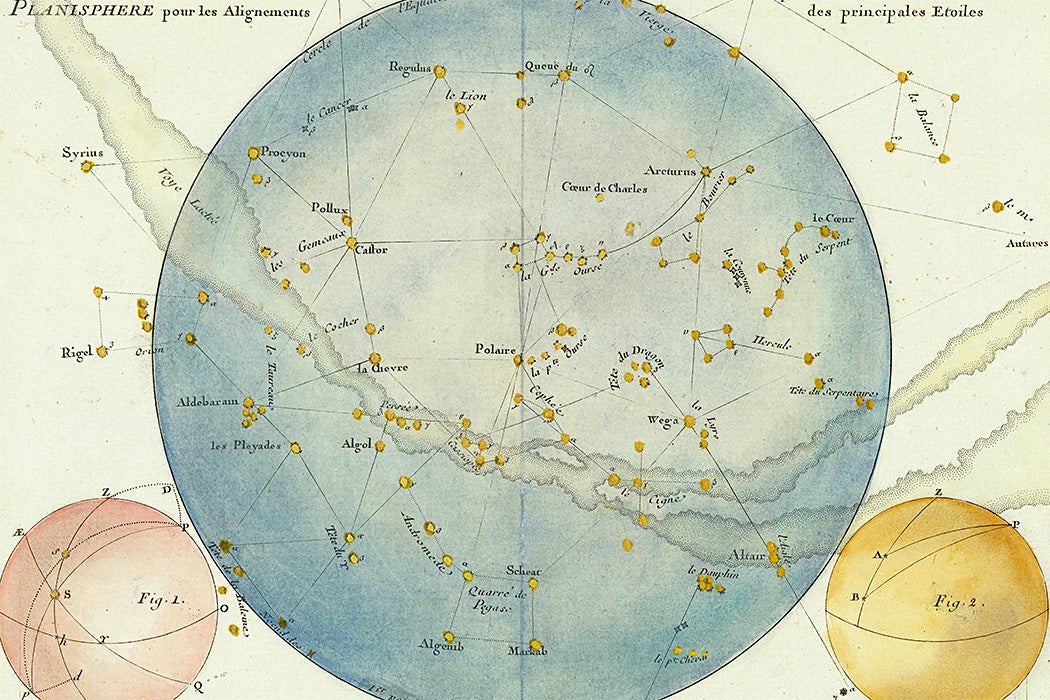
Spider in the Telescope: The Mechanization of Astronomy
Marco Antonia de Dominis made a similar argument, invoking the analogy to magnetism. But neither of their theories completely lined up with observation, and their arguments contained serious contradictions. To Bonelli and Russo, this means they likely used classical sources without fully understanding them.
In the early modern era, Copernicans like Galileo rejected the lunar theory, believing that the Earth’s movement created tides. This idea also appeared in classical writings of Plutarch and Aetius—favorites of the Copernicans, Bonelli and Russo point out. Later, John Wallis picked up this idea but also incorporated astronomical explanations like Chrisogono’s. His follower, Isaac Newton, took the next step using gravitational theory.
Weekly Newsletter
Current tidal explanations are a fusion of these ideas. Newtonian gravitational forces are a major component, but so is the Earth’s movement. A variety of local conditions also impact tides, which is partly why prediction was so difficult.
Historians have disagreed about the influence of ancient and medieval thinking on modern science. To Bonelli and Russo, their research shows an intellectual chain connecting modern theories to the Hellenistic Era. “The undervaluation of the debt modern science owes to ancient learning,” they argue, “calls for a loss of memory concerning links between them.”


.jpg)