“Unknown for many years in the French capital,” writes Nancy L. Green in a 1994 issue of French Historical Studies, Bermuda shorts “made a surprising appearance in the early 1990s. The baggy sportswear was miraculously transformed into office and even evening wear, causing even the most casual American observer in Paris to wonder about the mechanisms of cultural exchange.”


In short (excuse the pun), to read Green’s article is to be schooled in the reluctance (at least on behalf of the French) to accept the pan-Atlantic fashion exchange. The French gave America haute couture. In return, they got Bermuda shorts.
But America isn’t to blame for the idea of wearing shorts to even the most formal of occasions. That’s because Bermuda isn’t American at all; it’s the oldest of the UK’s collection of overseas territories.
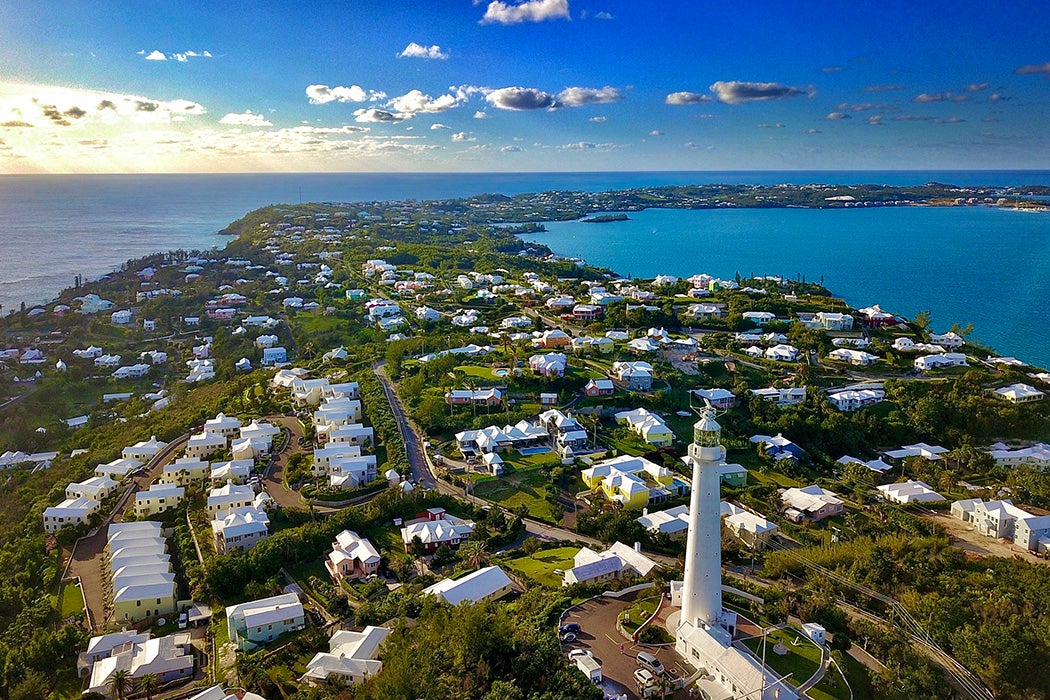
Densely populated yet with enough room for golf courses and marinas galore, Bermuda sits in the Western Atlantic around 650 miles from the nearest American coastline. It may be a small island, but its history encompasses much more than its unusual shorts and the fabled “Triangle” feared by pilots and sea captains for centuries.
Weekly Newsletter
It was a Spanish vessel that first sighted the island in 1503. Fearing the place to be haunted, it was left alone until 1609, when the first English settlers accidentally arrived after being diverted by a storm from reaching Jamestown in Virginia.
In its earliest inhabited days, it was a company-owned island. Originally named Virgineola after the Virginia Company, ownership of the island was transferred to the Somers Isles Company three years later, and logically enough, it was renamed the Somers Isles.
During the 17th century, African and American Indian slaves were brought to the islands, soon outnumbering white settlers. Its location was a highly serendipitous one for the British, as Michael J. Jarvis explains in The William and Mary Quarterly. “Bermuda lay at the crossroads of the Atlantic world in the age of sail,” Jarvis writes. “It was the most central location in England’s American empire, roughly equidistant from all the colonies in a broad thousand mile arc, from Newfoundland to Antigua.”
Jarvis goes on to describe the arrival of two slaves in August 1616, by which
Bermuda gained the dubious distinction of being the first English colony to export African labour, fully three years before Africans arrived in Virginia… Bermuda’s first blacks occupied an ambiguous legal status between slavery and limited servitude….By the 1640s however, they and their descendants were consigned to a perpetual and inheritable state of servitude.
Slavery wasn’t the only malady infecting Bermuda. A turbulent political system resulted in a swiftly revolving door policy for many governors. This unrest took place against a backdrop of shipwrecks, subsequent legal proceedings against on-board goods, and most sinister of all, a spate of witch-trials.
Already popular on the English mainland, the practice of trying women for allegedly possessing occult powers was described by Virginia Bernhard in a 2010 issue of The William and Mary Quarterly. Bernhard details the case of 23-year-old Anne Bowen:
A panel of women appointed to search Bowen’s body for telltale witch-marks…reported that after “diligent searche . . . we cannot find any outwards or innwards mark soe far as wee can p.ceave whereby wee can in conscience find them or either of them guilty of witchcraft.”
Anne was one of the lucky ones. Ten women were accused and four were executed as a result of this vile practise during the 1650s. “Bermuda was not unique,” concludes Bernhard, “but its witchcraft virus was more concentrated.”
More to Explore
Becoming the British Virgin Islands
Things are more demure in Bermuda these days. After US independence, construction began on the Royal Naval Dockyard as a base for Atlantic trade. Politically, the only break in what has been a mostly peaceful relationship between the island and the motherland came in the mid 1970s when Bermuda Police commissioner George Duckett and governor Sir Richard Sharples were shot dead within months of each other by members of the Bermudian Black Power group.
Three days of rioting ensued, with the British Army flying in to restore order. Yet according to Quito Swan in his 2014 book Black Power in the Caribbean, the bloodshed did have a partially positive effect in improving race relations.
“On the one hand, Black Power pushed the government to employ integrationist reforms intended to quell further black ‘militancy’ and maintain power,” argues Swan, which
increased the black middle class and served as a moderating influence on revolutionary black activism. The long-term propaganda campaign against black protest continued through police visits to schools, recruitment of local officers, youth outreach, television programs, and publications. The education system continued to perpetuate a myth of black privilege under British colonialism.
Divergence of opinion, as far as international wrangling goes, is today more focused on the fiscal field. For many outsiders, Bermuda is a by-word for tax haven. Writing in The University of Miami Inter-American Law Review, Ben Seessel describes Bermuda as the realization of “a world in which you could choose the rate at which you pay taxes.”
Seessel goes on to explain the island’s legal framework, under which local property and casualty insurance companies can avoid US taxation by shifting the capital reserves retained on insurance policies sold directly to a Bermuda parent corporation. That parent company, in turn, earns tax free income by investing their capital.
Whether you consider that ethical or not, the situation, according to Seessel, is unlikely to change.
The Bermuda loophole will probably remain in place because the reinsurance transactions have elements of economic substance, and legitimate business purpose, and probably, “the cure is worse than the problem.” Moreover, even if the Treasury or Congress closes the loophole with respect to Bermuda, the reinsurance business would shift to other tax efficient jurisdictions such as Switzerland and Ireland.
Some of these tax loopholes have since been closed, but transactions that move risk and assets offshore still occur and can produce notable tax and regulatory differences.
Away from the vicissitudes of corporate taxation, Bermuda has succeeded in becoming an exceptionally desirable vacation spot, particularly for the wealthier elements of East Coast mainland America. In an essay called “Life Among Ruins” published in the International Journal of Historical Archaeology, Brent Fortenberry explains the island’s quixotic appeal:
Its enduring colonial status has resulted in a twenty-first-century heritage landscape that primarily champions its white, colonial, and British heritage packaged for white, middle class, North American air and cruise ship tourists. Such forefronting obstructs the creation of narratives that represent unique Bermudian identities.
More scathingly, Fortenberry concludes that Bermuda occupies
a liminal state: at one moment within the British empire and at the next an “independent colony”; it comprises a space of enduring Imperial formations. These issues manifest not as the residues of decolonisation but rather the ruins of Britain’s neglect, apathy, and the outgoing tide of the colonial authority, leaving material traces since the end of World War Two.
Its founding fathers from the Virginia Company may be vexed to know that Bermuda is now best known for tax loopholes and gaudily coloured shorts. But, given the island’s surprisingly turbulent history, perhaps the present status quo can be interpreted as a welcome respite from a history that is often as mysterious and baffling as the infamous maritime triangle that lies near Bermuda’s now quieter shoreline.