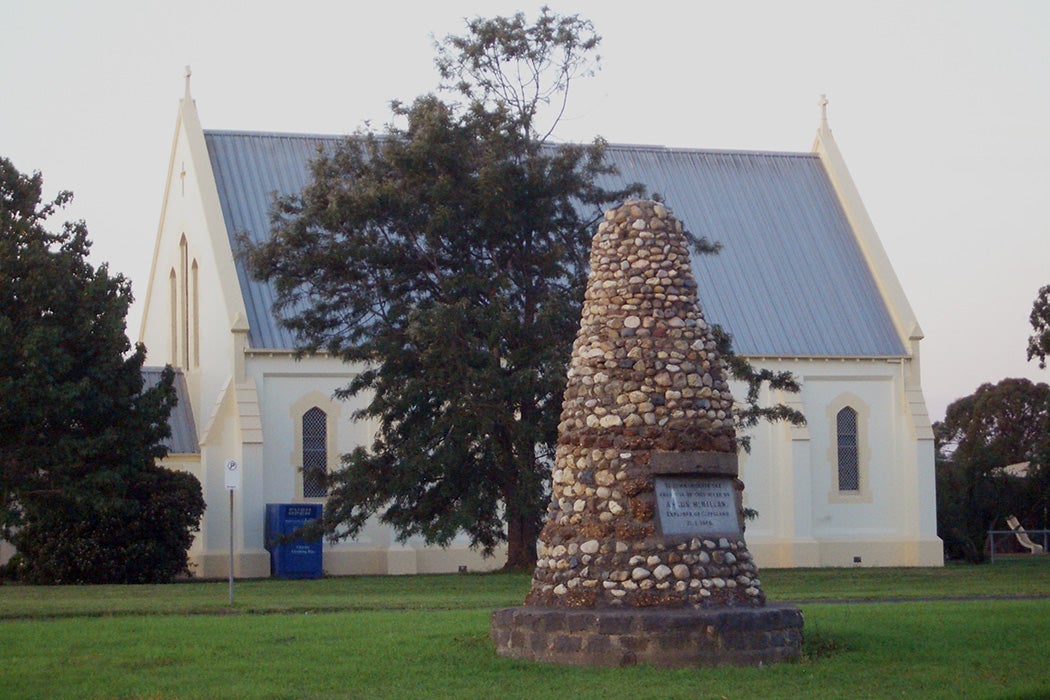
The Black Lives Matter movement started in the United States but became international. Following the May 2020 murder of George Floyd in Minneapolis by a police officer, and June 2020 protests in Bristol, England, that saw the toppling of a statue of slave trader Edward Colston, the Wellington Shire Council in the Australian state of Victoria voted 5–4 against a proposal to remove memorials to Angus McMillan.


Angus McMillan “is known by some as a murderer, leader of massacres and the ‘butcher of Gippsland,’ and by others as an explorer, a pioneer and a ‘founding father’,” write Gunai Elder and educator Aunty Doris Paton and self-described “settler historians” Beth Marsden and Jessica Horton in their collaborative exploration of a century of contesting the McMillan memorials.
Wellington Shire opponents of the proposal argued that actions like that in Bristol made the proposal rash and hasty, but in fact the proposal was part of a “long-term community campaign led by Gunaikurnai to address the representation of history […] particularly the dominance of McMillan” locally, the authors write.
Eighteen stone cairns were set up by the Victoria Historical Memorials Committee in 1926 to mark the route purportedly taken by McMillan into Gunaikurnai Country in 1840. The mid-1920s also saw a series of cairns lauding other settler colonialist “explorers.” Paton, Marsden, and Horton argue the fact that all these cairns are made of local stone was significant, marking them as part of “a tangible demonstration of settler claims of ownership over the landscape.” The cairns likewise acted as markers for the “symbolic dispossession of Aboriginal people.” The authors write that this was part of the conservative and nationalistic backlash against a short-lived Labor government in 1924 which had attempted to “redirect public history narratives glorifying war” and militarized nationalism.
“Just as the erection of the cairns was a form of history making the 1920s,” Paton, Marsden, and Horton write, “we argue that the process of removing the cairns is also a form of making (and reckoning with) history that is already underway, driven by the grassroots of Gunaikurnai people and organizations.”
In 1965, during the ceremonies marking the centenary of McMillan’s death, there were walking reenactments over his assumed routes. These “performative claims of possession” included white Australians in blackface. The authors note that this same year was also one of a peak of “organized Aboriginal political activity,” including the “fierce contest over the future” of the last Aboriginal reserve in Victoria.
More to Explore
How Forced Labor Built Western Australia
“The reinscription of McMillan’s explorations,” they argue,
via publications, public re-enactments and debates through the twentieth century, is a form of reasserting but also revising the colonial metanarratives of exploration and white possession to meet the contemporary objectives and pressures of the moment.
Public commemorations, public histories, and school curricula (including those taught to Aboriginal children) all exalted McMillan through the decades after the cairns were put up. But history is nothing if not a series of revisions, re-envisioning the past with new data, new interpretations, new contexts. The 1988 publication of Peter Gardner’s “deliberately provocatively titled” Our Founding Murdering Father: Angus McMillan and the Kurnai Tripe of Gippsland, 1839–1865 was one of the first great challenges to the reigning interpretation of McMillan’s actions and the way he should be remembered.
Weekly Newsletter
Seventy-eight percent of responses to proposals before the Wellington Shire Council were in support of either removing the cairns or adding text from a Gunaikurnai perspective. Only seventeen percent opposed removal or alteration of the stones. Paton, Marsden, and Horton note the resulting 5–4 Council vote in support of the cairns in situ suggests that “settler pride in exploration and colonization, and the desire to maintain memorialization of a known murderer, remains strong.”
Perhaps then, it should not be so remarkable the idea of “settler colonialism” as inherently genocidal stems from an Australian context.